No team has raced a 2026 F1 car in the wet. The first time could be Friday at Spa, in a session that counts..
The 2026 Formula 1 season has run nine rounds without a single fully wet competitive session. Chris Medland's race-week preview for formula1.com notes the grid has never collectively driven the new car in the rain when it mattered, and the Belgian Grand Prix forecast, for a race confirmed as round 10 at Spa-Francorchamps from July 17 to 19 on formula1.com, carries a chance of rain across all three days. If it falls, the first read arrives in a session that scores points.
A handful of drivers have touched a wet 2026 car in isolation. RacingNews365 reports that Lewis Hamilton, Pierre Gasly, Liam Lawson and Arvid Lindblad each did some rain running, either at a pre-season shakedown or in a dedicated Pirelli tyre test. Four drivers, in private, on their own programmes, is the entire body of collective wet knowledge for a twenty-car field. Everyone else meets the condition for the first time when the spray comes up off the car in front.
Three variables changed at once, and the rain reads all of them
In the wet, the 2026 chassis is a different object from the car it replaced. The regulations narrowed the bodywork and reworked the underfloor, which changes how the car sheds standing water and where it loses grip first when the surface goes greasy. A team learns those thresholds by driving into them, cautiously, over a session or two of gradually falling lap times. Nobody has had that session, so the thresholds are theoretical until a driver finds one at the exit of a corner.
A second variable is the power unit, and it is the one that does not care about the weather until suddenly it does. The 2026 formula leans far harder on electrical deployment than its predecessor, and managing that energy is already a dry-weather craft that Paddock Notes has written about as the invisible skill the new rules reward. In the wet, deployment becomes traction management. A sudden delivery of electrical torque to a driven axle on a wet surface is a spin waiting for an input, and the software maps that smooth every driver relies on were calibrated on dry data.
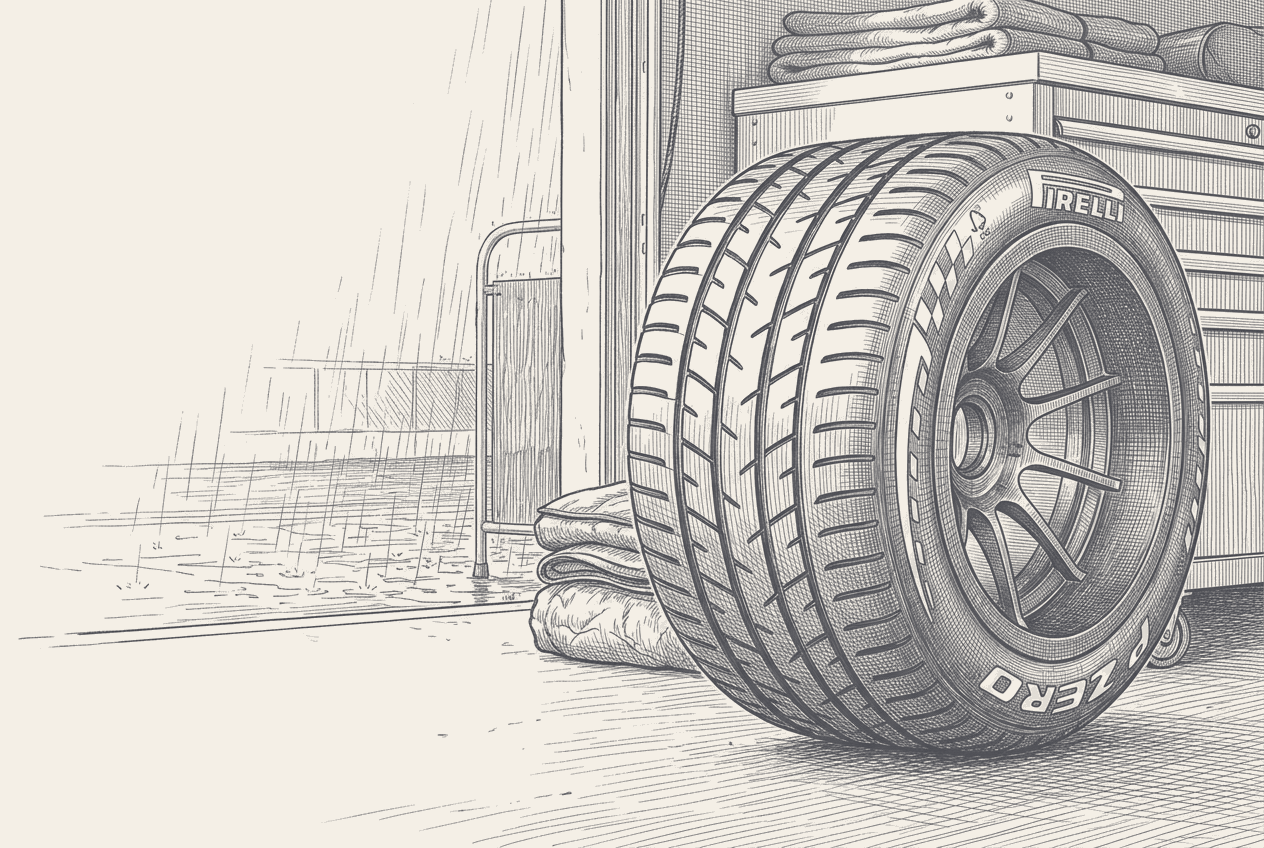
Least tested of all is the tyre, the third variable. Pirelli's 2026 wet and intermediate compounds have barely turned a competitive lap, because the season has not made them. Warm-up window, crossover point to a slick, aquaplaning resistance at speed: each of those is a number teams normally carry into a weekend from prior races, and this weekend they carry almost nothing. The Mercedes tyre-allocation note for the round sets the dry compounds, but the wet-weather set is the one whose behaviour is a guess.
Spa is the worst place on the calendar to learn this
Spa-Francorchamps is 7.004km, the longest circuit F1 visits, and its length is the specific problem. A lap that long can hold a soaked sector and a dry one at the same time, so a driver crests a rise into standing water on cold tyres while the timing screen still says the track is drying. The circuit does not offer a uniform condition to read. It offers several at once, changing between them faster than a pit wall can call.
Closing speeds compound the problem. Spa carries some of the highest average speeds on the calendar, and on the run through Eau Rouge and up the Kemmel straight its top speeds approach the fastest the season sees, which means the consequences of finding a grip threshold late are measured in the biggest numbers of the year. Those two sections are taken effectively flat in the dry, and the margin a driver has to discover the wet equivalent is the margin between a committed lap and a very fast accident. This is the venue where the field's collective ignorance meets its narrowest error budget.
There is also the active-aerodynamics layer sitting on top of everything. The 2026 cars run moveable aerodynamic surfaces, and the rotating rear-wing concept that caused Red Bull's problems at Silverstone is one expression of how load is now shifted mechanically between corners and straights. How those surfaces behave when the airflow over them is full of water, on a circuit that alternates long full-load straights with heavy braking zones, is one more thing the grid has not tested in anger. A wet Spa asks the newest hardware on the car its hardest question first.
What to actually watch, if it rains
The first meaningful signal is not lap time, it is the gap between the drivers who did private wet running and those who did not. If Hamilton, Gasly, Lawson or Lindblad look immediately settled while the rest of the field scrabbles for a warm-up window, the value of that isolated testing is the story, and every team that skipped it will note the deficit for next season's programme. If the four look no better than anyone else, the private running proved less transferable than the calendar time it cost.
A second signal is where the incidents happen. Aquaplaning is a speed-and-water-depth phenomenon, and on a circuit with Spa's range of both, the crashes will cluster at the specific points where standing water meets high speed. Those locations become the map every engineer reads for the rest of the weekend, and the first driver to find one supplies data the rest get for free. It is a brutal way to run a test, and it is the only way this test is going to be run.
The last thing to watch is the championship exposure. A wet, unpredictable Spa is a lottery bolted onto a title fight, and the drivers with the most to lose are the ones leading, because a first read on a wet 2026 car in a session that counts is the least controllable variable of their season. The rain is not certain. The forecast only says it might come. What is certain is that if it does, no team on the grid has raced this car in the wet before, and every one of them learns how it swims by swimming it, at the fastest place they could possibly have to.