Red Bull's rotating rear wing has crashed Verstappen twice in eight days. At Spa, keeping it and dropping it both cost lap time..
Lap 48 of 52 at Silverstone, running third, Max Verstappen felt the rear of the Red Bull let go at Stowe and spun into the gravel, ending his race under the safety car. His own account named the cause before the car had stopped moving: the rotating rear wing had not closed fully on the way from straight-line mode to cornering mode, and the downforce it should have restored for the high-speed right-hander never arrived. It was the second time in eight days the same device had put him in the barriers, and Verstappen called the situation "super dangerous". Red Bull now has to decide whether to run it at Spa in nine days, and both answers cost lap time.
What the Macarena wing actually does
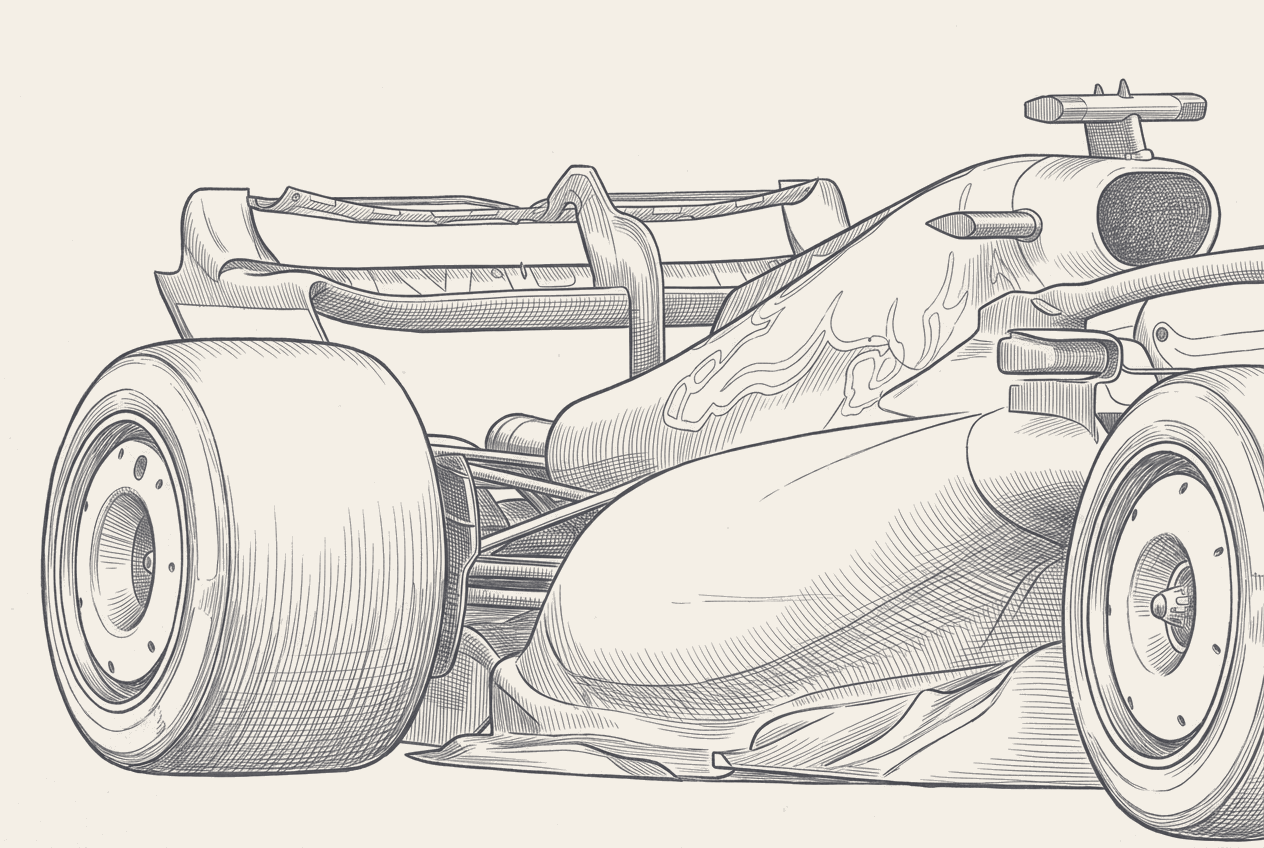
The device is the most visible product of a rule change: for 2026 the FIA reintroduced active aerodynamics, letting the front and rear wings drop into a low-drag setting down the straights and snap back to a high-drag setting when the driver brakes or lifts for a corner. Most teams execute the rear half of that with a conventional flap that opens like an oversized DRS. Ferrari and Red Bull do it by rotating the flap almost fully over, and the rotation is dramatic enough that Ferrari boss Fred Vasseur nicknamed it the "Macarena" wing after the mid-1990s dance.
Flipping the flap upside down, rather than simply opening it, buys a bigger gap for the air to pass through. The component creates a much larger slot for airflow than a standard active-aero wing, which sheds more drag on the straight and, in theory, hands back more straight-line speed for the same corner downforce. Paddock estimates put the gain as high as 8 to 10 kph in the right conditions, a number teams treat as a straight time-per-lap saving at any circuit with long full-throttle runs. That is the whole point of the concept, and it is also the reason nobody wants to give it up.
Active aero exists in 2026 to solve a problem the old DRS could not. The current rules replaced a single overtaking-only rear flap with full front-and-rear low-drag modes the driver runs on every straight, partly to claw back speed for cars carrying a heavier electrical deployment burden that has left drivers lifting and coasting down long straights to save battery. A rotating wing that opens a bigger slot than a hinged flap is the most extreme legal way to attack that drag, which is why both Ferrari and Red Bull reached for the same idea. The upside is real and measured in kph; the exposure is that the harder a mechanism works, the more of the car's lap now depends on a moving part behaving perfectly every lap.
Ferrari drew it first, and flinched first
Ferrari owns the origin story. The team ran the rotating wing in the second week of pre-season testing in Bahrain and had it earmarked as the SF-26's signature 2026 innovation before a wheel had turned in anger. Then came the first warning. At the Chinese Grand Prix in March, Hamilton spun in FP1 with the wing fitted and Ferrari reverted to a conventional DRS-style mechanism for the rest of that weekend, delaying the concept's race debut to Miami in May.
That pattern matters now, because it is the exact move Red Bull is weighing. Ferrari saw an unexplained on-track moment, judged the risk unacceptable for a race weekend, and parked the trick wing for a proven one until it understood what had happened. Since bringing the wing back at Miami, Ferrari has run it without a technical failure, and Vasseur's team has taken it to every subsequent round. The originator's caution, followed by a clean run once the concept was understood, is the optimistic version of the position Red Bull finds itself in.
Red Bull built the more aggressive version
Wache's engineers did not copy Ferrari. Red Bull technical director Pierre Wache has stressed his team began work on its own rotating wing in November 2025, and Red Bull's version rotates in the opposite direction to Ferrari's and opens a larger active-aero gap, which means more drag reduction on the straight and, on the current evidence, less margin. The more aggressive the mechanism, the more there is to go wrong in the 400 milliseconds it has to move.
Two failures in two race weekends are the result. Verstappen crashed out of Q3 at the Red Bull Ring on June 27, a failure Red Bull attributed to the wing and said afterward it understood. A week later the wing failed differently at Silverstone, refusing to close cleanly on corner entry, which Verstappen was careful to separate from the first: he described it as "different fault but same outcome". Two distinct failure modes on the same component in eight days is worse news than one repeated fault, because it points at the concept rather than a single bad part.
Ferrari's clean record with a less extreme version sharpens the question for Red Bull. Same idea, same regulation, same 400ms window, and one team has had no trouble while the other has crashed its lead driver twice. Either Red Bull's more aggressive geometry sits closer to the edge of what the mechanism can reliably do, or it has a manufacturing or actuation problem Ferrari does not, and the team's review has to tell those apart before Spa.
The 400-millisecond question
The FIA has now made this more than a Red Bull problem. The governing body has contacted both Red Bull and Ferrari seeking information to confirm the rotating wings meet every safety requirement while operating, the two teams being the only ones to have raced the concept so far. The trigger was Verstappen's pair of crashes, and the request is for data rather than a charge.
At the center of the rule sits a single number. The technical regulations require that any adjustment of the rear-wing flap be controlled by the FIA standard ECU and complete its move between the two fixed positions in no more than 400 milliseconds, timed from the command until a position sensor confirms the flap has arrived. The catch the FIA itself acknowledges is that hitting the 400ms target does not guarantee the airflow has reattached to the wing in time, which is precisely the gap between "the flap moved" and "the downforce came back" that Verstappen fell through at Stowe.
Where this ends is still open. In the most extreme outcome the FIA could ban the rotating concept for the rest of 2026 or for 2027, though the governing body has been clear that a ban is not the aim of the current inquiry. The near-term reading is narrower: the FIA wants to know whether Red Bull met every existing requirement and still crashed, because if it did, the rule, not the team, is what needs changing.
Why Spa makes the call expensive
Spa is one of the worst circuits on the calendar at which to lose a drag-reduction device. The Circuit de Spa-Francorchamps rewards straight-line efficiency more than almost anywhere, with the long climb through Eau Rouge and up the Kemmel straight putting a premium on exactly the low-drag mode the Macarena wing exists to deliver. Reverting to a conventional wing would hand back the failures at the cost of the concept's whole benefit on the one weekend it is worth the most, which is why Red Bull has left every option open, including running an older specification at Spa.
Verstappen's mood removes some of the freedom to gamble. A four-time champion sitting seventh in the standings, calling his car dangerous in public, is not a driver a team can ask to trust a twice-failed component on a circuit where the highest-speed corners punish a rear-downforce loss most severely. Team principal Laurent Mekies framed the review in absolute terms, saying Red Bull will "review the full area to make sure we leave zero chance for that to happen again" and do whatever is needed to be safe. Zero chance and maximum straight-line performance are not available at the same time this weekend.
Seventh in the championship on 76 points, Verstappen left Silverstone 103 behind leader Kimi Antonelli after a third non-score of the season, the crash at Stowe having thrown away a podium he had held all afternoon. Another wing failure at Spa would not just cost points a title-out-of-reach season can spare; it would harden the questions already circling his future. That context is why a technical decision about a flap's travel is really a decision about whether Red Bull can keep its lead driver's trust through the second half of the year.
The decision reaches past Red Bull's own garage. McLaren built its own rotating wing, brought it to Austria without racing it, sat it out through the Silverstone sprint format, and has hinted the design could make its debut at Spa. Whether a third team introduces the concept the same weekend the concept's most aggressive user might retreat from it will tell the grid how much of the active-aero direction for 2026 and beyond survives contact with Verstappen's two crashes. Spa practice starts on July 17, and the first thing worth watching is which cars roll out with the flap that flips all the way over.