Tokyo settled both races on the last lap and left nine drivers alive for a finale worth 58.
Nyck de Vries won the second Tokyo E-Prix from a restart that left the field one racing lap to settle it, with Nick Cassidy 0.683 seconds behind and Jake Dennis third at 0.958. De Vries started fifth and sits ninth in the championship on 94 points, which is to say the man who won on Sunday is the furthest back of the nine drivers who can still take the title.
Jake Dennis leads the championship on 146 points without having won either race in Japan. He was passed for victory on the last lap on Saturday and finished third on Sunday, and it was enough, because the two drivers who arrived in Tokyo above him spent the weekend in the barriers and the stewards' room.
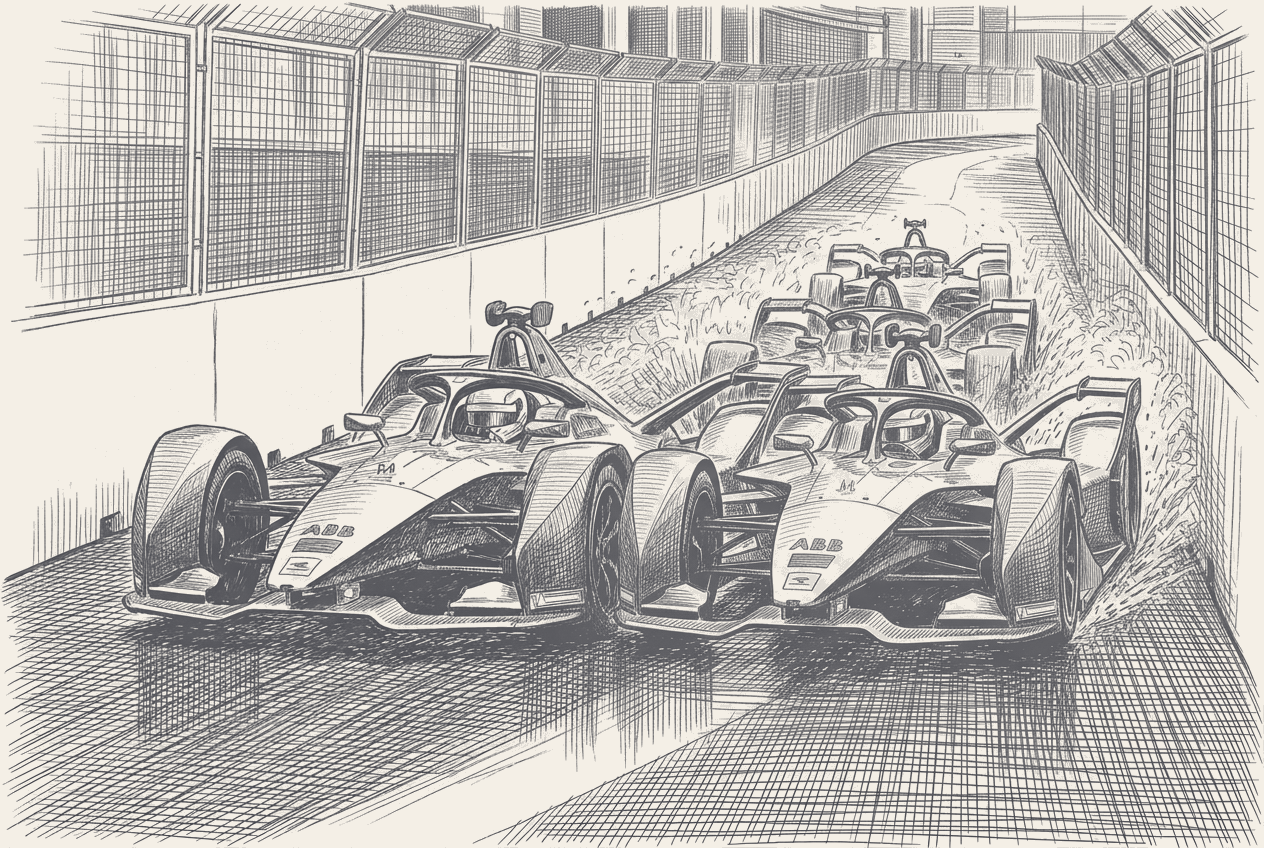
Dan Ticktum decided Saturday two corners from the end, taking the win from Dennis, who had started on pole and finished 0.380 seconds behind. Cassidy was third at 0.617. The race that mattered for the championship, though, was happening several seconds back, and it started with a car deliberately going slowly.
Sebastien Buemi, carrying a five-second penalty for first-lap contact with de Vries, dropped his pace as the pit window opened, which pulled Edoardo Mortara, Antonio Felix da Costa and Pascal Wehrlein onto his gearbox through Turns 6 and 7. Buemi told The Race the call was made to help his Envision team mate Joel Eriksson through the field: "I got instructed to do that and I just did what the team told me to do." Asked whether it was fair given the penalty he was already serving, he said "whether that's totally fair or not, it's another discussion" and noted it "is not forbidden."
Da Costa, running fourth and reckoning he had the race won, called the tactic "very unsporting" and aimed his complaint at the powertrain politics beneath it. Envision is a Jaguar customer team, and da Costa drives the works Jaguar. "If there's one team we try to race with more respect, it's the other Jaguar powertrain team," he said. "The one car that doesn't have the same colour as mine that I am hoping to get a slightly easier time from, they put my race in the bin today."
The compression that followed put da Costa in the TecPro barrier and Wehrlein's Porsche into the wall with a broken wing and suspension. Da Costa accused Wehrlein of doing it deliberately: "He crashed me out on purpose. He had damage from the corner before and I think he decided that if he is out, I am out, too." Wehrlein's account is that he was entitled to room he did not get. "I was on the inside, there's a rule in that sequence of corners where you need to be given space on the inside if you are side by side the corner before. I wasn't being given that." The stewards gave Wehrlein a ten-second penalty.
Mitch Evans came through from 16th to fourth in that race and took the championship lead by three points, erasing the nine-point advantage Wehrlein had built. Neither man held anything by Sunday evening. Evans stopped on the last lap of race two with suspension damage and out of the points; Wehrlein finished 15th and scored nothing across either race in Japan.
Sunday's race turned on tyre pressures chosen before anyone knew what the weather would do. Drivers set up for the wet faded as the circuit dried, and the dry-pressure runners came forward late. De Vries ran in the midfield for most of the distance and took the lead from Oliver Rowland on lap 28 with a well-timed final Attack Mode. Rowland deployed his own too late and fell from second to fourth behind Cassidy and Dennis.
On lap 32, Mortara turned Eriksson into the wall, blocking the circuit and trapping da Costa in the concertina behind. The race resumed after the red flag with a rolling start led by de Vries from Cassidy and Dennis, and that was the finishing order, with Rowland fourth and Jean-Eric Vergne fifth.
Nine drivers can still win the championship, and the arithmetic is not generous, it is simply tight. The London double header on August 15 and 16 pays a maximum of 58 points, two races worth 29 apiece once a win, pole and fastest lap are counted. The spread from Dennis on 146 to de Vries on 94 is 52. Evans is second on 144 and Wehrlein third on 141, then Rowland on 132, Mortara on 116, da Costa on 113, Cassidy on 104 and Nico Mueller on 100. Every gap in that table is smaller than one weekend.
Attack Mode hands every driver a deployment window he can spend early or late, which converts a speed deficit into a timing decision. Energy management rewards whoever reaches the final lap with margin rather than whoever led the first thirty. A red flag can reduce a full race distance to a single restart, as it did on Sunday. A customer powertrain deal gives a team on the fringes of the top ten a reason to care who wins. Tokyo ran all four mechanisms inside two days, and not one of the four is a measure of how fast a car is.
Dennis therefore arrives in London leading a championship he has not won a race in since the weekend began, with a two-point margin over Evans that is worth roughly one finishing position, and seven other drivers behind them who need a bad Saturday from the top three rather than a good one of their own.