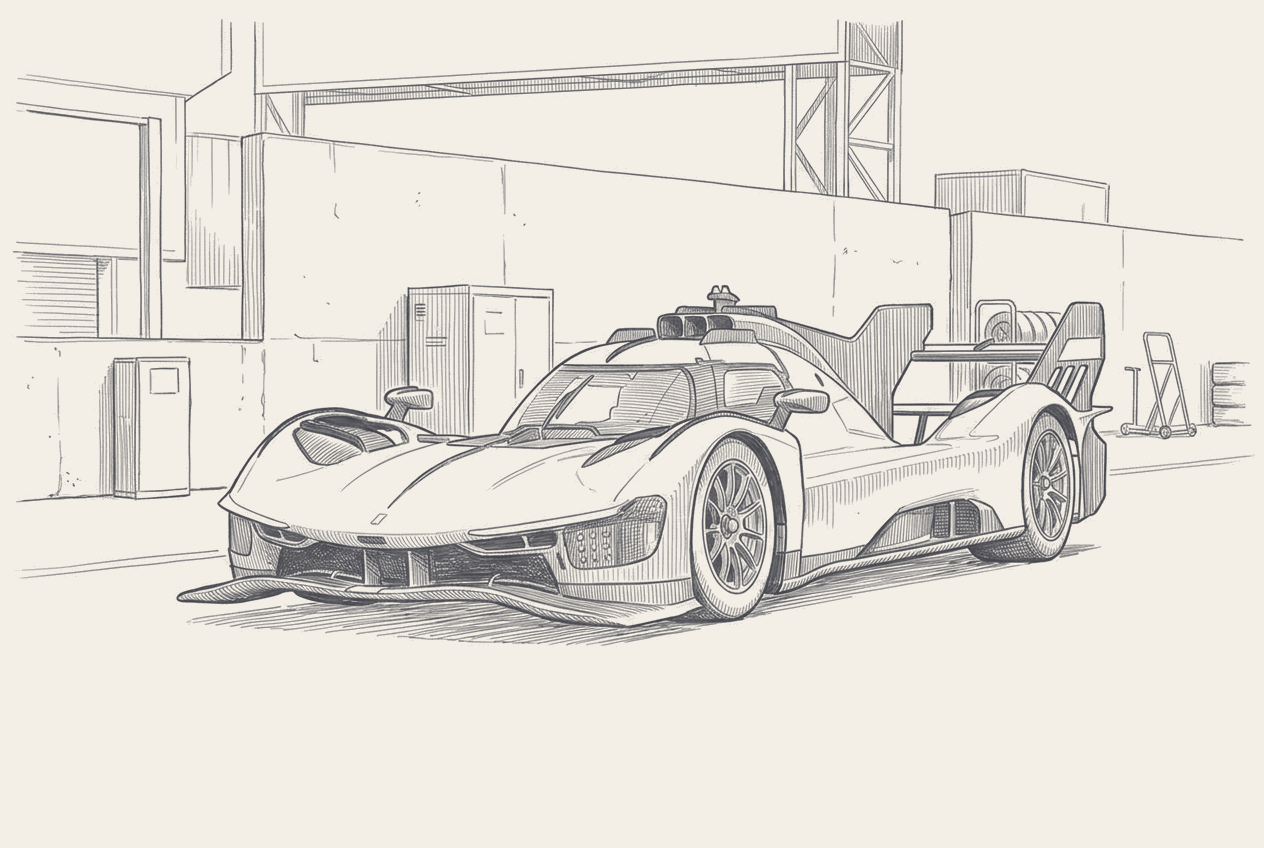
Ferrari's factory cars won the three races that set the handicap. At São Paulo the fastest 499P on the property belonged to a customer..
The Balance of Performance that governed the Rolex 6 Hours of São Paulo on July 12 was computed from three races: Qatar, Imola and Spa. Le Mans, run three weeks earlier, was excluded from the calculation by design. Ferrari's factory 499Ps had won all three of the races that counted. The correction that arrived at Interlagos was therefore aimed at them, and this is the first season in which nobody outside the FIA and the ACO can check by how much.
BMW M Team WRT won the race. The #15 M Hybrid V8 of Kevin Magnussen, Raffaele Marciello and Dries Vanthoor took the flag 2.254s clear of the #51 Ferrari of James Calado, Antonio Giovinazzi and Alessandro Pier Guidi, with Motorsport Week recording fewer than seven seconds covering the top three at the end of six hours. Will Stevens brought the #12 Cadillac Hertz Team JOTA home third from pole.
On lap 11, Magnussen forced the #15 past Earl Bamber's Cadillac at Ferradura, and the lead the BMW later inherited through the pit sequence never changed hands again. Cadillac had locked out the Hyperpole front row and then lost the race in its own pit box, to a wheel-nut delay at the #12's first stop, per the FIA WEC race report. All 35 starters saw the chequered flag. When a six-hour race produces zero retirements from a field that size, the pit lane is the last place left where it can be won.
The handicap is collectivised, and the customer pays for the factory's wins
Balance of Performance in Hypercar is applied by car model, not by entrant. Every Ferrari 499P on the grid runs the same power curve and the same minimum weight, whether it is operated by the works squad or bought and campaigned by a customer team. So when the factory cars won Qatar, Imola and Spa, the correction those results generated landed on AF Corse's privately entered #83 as well. That car won none of those races. It carried the penalty for them regardless.
At Interlagos the #83 was quicker than both works cars, according to Pit Debrief's race report, across a weekend in which the two Ferraris that had written the handicap could not beat the one that had merely inherited it. Read one way, that is a performance handicap doing exactly what it is built to do: compress the field until the advantage that produced three straight wins stops being worth anything. Read another way, a paying customer just watched a bill arrive for a party it was not invited to.
Whether the correction was proportionate is the question, and it is now unanswerable from outside. The FIA and the ACO stopped publishing BoP tables for 2026, reasoning that the figures invited speculation and misinterpretation. Paddock Notes wrote about that blackout ten days before Le Mans, when it had not yet been tested against a result anyone would want to argue with.
The case for the blackout deserves stating properly, because it is not weak. When the tables were public, every adjustment became a press release for somebody: a manufacturer that had been given two kilogrammes could brief that it had been robbed, and a manufacturer that had been given nothing could brief that its rival had been gifted a win. The organisers argue, with some evidence, that publishing the figures turned a technical exercise into a permanent grievance industry, and that the racing was worse for it. RACER's examination of how the FIA WEC actually sets the balance makes clear that the process is considerably more careful than its critics assume. Secrecy protects a good process from bad-faith reading.
It also, unavoidably, protects a bad process from good-faith reading, and there is no way to have the first without the second. The Race set out the risk in advance: a championship whose competitive order is set by an invisible hand asks its audience for trust it has no mechanism to earn. Six hours of racing at Interlagos produced a genuinely close result, and a viewer who wants to know whether that closeness was won by BMW or granted by a spreadsheet has nowhere to look. That is the trade, and São Paulo is the first race where it cost something.
Toyota finished twelfth and seventeenth, and leads the championship
Toyota's #7 came home twelfth and the #8 seventeenth, with the team's own newsroom recording minutes lost to a suspension change. Toyota also leads the manufacturers' championship by five points at the halfway mark of the season. Both of those things are true, and the gap between them is the season in miniature. It is the same Toyota that won Le Mans from fourteenth on the grid in June, a result that also owed more to attrition and pit discipline than to pace.
A points system rewards arriving, and in a class where 35 cars can run six hours without a single mechanical retirement, arriving has stopped distinguishing anybody. What separates the entries now is a narrow band of operational competence: whether the wheel nut goes on, whether the stop is clean, whether the driver change costs four seconds or fourteen. Cadillac had the fastest car over one lap and lost to a fastener. BMW did not have the fastest car over one lap and won by making no mistakes in six hours.
The next Balance of Performance will be computed from Imola, Spa and São Paulo, and Ferrari did not win the most recent of those. Whether the handicap loosens, and by how much, is the thing worth watching when the championship resumes. The only way anyone outside the room will find out is by holding a stopwatch on it.