
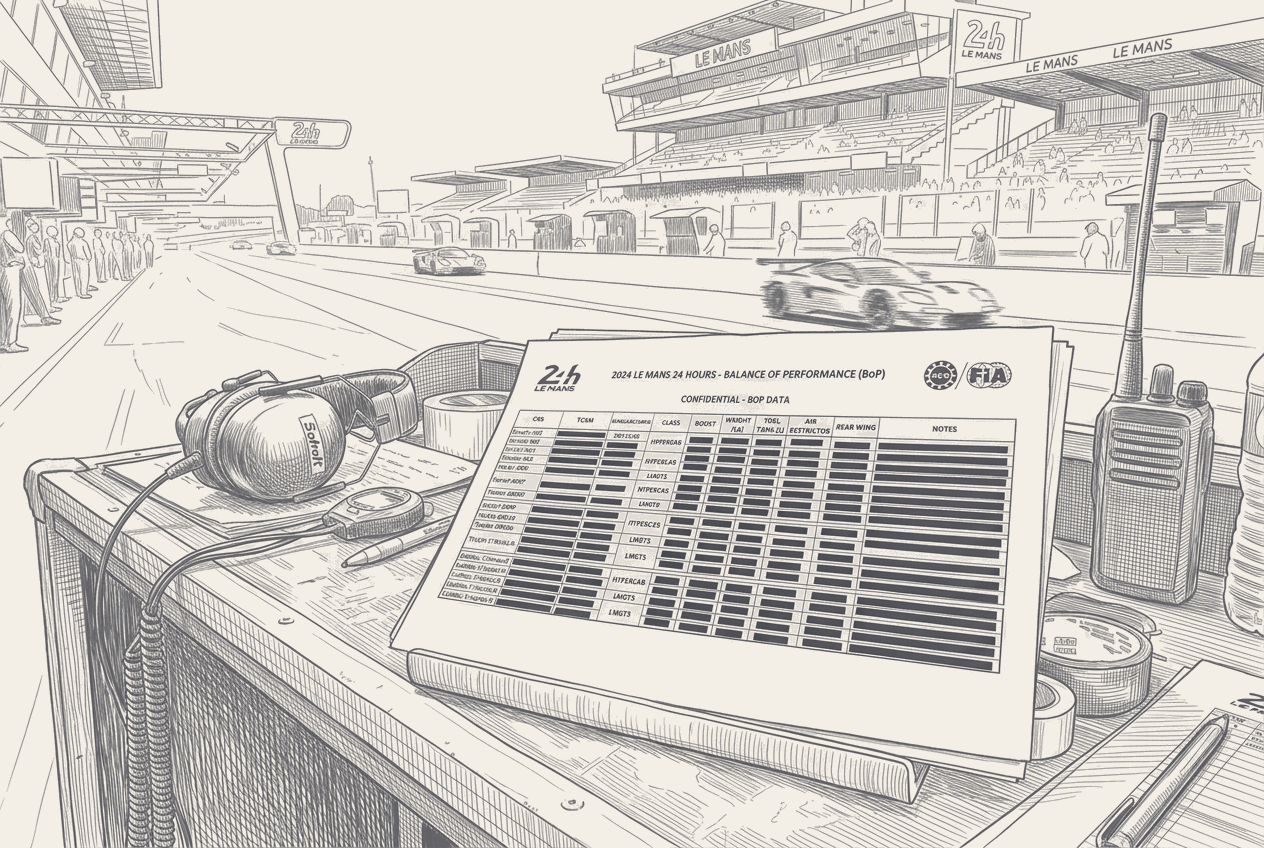
The first Le Mans of the BoP blackout era starts in ten days, with 18 Hypercars racing to numbers nobody outside the paddock can see.
Ten days before the 94th 24 Hours of Le Mans, the most argued-over spreadsheet in sportscar racing is invisible. From the start of the 2026 season the FIA and ACO stopped publishing Balance of Performance figures for the Hypercar and LMGT3 classes, ending the practice of releasing the per-car weight, power, and energy allocations that framed every result in the field's first question: who got helped this month. The figures still exist. Teams receive them. The public does not, and the first Le Mans run under that arrangement starts June 13.
What the blackout actually is
Confidentiality now covers the whole adjustment table. The Le Mans-specific Hypercar BoP went to teams under non-disclosure terms, per Sportscar365, so the platform-by-platform numbers for the year's biggest race are a closed document set. The ACO's stated logic, laid out by deputy director of competition Bruno Famin, is that published figures were meaningless without the homologation data behind them, and the homologation data cannot be revealed for confidentiality reasons. A number without its reference, the argument runs, informs nobody and inflames everybody.
There is a real observation buried in that. BoP tables never showed why a car carried 12 extra kilograms, only that it did, and the gap between the number and its rationale was where a decade of grievance lived. What the blackout changes is who gets to fill that gap. Under publication, anyone could litigate the table; under secrecy, only the regulator's conclusions ever surface, and the litigation moves somewhere less visible.
The season that made secrecy attractive
Toyota spent 2025 pointing at the table. The marque went seven of eight races without a podium before a dominant result at the Bahrain finale, and across that run it repeatedly identified Balance of Performance as the reason its GR010 could not compete. Porsche's exit sharpened the pattern: the company cited the BoP system among its reasons for withdrawing its factory Hypercar program. One manufacturer blaming the mechanism for a bad season, and another naming it on the way out the door, is the backdrop against which the regulator decided the numbers should stop being public.
Read cynically, the sequence is straightforward: the table kept losing the series its headlines, so the series withdrew the table. Read generously, the governing bodies concluded that publication had become a weapon pointed at the championship's own credibility, with every adjustment instantly converted into a narrative of favoritism by whichever garage it disadvantaged. Both readings agree on the mechanism. Publication gave aggrieved manufacturers a public scoreboard, and 2025 proved how expensive that scoreboard had become.
Ratel's case for the dark
Stephane Ratel does not run the WEC's BoP, and he spent this week defending it anyway. The SRO founder, whose GT3 platform runs on performance balancing, told Autosport the criticism of the blackout reflects "the public's constant need for conspiracy theories," and argued that uncertainty "is essential" to the product. In the same interview circuit he put the position at its bluntest: "There is no conspiracy."
His resume is why the defense carries weight. GT3 exists because Ratel persuaded manufacturers two decades ago to accept regulated parity as the price of a sustainable customer-racing market, and that ecosystem now spans every continent and underpins the WEC's own LMGT3 class. When the person who built the most BoP-dependent structure in motorsport says the adjustments work better unseen, it is an argument from operational experience, not public relations. Uncertainty, in his telling, is not a bug being hidden; it is the product itself, the thing that keeps eight manufacturers believing they can win the same race.
The case against trusting the room
Autosport's editorial counter, published when the blackout took effect, lands on the timing: the BoP "is part of the story of the WEC," and it seems strange, one season after the system demonstrably misfired, to ask the public to simply trust that it is now being got right. Secrecy asks for credibility at the exact moment the visible record argues the system had the least of it.
Accountability cuts both ways under a blackout, and that is the problem no interview resolves. When the next manufacturer has a Toyota-shaped season, it will still brief journalists, still hint at the numbers, still build the grievance narrative; nothing in the policy prevents that. What the policy removes is the regulator's own ability to answer with evidence, because the evidence is now classified by its own rule. A published table at least let the FIA and ACO point at the same numbers their accuser was pointing at. A confidential one converts every future dispute from an argument about data into an argument about institutional honesty, which is precisely the conspiracy-theory terrain Ratel says he wants to drain.
Eighteen cars, eight manufacturers, one test
The field racing into this experiment is the deepest and smallest of the era at once. The entry counts 18 Hypercars from eight manufacturers: Ferrari, Toyota, Cadillac, BMW, Genesis, Alpine, Peugeot, and Aston Martin, per Motorsport.com's breakdown of the 62-car, 186-driver entry list. Eighteen is down from the 23-car peaks of recent seasons, the first contraction of the top class in the LMH and LMDh era, even as the manufacturer count holds. Ferrari arrives with three 499Ps chasing a fourth consecutive win; Genesis arrives having never turned a competitive lap at La Sarthe.
Sunday's Test Day is the policy's first public stress test. All 62 cars share six hours of running on June 7, and the timing screens will do what timing screens do: produce a pecking order that nobody can calibrate, because the one document that says who is carrying what stays in the teams' inboxes. Sandbagging reads, always Le Mans test-week sport, become pure speculation without a reference table. Race week follows on June 10-14.
Whether the design survives contact is the season's real governance question. A clean race, won on the road by visible margins, banks the blackout a year of credibility. A race decided by a dominant car that the paddock whispers was flattered by its invisible allocation hands the policy its first crisis, with no published number available to defend it. The FIA and ACO have bet that what the public cannot see, it will stop arguing about. Ninety-four editions of Le Mans suggest the argument just moves venues.