McLaren's Hypercar ran 1.86km up a hill with Lando Norris driving. Its team principal says the run was barely planned..
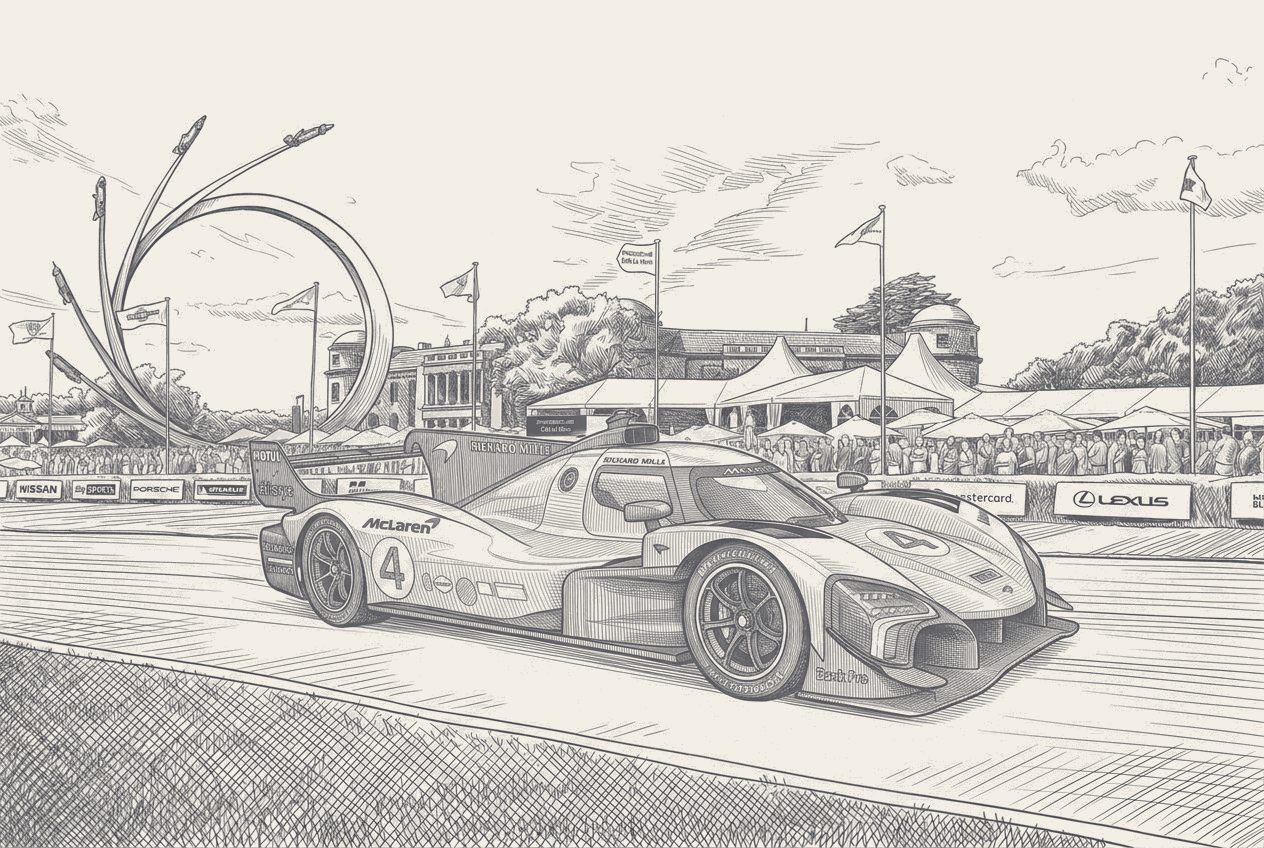
Lando Norris drove McLaren's MCL-HY Hypercar up 1.86km of Goodwood hill on July 10, in a Bruce McLaren tribute test livery, and the car went back to its test programme the following Sunday. That is the entire public racing history of the machine with which McLaren returns to the top class of endurance racing in 2027, and by the account of the man running the programme, even that much was close to an accident.
James Barclay, McLaren's team principal for the endurance effort, told the FIA WEC that the Goodwood appearance was decided late and that the car is "extremely early in our test programme." A team principal does not volunteer that his flagship 2027 project was lightly pencilled into a public event by accident. He hedges, in advance, against anyone reading a hillclimb demonstration as a statement of readiness.
The V6 twin-turbo MCL-HY has already got a driver line-up before it has a race. McLaren has signed Mikkel Jensen and Laurens Vanthoor, and it has a reigning Formula 1 world champion telling reporters, on the record, that he hopes to drive the thing on a racetrack one day. Norris is contracted to a Formula 1 team that is also the parent of the endurance programme, which makes his enthusiasm both free and slightly complicating.
The value being banked is 30 years old
McLaren last contested the top tier of sportscar racing with the F1 GTR, which won Le Mans in 1995, a lineage the FIA WEC leaned on explicitly in its account of the Goodwood run. Nothing in the intervening three decades connects the MCL-HY to that car mechanically. What connects them is a photograph: a McLaren prototype in heritage colours, on the most photographed 1.86km in motorsport, with the sport's current champion at the wheel. The programme delivered an image before it delivered a lap time, and the image lets a 2027 entry borrow credibility from a 1995 result.
That is not a criticism so much as an accounting note. Endurance programmes are sold to boards long before they are sold to fans, and the interval between a manufacturer's announcement and its first race is where the marketing has to do the work alone. Cadillac, Porsche, Ferrari and BMW all ran this playbook. McLaren's version has the advantage of a genuinely famous ancestor and the disadvantage of a car that, on its own team principal's account, has barely turned a wheel.
Norris's interest is the part worth sitting with. A reigning Formula 1 champion publicly angling at Le Mans, while his own organisation admits the car is early in testing, tells you how the balance of prestige between the two disciplines has shifted since Fernando Alonso made the same detour. F1 drivers no longer take on Le Mans when the F1 has stopped going well. They now say they want it while it is going well.
The hire that matters more than the hillclimb
Mikkel Jensen and Laurens Vanthoor arrived with far less noise than a tribute livery, and they count for more. Vanthoor has won at the top level of sportscar racing; Jensen has a Hypercar title to his name. Signing established endurance professionals rather than F1 refugees is the choice of an organisation that intends to be competitive rather than photogenic, and it sits oddly alongside a public debut engineered entirely for the camera.
Both things are being done at once, and they are aimed at different rooms. The Goodwood run is for the people who will buy the merchandise and the sponsors who will fund the entry. The driver signings are for the people who will have to beat Ferrari, a Toyota that won Le Mans from fourteenth on the grid, Porsche, Cadillac and a BMW squad that has just won at Interlagos. McLaren has correctly identified that it needs both, and it has done the cheap one first because the cheap one is the one you can do with a car that is not ready.
What has to happen before any of it means anything
Hypercar in 2027 will be a harder room than the one McLaren announced into. At the 6 Hours of São Paulo on July 12, the FIA WEC recorded all 35 starters reaching the finish and fewer than seven seconds covering the top three. A grid that dense punishes a new entrant in a specific way: there is no reliability advantage left to exploit, because everybody finishes, and no pace advantage left to find, because the Balance of Performance will remove it.
That leaves operational precision, which a debutant can neither buy nor simulate. Cadillac lost São Paulo to a wheel nut after locking out the front row. A team arrives in this class with its aerodynamics sorted and its pit stops not, and it takes a season of losing races in the pit lane to find out which of its people can do the job under a clock. McLaren's Formula 1 operation is excellent at exactly this, and almost none of that competence transfers: different crew, different regulations, different failure modes, and a driver change in the middle of it.
McLaren's test programme is the story from here, and almost none of it will be public. The next useful data point is not another hill. It is the first time the MCL-HY completes a full race distance simulation and somebody outside the team finds out how long it took.