The blue flags failed at Hungary, and the race rearranged itself around the missing information.
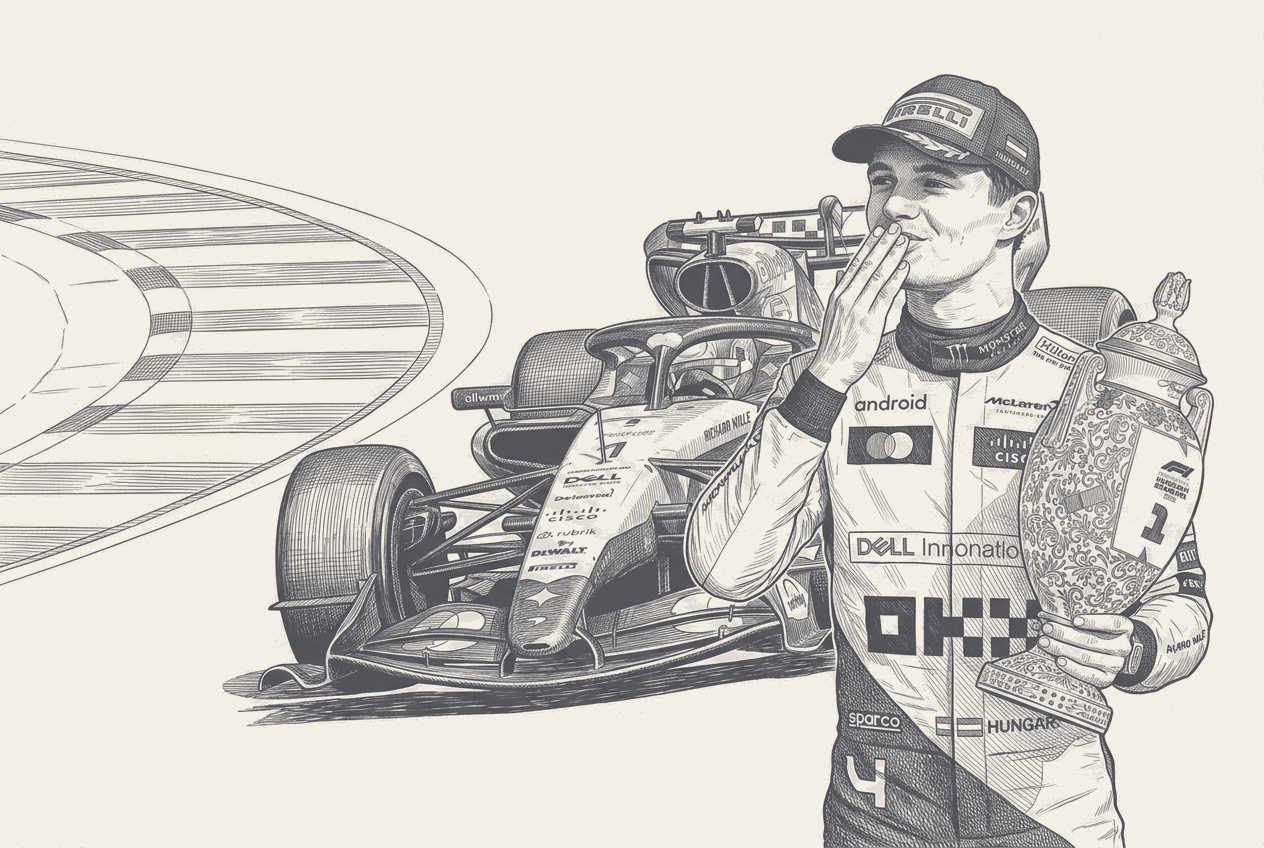
Lando Norris won the Hungarian Grand Prix by 15.080 seconds from Max Verstappen, the first victory of a title defence that has otherwise gone badly enough to leave the reigning champion sixth in the standings. Kimi Antonelli finished third at 18.728 seconds. The result that shaped the afternoon, though, belongs to a car that did not finish: Oscar Piastri led the opening stint, lost the lead in a collision with a car he was lapping, and retired from second with a reported gearbox failure.
Formula 1's automatic blue flag system malfunctioned around nine laps into the 70-lap race, The Race reported, sending erroneous blue signals to drivers who were not being lapped at all. Race control paused the automatic system once the fault was identified, which stopped the false prompts and also removed the real ones. For the rest of the afternoon, blue flags existed only as cloth at marshal posts and as radio calls from pitwalls. The steering wheel panel that normally tells a driver, by car number, that he is about to be lapped, showed nothing.
Carlos Sainz was in that blind spot in the most literal sense. The Williams driver made contact with Piastri while being lapped, and explained afterwards that "we didn't have blue lights on the steering wheel which normally, when we are in fights like that one where we are fighting for position, it helps us to understand whether we're getting lapped or not." He added that he was mid-move on Fernando Alonso at the time: "So at this stage, I had no idea I was about to get lapped." The stewards gave him a five-second penalty, reduced from the standard ten, and their decision document locates the mitigation somewhere other than the flags. It finds Sainz wholly responsible, then records that "the positioning of Car 55 relative to the circuit and the other cars meant that Car 81 was not visible to the driver of Car 55 prior to the attempted overtake." The same paragraph notes that Williams had told him blue flags were being shown for Piastri's approach, which sits awkwardly against the account of a driver who knew nothing.
Piastri rejected the explanation in unusually direct terms. "I knew there were blue flags, but there were blue flags on all the marshal signals. I was right behind him for a sector. I couldn't believe what happened," he said, before calling the incident "one of the dumbest things I've ever seen on a race track" to Viaplay. His objection was not really to Sainz's eyesight. It was to the idea that a car fighting for eighteenth place should be unaware of a race leader: "The fact that he didn't and no one told him or there was a lack of complete awareness, is unacceptable."
Sainz did not end Piastri's race. A gearbox failure did that later, with Piastri running second. What the contact cost was time, and the time cost track position, because Norris cleared his team mate during the second pitstop sequence on an overcut he had committed to independently. Norris called it "some of the best pace I've had" and was the faster McLaren all afternoon, so the counterfactual is unclear. What is not unclear is that McLaren lost a one-two it was on course for, and that Sainz was classified 18th.
Oliver Bearman took the weekend's second blue flag penalty, also five seconds, for ignoring flags while being lapped by Isack Hadjar. His description is the clearest account of what a broken information channel feels like from inside the car. "At the start of the race I was getting blue flags after six laps, and I thought, wow, that's strange. We're not that slow to be lapped in six laps." From that point, he said, "there were some blue flags every single lap. It was really tough to know what was real, what was fake, what was for me, what wasn't, because normally you have your number, this time it was just a blue."
Toto Wolff aimed his complaint at the humans who were supposed to backfill the gap, telling DAZN España that lapped cars defending against Lewis Hamilton and Antonelli late in the race was "just disgraceful from some of the Teletubbies engineers that sit on the pitwalls of these teams, not telling the drivers what's happening behind." The remark is impolitic and also a fair description of the failure mode. When an automated channel drops out, the load transfers to whichever pitwall is least equipped to carry it, and the cars at the back of the grid are run by the smallest operations.
Verstappen's second place was the cleanest piece of racing on the day, and it came out of a tyre call rather than a car. Red Bull recognised that the soft was viable for a 29-lap final stint, a read Alonso's Aston Martin had already demonstrated earlier in the race, and Verstappen delivered a podium in what The Race assessed as the fourth fastest car at the Hungaroring. He leaves for the break sixth on 109 points.
Ferrari inverted its own expectations completely, and Charles Leclerc said so plainly. "There were two races where we were expecting to struggle and we finished first and second. And in the race where we expected to do well, we finished fourth and fifth." Ferrari had swept both Friday sessions at a circuit whose low speed corners suit a car that is strong in the turns and short on straight line power, and converted that into fourth for Leclerc and fifth for Hamilton. Against Mercedes it took one point back in the constructors' championship and lost ground in the drivers'.
George Russell dropped to 22nd at the start with a technical problem he described as the engine "revving all over the place" four seconds before the lights, recovered to seventh, and offered the bluntest summary of the first half of anyone's season: "I usually don't feel like I need a break; this year I definitely feel like I need one."
Aston Martin's B-spec AMR26 finished 13th and 14th, still outside the points, and still the most encouraging thing the team has done this year, clearing Williams, Haas and Cadillac on a weekend when its upgrade actually ran a full distance. Nico Hülkenberg scored his first points of 2026 in ninth. Liam Lawson took eighth, enough to move Racing Bulls ahead of Alpine into fifth in the constructors' championship. Both Cadillacs retired, Valtteri Bottas with brakes that caught fire on a weekend the team had brought new brake ducts specifically to cure that problem.
Antonelli leaves Budapest on 219 points with a 50-point lead over Hamilton, having extended it by five without winning, from seventh on a grid he was demoted to by a penalty of his own. Eleven of 22 rounds are gone and 291 points remain available, so the arithmetic is not settled. Mercedes leads Ferrari 379 to 307 in the constructors' championship. The Dutch Grand Prix on August 23 is the first race back, and the first look at whether the panels return working.
Corrected 20 August 2026. An earlier version of this article placed Max Verstappen fifth in the drivers' championship on 128 points in its opening paragraph; that is Lando Norris's total, and Verstappen left Hungary sixth on 109, as the article stated correctly further down. The same version reported that the stewards reduced Carlos Sainz's penalty for the limited visibility of blue flags. FIA Document 54 gives the mitigation as the position of Sainz's car making Piastri's car invisible to him, and records that his team had informed him of the blue flags; that passage has been rewritten to follow the document. Oscar Piastri's quotation has been corrected to the wording carried by three independent transcriptions of the Viaplay interview.