A blue-flag penalty is paid in race time. The cars it is written for have the least of it to lose..
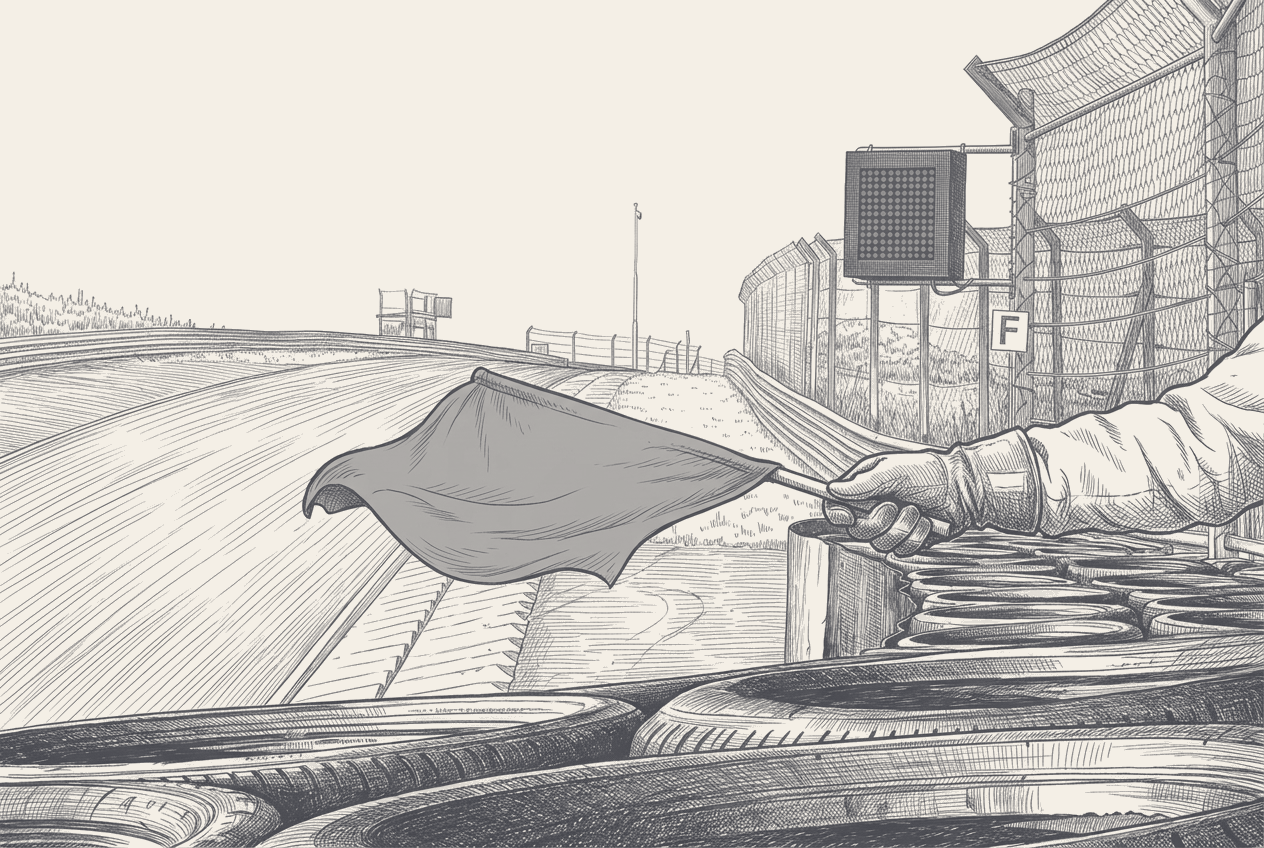
Roughly nine laps into the Hungarian Grand Prix, the electronic system that tells a driver he is about to be lapped stopped working. Race control paused the automatic blue-flag panels, as The Race reported, and handed the next 60-plus laps of lapping back to marshals waving flags by hand. The race rearranged itself around the missing information: two lapped cars picked up five-second penalties, and the race leader lost his position in a collision with a backmarker.
That is the failure, and the failure is the fixable part. Hardware can be repaired or replaced across a four-week shutdown, and the FIA will spend some of that time on the panels. The part worth looking at is the one the malfunction only exposed, because it was there before the system broke and it will be there after the system is fixed: the penalty for ignoring a blue flag is denominated in race time, and race time is the one thing the cars blue flags exist to move do not have much of.
Carlos Sainz supplied the clearest version of the problem. Fighting Fernando Alonso in the midfield, he made contact with race leader Oscar Piastri while being lapped, and told reporters afterwards that "we didn't have blue lights on the steering wheel" and that mid-move on Alonso, "I had no idea I was about to get lapped." The stewards found him wholly responsible and gave him five seconds, reduced from the standard ten.
Set the information failure aside for a moment, because the incentive was pointed the wrong way even with a working panel. Sainz was racing Alonso for a finishing position that mattered to him. Being lapped by the leader mattered to the leader. When those two priorities met at one corner, the driver who was not fighting for the win had every reason to protect his own race and a five-second threat as the only thing on the other side of the scale. The penalty landed, Sainz served it, and it changed his afternoon by a handful of positions. It did not change the fact that in the moment, defending against Alonso was worth more to him than yielding cleanly to a car he was not racing.
Oliver Bearman drew the starker case. He took the weekend's second blue-flag penalty, five seconds for ignoring flags he said he could not read, telling reporters "there were some blue flags every single lap. It was really tough to know what was real, what was fake, what was for me, what wasn't." Bearman was running near the back, a lap down, in a car fighting no one for points. For a driver in that position, a five-second time penalty is close to free. It cannot demote him below cars he is already behind, and it cannot cost him points he was never going to score. On the RaceFans rate-the-race thread, a commenter using the handle Esploratore put the whole enforcement problem in nine words: "why would the car in last position care about a 5 sec penalty?"
The deterrent and the offence are priced in different currencies
A time penalty is a good instrument when the target has time to lose. Give a five-second penalty to a driver scrapping for fourth and it can drop him to seventh, so he yields, because yielding costs him less than the penalty would. That is the design working. The instrument fails at exactly the point of the field blue flags are aimed at, because a lapped car in the last third of the order is defending a classification that a five-second penalty does not move. The threat is real currency for the front and near-worthless paper for the back, and the offence blue flags punish lives entirely at the back.
Sainz and Bearman were not blameless, and the stewards' verdicts stand. But the FIA's shutdown to-do list has two items on it, not one. The panels are the visible item and the straightforward one. The second item is that the sport's blue-flag deterrent scales with a driver's finishing stake, and the drivers it most needs to reach are the ones with the smallest stake in the room. The currencies that would actually reach a backmarker already exist elsewhere in the rulebook, grid penalties applied at the next race and points on the superlicence, both of which follow a driver past the flag and into a weekend where he does have something to protect.
Whether any of that changes is a question for the four weeks between now and the Dutch Grand Prix on August 23. The hardware will get attention because it obviously broke. The harder conversation is the one the malfunction only made visible, and it does not involve a single wire.