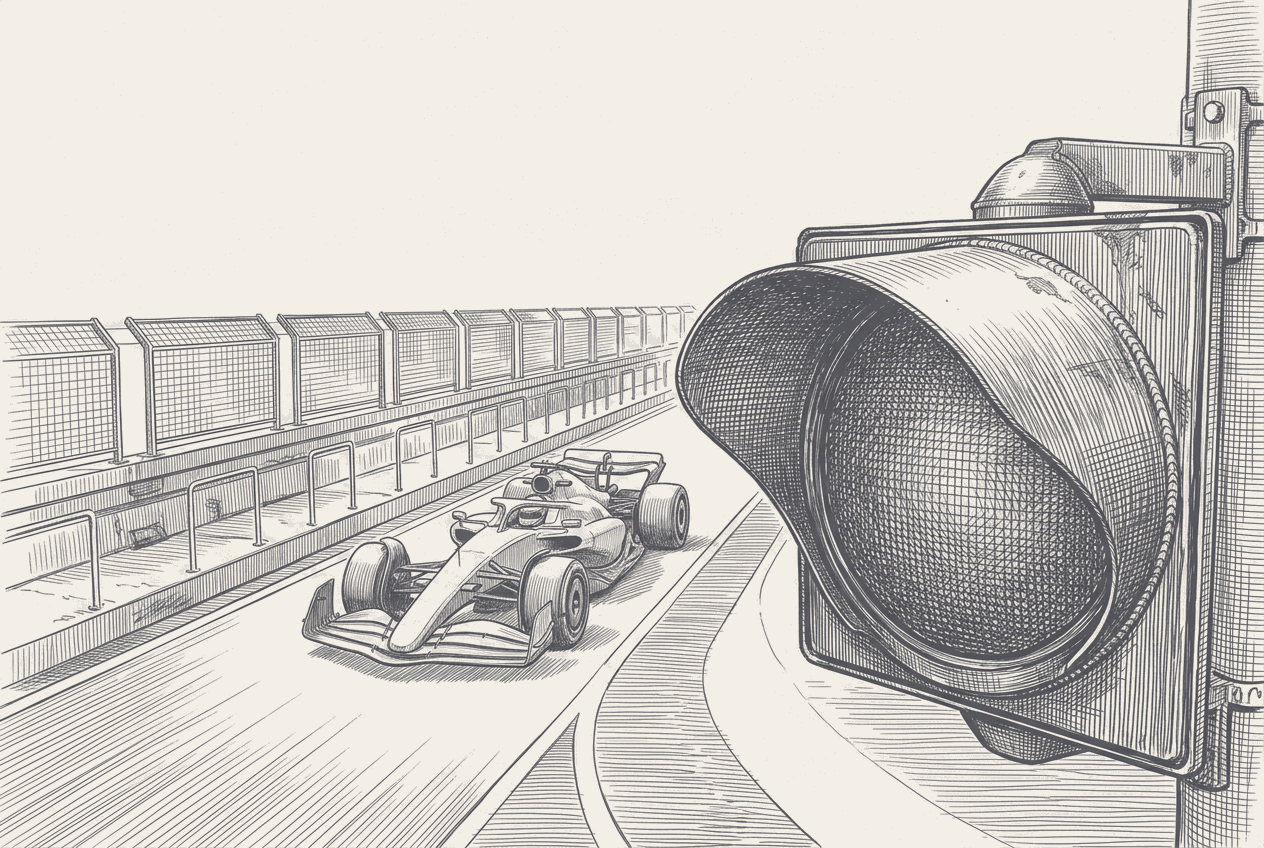
Zandvoort's red pit-exit light drew two reprimands, and the FIA's published tariff never said disqualification.
The FIA stewards logged both infringements at 15:33 and published them twenty-three minutes apart on Sunday evening. Document 69 records that car 87, Oliver Bearman, "left the pit lane when the light at the end of the pit lane was red." Document 70 says the same of car 5, Gabriel Bortoleto. Both cite a breach of Article B1.6.3e. Both end in a reprimand, the first of the season for each driver. The reasoning attached to the two documents is identical, and it is the most useful thing either of them contains.
"Such an infringement happening during the race normally requires a very significant penalty as the drivers are obliged to obey light signals at all times," the stewards wrote. "However, in this case the infringement did not happen during a live race, but rather on the build-up before the re-start, although the race had technically already resumed in accordance with Article B5.15.2g." That article deems a suspended race to have resumed "when the Pit Lane exit is opened," which is what puts the two drivers inside a race they were not yet competing in. The stewards then note that "neither any advantage was gained nor any potentially dangerous or unsafe situation was created," and land on a reprimand "given the mitigating circumstances and the unique scenario."
Article B1.6.3(e) itself is four lines long and admits no ambiguity about the rule. "F1 Cars may only be driven out of the Pit Lane when the light at the end of the Pit Lane is green," reads the 2026 Sporting Regulations, Section B. What varies is not the rule but its price, and the price is published. The 2026 FIA Formula 1 Penalty Guidelines list "failing to stop at a red light at the pit exit during a race" at a 10-second stop-and-go and three penalty points, and the same offence "during practice" at a reprimand or up to three grid places with zero to two points. Neither line says disqualification.
Lance Stroll, stopped at the same light and watching two cars go past it, asked for a stop-go on team radio and said "It's the rules." He was describing the guideline correctly and the classification of the moment incorrectly, and the gap between those two things is the entire decision. Zandvoort's restart sat in a seam the tariff does not name: a race that had legally resumed under B5.15.2g while nobody was yet racing.
The grievance that outlived the afternoon reached for a heavier precedent than the guidelines carry. This offence is remembered through a run of disqualifications, and those cases are real. Rubens Barrichello was disqualified from the 2008 Australian Grand Prix after leaving the pit lane with the light on during a safety car period. Giancarlo Fisichella and Felipe Massa were both black-flagged at Canada in 2007, Juan Pablo Montoya at Canada in 2005, Heinz-Harald Frentzen in Australia in 2002 and Jarno Trulli in Austria in 2001, a set Motor Sport Magazine has collected. Every one of those falls between 2001 and 2008.
That range is not a coincidence, and it is the load-bearing fact. The two most recent cases in it, Barrichello in 2008 and the pair at Canada in 2007, sit inside the rule that closed the pit lane when the safety car was deployed, so a car passing a red light was re-entering a track it had been formally shut out of, usually to take fuel it was not entitled to take. The FIA introduced that closure for 2007 and reversed it for 2009 once a dashboard minimum-lap-time system removed the incentive it was written to suppress. Charlie Whiting called the closure "a bad one" and said the sport had "gone back to the 2006 regulations," as Autosport reported at the time. The earlier cases arise from different circumstances again, Frentzen's from a start procedure rather than a safety car. What the six have in common is that all of them predate the published guidelines that now set the price, and none of them was decided against the tariff a 2026 steward reads.
One claim circulating since Sunday does not survive contact with the documents at all. Several outlets have characterised the light as having turned red in error. The stewards' decisions contain no such finding, and they are the only official account of the incident that exists. Article B5.15.4 of the same regulations provides that on the "STANDING START" message "the Pit Lane exit will be closed," which makes a red light at that point a prescribed step in the restart procedure rather than evidence of a fault. No FIA statement, race-control log or Tier 1 report locating an error was found for this piece. The characterisation belongs to the outlets that published it, and until the FIA says otherwise it should be attributed to them rather than to race control.
Consistency is a fair thing to want from the stewards, and Zandvoort produced a second data point on the same afternoon. Bearman and Bortoleto were reprimanded under a discretionary asterisk in the guidelines. Lawson and Franco Colapinto each took a flat 10-second penalty for failing to slow for yellow flags, and Carlos Sainz took 10 seconds for the collision between the two Williams cars. The reprimands are the only one of those three that departed from the published number, and the stewards wrote down why, in a paragraph naming the article, the mitigation and the scenario.
The FIA's International Court of Appeal sits on 25 August on a related question of who gets to change a decision after the fact. Case ICA-2026-06-07-08-09 hears McLaren and Red Bull against the stewards' decision to rescind two 5-second pit-lane speeding penalties given to Pierre Gasly at Monaco, per the FIA's own notice, after Alpine petitioned for a right of review and the stewards found "a significant and relevant new element." The hearing is closed to press at the parties' request. Two decisions about how much room the stewards have, taken in the same fortnight, one of them already written down and one of them not yet.