2:59:08 in his first marathon: the post-F1 second act Sebastian Vettel has been quietly engineering.
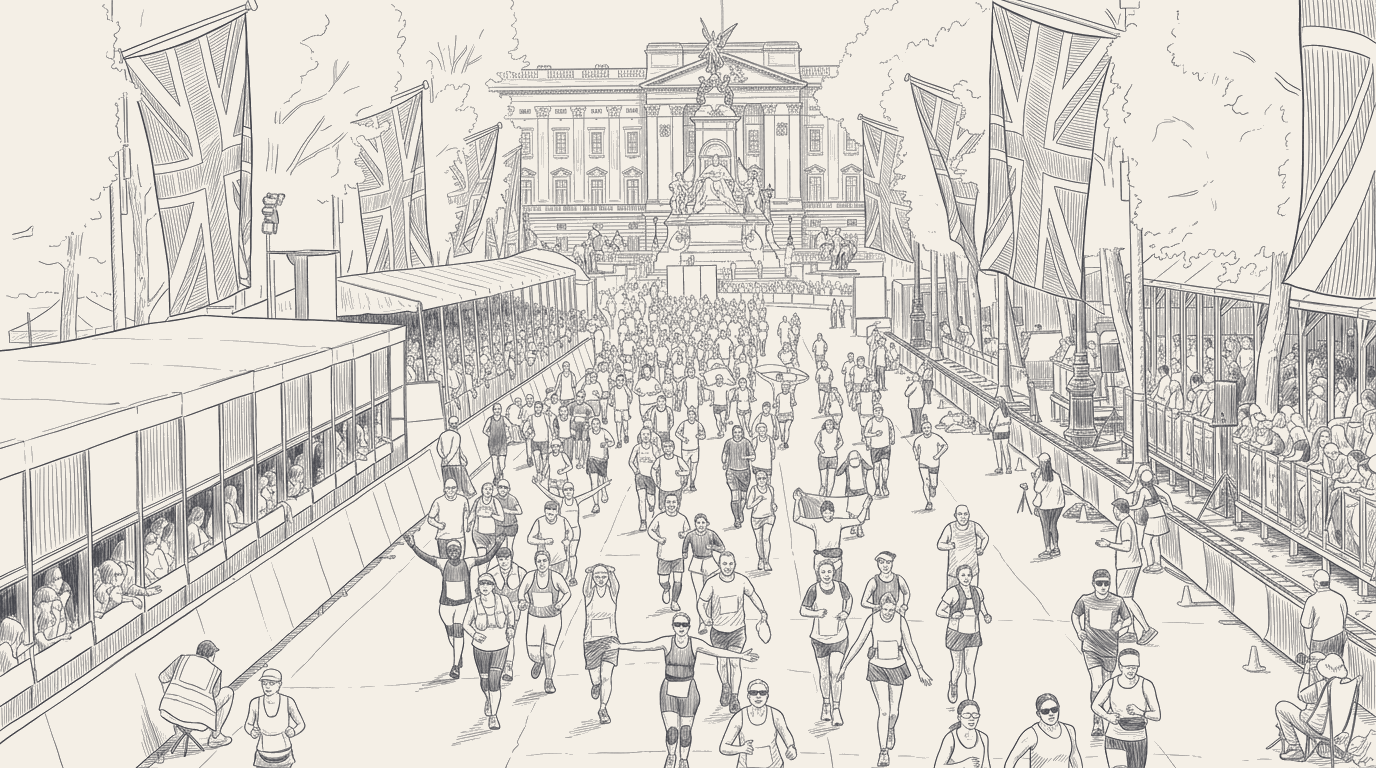
Sebastian Vettel crossed the finish line on the Mall on April 26 in two hours, fifty-nine minutes and eight seconds. It was his first marathon. His stated target before the race was sub-three hours. He hit it by fifty-two seconds. Per Motorsport.com the run was for the Grand Prix Trust and the Brain & Spine Foundation, alongside long-time F1 broadcaster Tom Clarkson. By midweek the fundraising page had passed eight thousand eight hundred pounds against a five-thousand ask. Reddit picked it up immediately. The r/formula1 thread cleared 11,150 upvotes and 404 comments, the most upvoted-and-commented human-interest story across every motorsport subreddit this week.
The cleanest read on Vettel's run is not the time. It is what the time tells you about a four-year project the F1 paddock has been watching with mild curiosity but no clean read since 2022.
What three hours of marathon actually means
A 2:59:08 London Marathon places a runner inside the top one and a half percent of all finishers in the field of 56,000. For a first-time marathoner who has not been a professional runner, it implies a base of regular twenty-mile training weeks for at least the previous year and a methodical taper. The pace, six minutes fifty-one seconds per mile, is sustained running at roughly seventy-eight percent of maximal aerobic capacity for a man in his late thirties. There is nothing accidental about that number. It is the output of a programme.
Vettel was not surrounded by a charity-tier press machine in the buildup. The pre-race coverage was sparse, mostly recycled retirement-era profiles and the occasional cameo at a Volkswagen-affiliated youth event. The post-race coverage caught up faster than the build-up did, which is the signal worth reading. The 2:59:08 was not a stunt finish. It was a goal he had specified publicly, run privately, and delivered close to the lower bound of credible.
The Grand Prix Trust line item
The Grand Prix Trust is the F1 paddock's mutual-aid fund. It exists to support former Formula 1 personnel, mechanics, engineers, marshals, support-paddock workers, who fall on hard times after their professional racing years end. It is funded by an opt-in levy from current paddock workers, by alumni contributions, and by exactly the kind of charity-run fundraising Vettel just did. The Trust's annual public reports list disbursements without naming recipients; the median recipient is a mechanic over fifty-five with a chronic-injury claim or a redundancy gap.
That is the F1 paddock's quiet welfare state. Vettel running for it is a clear line of editorial intent. The Brain & Spine Foundation, his second beneficiary, picks up where the Trust ends, because catastrophic head and spine injuries are the failure mode the Trust cannot fully insure against. The pairing of the two beneficiaries is the most direct statement Vettel has made in retirement about how he reads his own profession's risks.
What the second act has actually been
Since his Abu Dhabi 2022 retirement, Vettel's public motorsport activity has run on three explicit tracks. The first is sustainability advocacy, including the Race Without Trace planting drive at Suzuka in 2022 and the bee-hotel project at the Nurburgring in 2023. The second is the historic-machinery work, including his demo runs in Ayrton Senna's MP4/8 at Imola in 2024 and the Mansell-era Williams demonstration he ran at Silverstone the same year. The third, until April 26, was the quietest of the three: physical preparation. He had publicly mentioned wanting to run a marathon on multiple occasions through 2024 and 2025. The London time confirms the work was happening.
The three tracks share a register. Each one is a slow, public-facing investment in the institution rather than the personal brand. Sustainability advocacy is the institutional health of the racing series. Historic-machinery work is the cultural memory of the racing series. Charity-run fundraising for the Trust is the welfare of the racing series's people. None of the three has resembled a return-to-the-cockpit campaign. None has resembled a media-presence campaign either. They have resembled a careful retirement, executed at a tempo more deliberate than the F1 paddock is built to read in real time.
The companion story to keep separate
The same morning, on a different beat, Sylvain Guintoli ran the same marathon in his racing leathers. The MCN write-up put the time at 3:47:46, an unofficial Guinness record for fastest marathon completed in motorcycle leathers, with the leathers RST-built and finished in a Sonic the Hedgehog motif chosen by his son Luca. Luca died of childhood cancer in July 2025. The PASIC fundraiser around Guintoli's run had cleared one hundred and forty-one thousand pounds by race day.
The two stories sit at different emotional registers. Vettel's is a four-year arc paying out as a stated time. Guintoli's is a parent doing something specific and improbable in honour of a child who is no longer here. The cross-paddock signal that both ran the same marathon, on the same day, in the same city is real. The signal that Vettel and Guintoli are running the same kind of run is not. They are running for institutions, but the institutions and the stakes are theirs alone, and Paddock Notes will treat them as separate stories rather than combine them under a single charity-running header. The piece on Guintoli sits separately on the desk and the cadence of that piece matters more than the cadence of this one.
Why this is a launch-week story
Paddock Notes opens its window onto the sport in a week when the institutional headlines are about Miami's weather radar, the FIA's fourteen-line PU rule patch, and a five-year Istanbul Park calendar deal. Those are the structural stories. The Vettel run is the quiet corollary. It is the reminder that the people the championship cycles through have lives that continue at a different cadence after the cars stop, and that a four-time champion whose retirement the paddock had read as final has, in fact, been engineering a second act all along.
The London time is not the headline. The headline is that the second act has had a measurable output, sustainability work that is verifiable on the ground at Suzuka and the Nurburgring, charity totals the Trust is now publishing, a 2:59:08 marathon that lands inside the upper percentile of every field he could have entered, and a pair of beneficiaries that read as a single statement about what a serious retirement from F1 can look like. The story is what the project was the whole time, not the result on Sunday.
What comes next
Vettel's Trust fundraiser remained open through the end of April. Tom Clarkson's pace, paced by Vettel through the final five miles, finished within two minutes of Vettel's. The two were photographed at the finish in matching Trust singlets. There has been no public announcement of a follow-up race or a follow-up project, and the absence of a follow-up announcement is itself part of the cadence the second act has run on. The next public-facing step, if there is one, will arrive without fanfare and will resemble the previous one in shape rather than in scale. That is the working assumption to take into the rest of 2026.