
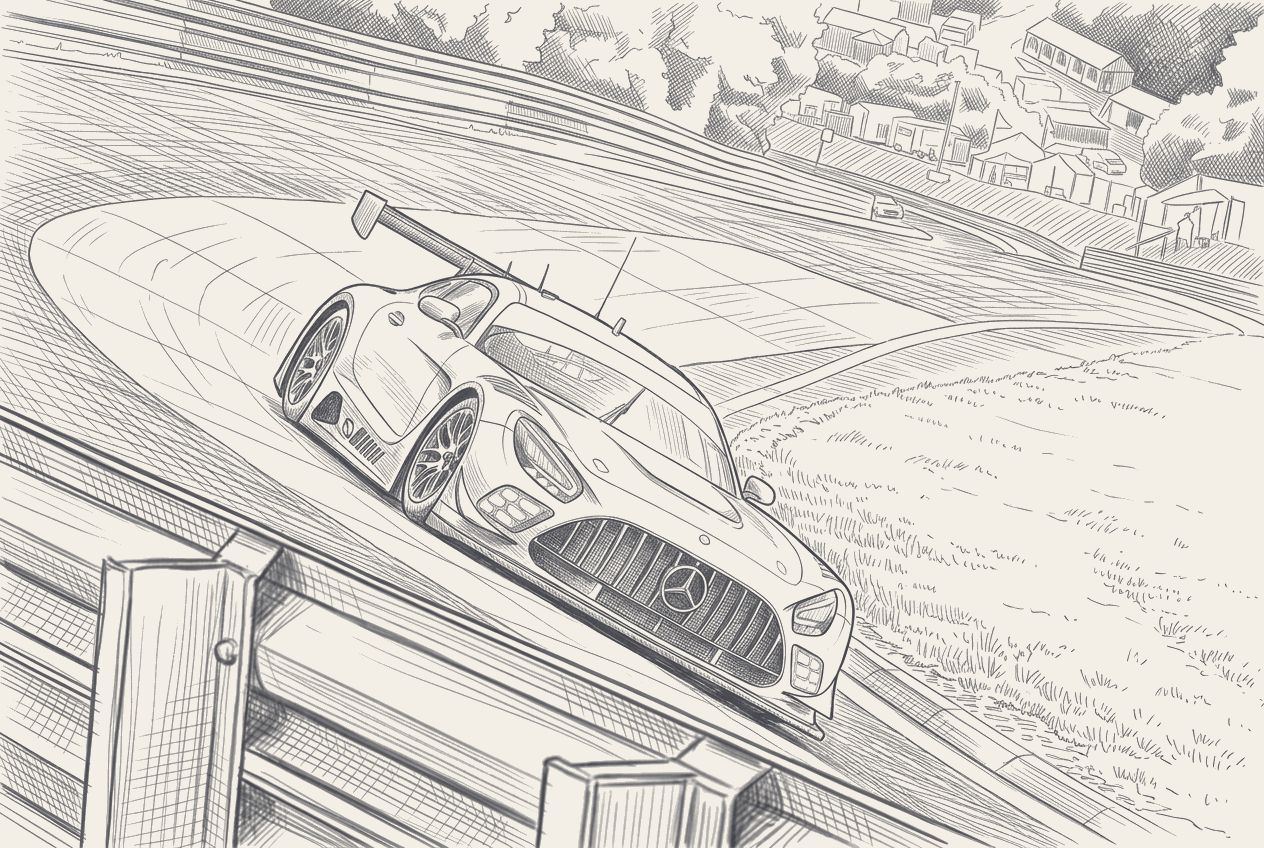
Verstappen at the Nurburgring 24, and the first weekend-ticket sell-out the event has logged.
ADAC confirmed on Tuesday, May 12, that the 24 Hours of Nurburgring has sold out its weekend ticket inventory for the first time in the event's history. The race has run since 1970, the 2026 edition is its 54th, and across every prior edition the weekend ticket has remained an available walk-up purchase right through to race week. Per the Motorsport Week Tuesday piece, the organisers paired the announcement with the entry-list confirmation for the #3 Mercedes-AMG GT3 carrying Max Verstappen, Lucas Auer, Jules Gounon and Dani Juncadella across the May 16-17 race. The car runs under the Verstappen Racing entry name and is operated by Winward Racing, the US-based Mercedes-AMG GT3 customer team that won the 2026 Daytona 24 Hours GTD class with Auer on the driver list.
The audience-side number that has not happened before
Weekend-ticket sell-out at the Nurburgring 24 carries a specific institutional weight. The event has run continuously since 1970 (the modern Nordschleife-and-Grand-Prix-circuit configuration since 1984), and through the entire history of the German fan-camping culture, the manufacturer-backed grandstand cycles and the SP-class fanbase, the weekend ticket has remained an available walk-up purchase right through to race week. Per the Motorsport.com piece on the sell-out announcement, ADAC framed the result inside the Verstappen-effect specifically, citing the entry list confirmation as the inflection point for ticket demand inside the final four-week window.
The audience number is the read. A current World Champion entering an in-season non-F1 24-hour endurance race is a fan-side event the modern F1 calendar has not produced. Fernando Alonso's 24 Hours of Le Mans wins ran inside off-season WEC entries plus the 2019 Daytona 24 (the F1 calendar's January gap); Valtteri Bottas's Bathurst 12 Hour entries in 2025 and 2026 ran inside the off-season pre-season-test cycle. Verstappen's Nurburgring entry is the first reigning-F1-champion cross-series finish that ends inside the same Sunday morning as a Grand Prix FP1 day at a separate circuit.
The team composition, three GT3 specialists and a champion
The four-driver line-up reads as a customer-Mercedes-AMG GT3 reference entry under the rules of the Nurburgring Endurance Series (NLS) and the headline Nurburgring 24. Per the GrandPrix247 driver-line-up piece, Lucas Auer is a former DTM front-runner and Daytona 24 Hours 2026 GTD-class winner with Winward Racing; Jules Gounon is a two-time Spa 24 Hours overall winner and three-time Bathurst 12 Hour winner; Dani Juncadella is a former Williams and Force India F1 test driver, a Mercedes-AMG factory pillar since 2017, and a triple Macau Grand Prix winner.
The composition is the second signal. A Permit-A holder running with three Mercedes-AMG factory-grade endurance drivers is the customer-GT3 cycle's reference team structure. Verstappen's qualifying-for-Permit-A cycle ran inside 2024 and 2025 in private testing and customer-class entries (covered in the April 30 brief race-to-road thread), and the 2026 entry is the first published full-distance Nurburgring race for him after the permit closed. Per the Crash.net piece on the published target, Verstappen's stated objective is to win the race at the first attempt, a target Auer framed as inside the team's GT3 baseline rather than as an aspirational note.
The Mercedes-AMG livery on a Red Bull driver, what crosses the brand line
The cross-manufacturer read is the third signal. Verstappen is a Red Bull Racing-contracted F1 driver, and Red Bull's parent group runs technical partnerships with Honda Racing Corporation (F1 power unit) and Ford (the 2026-onward Red Bull Powertrains supplier through to 2028). Mercedes-AMG is the manufacturer of the GT3 car Verstappen drives at the Nordschleife; the livery is a Verstappen Racing entry rather than a factory-Mercedes-AMG entry, but the chassis, engine and customer-support cycle all sit inside the AMG customer programme.
The cross-brand precedent does not have a recent F1-side comparable. Lewis Hamilton's 2020-era Mercedes contracts permitted Mercedes-EQ Formula E activities and personal Mercedes-AMG GT car entries; Max Verstappen's Red Bull contract permits non-F1 motorsport activity that does not compete commercially with Red Bull's branded properties. Mercedes-AMG GT3 customer racing sits in that allowance: the racing programme is not a Red Bull commercial competitor; the car colour is not a livery point under the contract; the driver's name on the entry list is the asset Mercedes-AMG receives as a customer programme.
Verstappen Racing as an entity is the fourth read. The privately-held racing organisation Verstappen has been building since 2023 (the Quadrant-overlap sim-racing programme, the private GT-customer programme, the Nordschleife test cycles covered in the May 1 sim-racing piece) is the legal vehicle for the Nurburgring 24 entry. The entity does not have to make money on the entry, the entity has to log the race finish under the Permit-A licence and the customer-GT3 Bronze-Silver-Gold-Platinum cycle. The Verstappen-Racing-as-vehicle-rather-than-team frame is the cleanest customer-programme architecture an F1 driver has published in a decade.
The schedule overlap, Imola FP1 to Nordschleife Sunday
The 2026 calendar puts Imola FP1 on Friday, May 15, at 13:30 CEST. The Nurburgring 24 starts at 16:00 CEST on Saturday, May 16, and finishes at 16:00 CEST on Sunday, May 17. Verstappen is contractually committed to neither F1 session inside that window; the Imola GP weekend is the round following Miami, and Verstappen's Red Bull RB22 race entry sits on the Sunday May 17 grid at 15:00 CEST. The published reading is that Verstappen finishes the Nurburgring 24 at 16:00 CEST Sunday and reads his Imola race result already final.
The schedule contradiction is the audience hook. The Imola Sunday race begins at 15:00 CEST; the Nurburgring 24 finish is at 16:00 CEST. The two times overlap by one hour. The Imola race is broadcast live; the Nurburgring 24 finish is also broadcast live. The audience that wants both reads them simultaneously, which is the structural reason ADAC sold out its weekend ticket inventory and Imola's Sunday ticket-prices have run at the published peak inside the round.
The Sunday-morning Nurburgring-to-Maranello logistics question does not apply because Verstappen is not racing at Imola. The reading splits cleanly: the F1 round runs without one of its World Champions; the Nurburgring round runs with one of F1's World Champions. The cross-broadcast Sunday is the cleanest audience-side cross-series read F1's modern era has produced.
What this signals about the road-to-race architecture
Mercedes-AMG GT3 customer racing is a Stuttgart-funded customer ecosystem that runs across NLS, ADAC GT Masters, GT World Challenge Europe, Bathurst 12 Hour, Daytona 24 Hours GTD-class, Spa 24 Hours and the Nurburgring 24. The car under Verstappen's name is a 2026-spec AMG GT3 EVO with the M159 6.2-litre naturally-aspirated V8 (the same engine layout used by Auer's Daytona 24 win earlier this year), the customer brake-rotor and brake-pad cycle from Brembo, and the customer-wheel-and-tyre supplier from Michelin. The car's road-relevant content is the AMG performance brand's published technology-transfer cycle: the GT3 brake-cooling-duct geometry, the differential-lock cycle and the suspension-load architecture all read back to the AMG GT 4-Door performance-edition road car.
The road-to-race throughline that Mercedes-AMG receives from a Verstappen entry is the customer-programme audience's reading of the AMG-GT3 platform as the asset above the road car. Verstappen's name on the entry list is worth a published-target podium probability that the team can market against the published-target podium probability of any other Mercedes-AMG customer entry. The audience-side reading is that the road-car buyer sees the world-champion-driving-this-platform photograph; the customer-team-side reading is that the new entrant's published interest in a Permit-A licence opened a pipeline of qualified amateur GT3 drivers the manufacturer absorbs.
The Bottas precedent and the Alonso comparable
Valtteri Bottas's 2025 and 2026 Bathurst 12 Hour entries are the closest in-season comparable for the cross-series finish. Bottas's 2026 Bathurst entry ran in February (the F1 calendar's pre-season test window), produced a P4 class finish, and drew published audience numbers that Supercheap Auto Bathurst 12 ran in its highest-ever broadcast year. The Bottas-Alfa-Romeo-and-then-Sauber driver position carried less commercial pressure than Verstappen's Red Bull seat, but the structural read carried the same direction: a current F1 driver runs a non-F1 round in season, the audience cross-broadcast picks up, the manufacturer the driver runs for receives an out-of-cycle marketing channel.
Alonso's 2019 24 Hours of Le Mans win sits as the deeper historical reference. The 2018-2019 McLaren-allowed Toyota Gazoo Racing programme produced two consecutive Le Mans wins and one Daytona 24 win, the cleanest cross-series triple a current-F1 driver has completed since the era of Phil Hill. Alonso's case ran with manufacturer-side cooperation between McLaren-Mercedes (the F1 program) and Toyota Gazoo Racing (the WEC program); Verstappen's case runs without manufacturer-side cooperation between Red Bull Powertrains and Mercedes-AMG, because the cross-program allocation is on the customer side of the AMG manufacturer ledger.
What converts on Sunday and what does not
A Verstappen win on Sunday is the published target. A Verstappen Racing podium finish is the published team baseline. A Verstappen full-distance finish inside the top-ten Permit-A field is the published Mercedes-AMG customer threshold. The Imola Sunday grid runs without him; the Nurburgring 24 grid runs with him; the broadcast hour from 15:00 to 16:00 CEST Sunday carries both events on parallel feeds.
The audience-side question is what happens to the F1 cross-series fan reading after the race. If Verstappen wins the Nurburgring 24, the published precedent is set for the modern era's first reigning-F1-champion in-season 24-hour win, and the customer-Mercedes-AMG GT3 programme absorbs a marketing reading that runs through 2027. If Verstappen finishes outside the podium, the read is a four-driver Permit-A team competing at the published baseline, and the customer-GT3 cycle's audience read is that the World Champion ran his Sunday at the Permit-A floor rather than at the Mercedes-AMG ceiling. Either result publishes inside the same weekend that the Imola FP1 cycle opened the next F1 build week.
The first-time sell-out is the published number that exists before any of those outcomes. The audience-side decision has already happened. The race-day result becomes the second data point on a story whose first data point is the audience-side read that drove the ticket sales. The Verstappen-Nurburgring cycle is the published read, and Saturday afternoon is when the on-track version begins.