Two Les Combes verdicts, seven laps apart. The stewards cited front-axle overlap for both, and three of The Race's analysts say the two decisions do not apply the same rule.
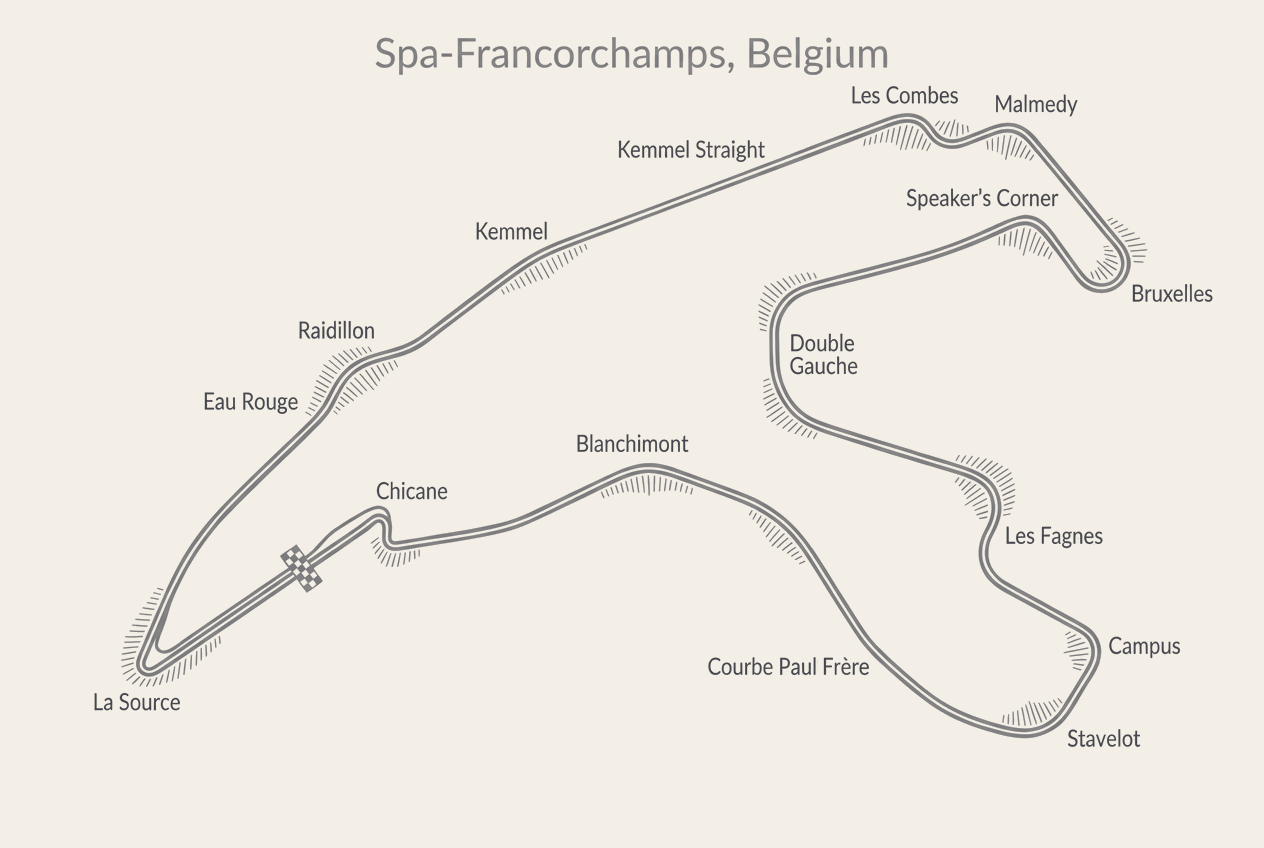
Lewis Hamilton served a five-second penalty at Spa for opening-lap contact with George Russell at Les Combes, an incident that beached the Mercedes in the gravel and ended Russell's Belgian Grand Prix before it started. Seven laps later the same corner produced a second collision, between Charles Leclerc and Oscar Piastri, and that one drew no action at all. The stewards published written reasoning for both, and in each case the criterion they named was where the overtaking car's front axle sat.
The panel, which included Pedro Lamy as driver steward, found Hamilton "wholly at fault for the collision" and then reduced the penalty anyway. Their account is that Hamilton experienced understeer through the corner, applied corrective steering in an attempt to avoid Russell, and made contact with the right-hand side of the Mercedes with his left-front wheel. Russell, they determined, remained within the available racing room.
Three mitigating factors brought a ten-second penalty down to five. Hamilton acknowledged Russell's presence, attempted to leave appropriate racing room, and made what the stewards called a genuine attempt to avoid contact. The collision was attributed to a loss of front-end grip rather than an aggressive or deliberate manoeuvre, and it happened on the opening lap, where reduced grip and compressed racing conditions are recognised as a distinct circumstance. No penalty points were assessed. Hamilton disagreed with the finding, telling reporters that "it was a racing incident, so I don't think there should be a penalty for that."
Lap eight, same braking zone
Piastri and Leclerc were fighting for third down the Kemmel Straight when Leclerc defended under braking and forced the McLaren around the outside, the gap closing until the two cars touched. The stewards recorded that Piastri had achieved some overlap but that his front axle was not ahead of Leclerc's, and that from that position there was no realistic possibility of completing the overtake. They also determined that Leclerc did not deliberately crowd Piastri off the track, describing him as following the normal racing line and moving slightly left to open up the corner, with side-to-side contact resulting from where both cars happened to be.
"I don't really know where I was supposed to go," Piastri said afterwards, contesting a decision he objected to on precedent rather than on what it cost him. "I'm not saying it needed to be a penalty necessary, but at least a black and white flag or something like that. Because if we think that that's fine, it's one thing having touches like that, but even just the incentive of knowing that you can leave everyone the absolute bare minimum space and get away with it, that's not the nicest place to be." Andrea Stella made the same argument about a defending car needing to leave room, and put a number on what the contact cost: floor damage worth two to three tenths a lap, which forced Piastri to overwork his tyres early in the stint and left him with heavy degradation later. He finished fifth, passed by Hamilton at Les Combes on lap 40.
Whether it is one rule
Ben Anderson, on The Race's post-race podcast, argued that the two verdicts cannot both follow from the same principle. His reading is that the stewards "treated it like the straight is the outside of the corner" and in doing so applied a rule that belongs further round at Les Combes, "kind of where Russell was with Hamilton." His conclusion was blunt: "To me they do not apply the same."
Valentin Khorounzhiy and Edd Straw took the same view from different angles. Khorounzhiy said he did not understand the explanation and pointed out that Piastri's tyre was firmly on the white line, so the McLaren was not somewhere it had no right to be. Straw called the decision ridiculous and set out a general principle against it: "As a general rule, if you're on a straight and someone is doing something to you when you are driving straight, on a straight, that requires you to move out the way, they are in the wrong in every case, because otherwise, racing doesn't work." Both characterised the move as crowding, which is precisely what the stewards' decision said it was not. Straw expects the point to be raised in a future drivers' briefing.
Leclerc's own account was narrower. "Luckily, it didn't have any consequences for either my race or his race," he said, having finished second, 1.9s behind Kimi Antonelli and 17s clear of Piastri. The objections to the other verdict ran the opposite way: Russell said Hamilton carried more of the blame but called it a racing incident and did not think a penalty was warranted, and Fred Vasseur went further, calling the five seconds "mega harsh" on the grounds that Russell had space to his left. Two verdicts, four objections, and not one of them from a driver arguing that the calls were consistent with each other.
Mercedes drew a practical conclusion from the lap-eight contact while the race was still running. The incident prompted the team to warn Antonelli about Leclerc squeezing cars on the outside of Turn 5, and Antonelli went on to make the pass that won him the grand prix. The warning was a response to the driving, not to a verdict.
Hungary runs from July 24 to 26. The open question travelling with the paddock is not what the front-axle test says, since the stewards wrote that down twice, but whether a car alongside on a straight can be closed down by a car that has the racing line and the front axle.