
Silverstone is the first high-speed test of the 350kW rules. The problem is that the track barely brakes..
The 2026 Formula 1 power unit recovers almost all of its electrical energy in one place: under braking. Delete the MGU-H, treble the crankshaft motor to 350kW, and the recovery job that used to be shared with the turbocharger now falls entirely on the brakes, as Formula 1's own regulations briefing sets out. That design assumes a circuit will give the car enough hard stops to fill the battery back up.
Silverstone is where that assumption meets one of the least accommodating geometries on the calendar. The British Grand Prix opens on July 3 and runs a Sprint through Sunday July 5, the ninth round of 2026 and the season's fourth Sprint, and it puts the new rules on a track built out of corners drivers barely brake for. The result is a weekend the whole grid arrives at knowing the same thing: whoever manages the battery best on Saturday and Sunday reads their 2026 engine most clearly.
The recovery moved onto the brake pedal
350kW is the figure that reset the arithmetic. The MGU-K jumped from 120kW to 350kW for 2026, close to a trebling, and it now supplies electrical power roughly equal to the combustion engine's contribution rather than the fifth it used to add, per Formula 1's power-unit explainer. Half the car's peak output is electrical, and electrical output is only as available as the battery behind it.
With the MGU-H deleted, the crankshaft motor is the only meaningful recovery device the car has left. The old formula harvested waste heat off the exhaust turbine continuously, whether the driver was braking or not; the 2026 car cannot. Its recovery is tied to the brake pedal, and the regulations lifted the energy a car may harvest under braking to around 8.5 megajoules per lap, roughly double the previous ceiling, precisely because braking is now the whole game.
Recovering that 8.5MJ needs braking events to spend it against. A heavy stop from high speed dumps a large slug of kinetic energy into the MGU-K in a second or two; a fast, lightly braked corner returns almost nothing. The engineering, framed by analyst Craig Scarborough as a return to the harvest-hard, deploy-hard logic of 2009-era KERS, works cleanly at a stop-start circuit. It works badly where the corners are quick.
Deployment fills the other half of the ledger, and the rules made it generous. A driver within a second of the car ahead can call a manual override that holds the full 350kW out to 337km/h, an overtaking tool the old formula never carried. The catch is that the override draws on the same battery the brakes are supposed to fill. Spend it down one straight and the charge has to come back before the next, which at a low-harvest circuit means the car takes it out of lap time somewhere else.
Why Silverstone is the wrong shape for it
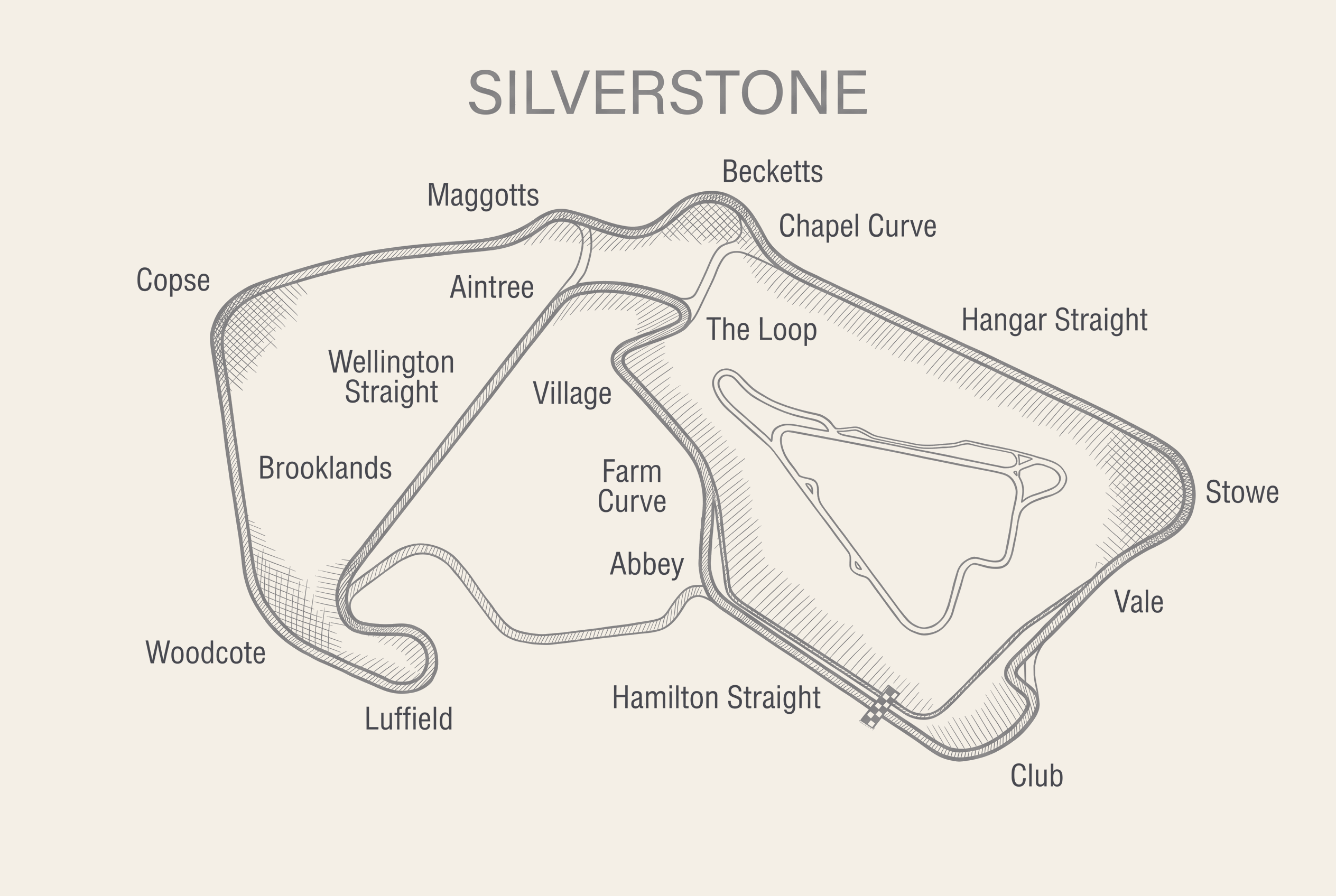
Copse arrives at roughly 290km/h and the 2026 cars are expected to take it with little more than a lift. It is the first corner after the startline sequence, and it returns almost no energy to the battery, because a corner taken near-flat is a corner with no braking event to harvest. The lap has begun by spending speed the car cannot bank.
Maggotts, Becketts and Chapel follow as one flowing sequence, and they stage the problem in the open. Cars flick left-right-left through direction changes at well over 250km/h without a real brake application, then fire onto the Hangar Straight. A driver reaches one of the longest full-throttle demands on the lap with a battery that the preceding corners did nothing to refill.
Only a handful of Silverstone's corners brake hard enough to harvest meaningfully: the Village complex at Turn 3, Brooklands at Turn 6, Stowe at Turn 15 and the Vale chicane before Club. That is a thin recovery budget for a lap that asks for full 350kW deployment down the Wellington and Hangar straights and out of the final corner onto the pit straight. The Silverstone recharge guide lays the mismatch out plainly: the layout gives the car more places to spend energy than to collect it.
Contrast that with a stop-start layout and the design makes sense again. A circuit like Montreal or Baku strings long straights between heavy braking zones, so every deployment down a straight is followed by a hard stop that refills the battery for the next one. The 2026 rules were written for that rhythm. Silverstone breaks it by chaining its fast corners together, so the car spends charge through Maggotts and Becketts and gets almost nothing back before the Hangar Straight asks for all of it.
Lift-and-coast is the symptom you will see
Drivers have already delivered their verdict on the 2026 energy rules, and it is not warm. Across the opening rounds they described the management as "annoying" and "sad" and took to lifting off the throttle early to let the MGU-K recover, trading lap time now for deployment later. That behaviour is mild at circuits with long braking zones. Silverstone is where it turns severe.
Max Verstappen previewed exactly how severe. After a simulator run at the circuit on the 2026 car he said he "just started laughing," a reaction he shared through GPFans, the laugh of a driver watching the tool refuse to behave the way instinct wants. A four-time champion treating a sim lap as a joke is a useful tell: the deployment map the engineers hand him for Silverstone will ask him to lift where he has spent a career flat.
Lifting and coasting is the fix and the tax at once. A driver eases off before a straight ends so the MGU-K can claw back charge, and the car crosses the line having given up top speed to buy electrical energy it could not harvest under braking. At a low-harvest track the lift comes earlier and costs more, which is why Silverstone will separate the engines that budget their energy well from the ones that arrive at Hangar with the battery already flat.
Harvest, not deployment, sets the ceiling here. Every 2026 car can push 350kW down a straight; the question is whether it collected enough under braking to have 350kW to push. At most circuits the two roughly balance over a lap. Silverstone tilts the balance toward spending, so the constraint that decides the lap is not how hard a car can deploy but how little it managed to recover through corners it took nearly flat, and that is the variable a driver cannot solve with bravery alone.
The Sprint doubles the read
Saturday adds a second race to score. Silverstone runs the Sprint format for the first time since the inaugural 2021 event, paying points 8-7-6-5-4-3-2-1 to the top eight, which hands the paddock two competitive race stints on the same low-harvest layout inside two days. Two data sets, one circuit, and the first high-speed sample of how each 2026 unit rations its charge.
One practice session is all the teams get to prepare it. The Sprint timetable gives a single hour of running on Friday before qualifying locks the cars into parc ferme, with Sprint Qualifying following that lone session on Friday afternoon. Teams therefore commit their deployment maps for a track they have never run under these rules on 60 minutes of data, and a map that guesses the harvest wrong leaves a driver coasting where a rival is still pulling. The format compresses the learning curve at the exact circuit least forgiving of a bad guess.
Ferrari is the case to watch hardest. Its combustion engine was rated more than four per cent off the benchmark under the ADUO ruling, and Lewis Hamilton reported being six tenths down in a straight line in Austria on energy that "tails off," a deficit Paddock Notes traced through the Austrian weekend. Silverstone's long full-throttle runs are exactly where a car that cannot hold deployment gets found out, and the contrast against Mercedes and the Red Bull Ford unit down Hangar will show whether the problem is the engine or the way the team spends its battery.
The line back to the road
Regenerative braking is the piece of this that leaves the paddock and reaches a driveway. A road EV recovers energy the same way the 2026 MGU-K does, by turning the motor into a generator under braking and storing the result, and the engineering question is identical in kind: how much of a stop can you capture before friction brakes waste it as heat. Formula 1 kept the half of its hybrid that maps most directly onto production electric cars and built a season around managing it.
What Silverstone tests, a commuter EV faces on an open motorway. A car that rarely brakes recovers little, so range and deployment depend on planning the energy rather than the throttle, the same discipline the 2026 grid is now learning in public. The British Grand Prix runs July 3 to 5, and the number to watch is not pole position but who reaches the end of the Hangar Straight still pulling, and who lifted at the corner before to get there.