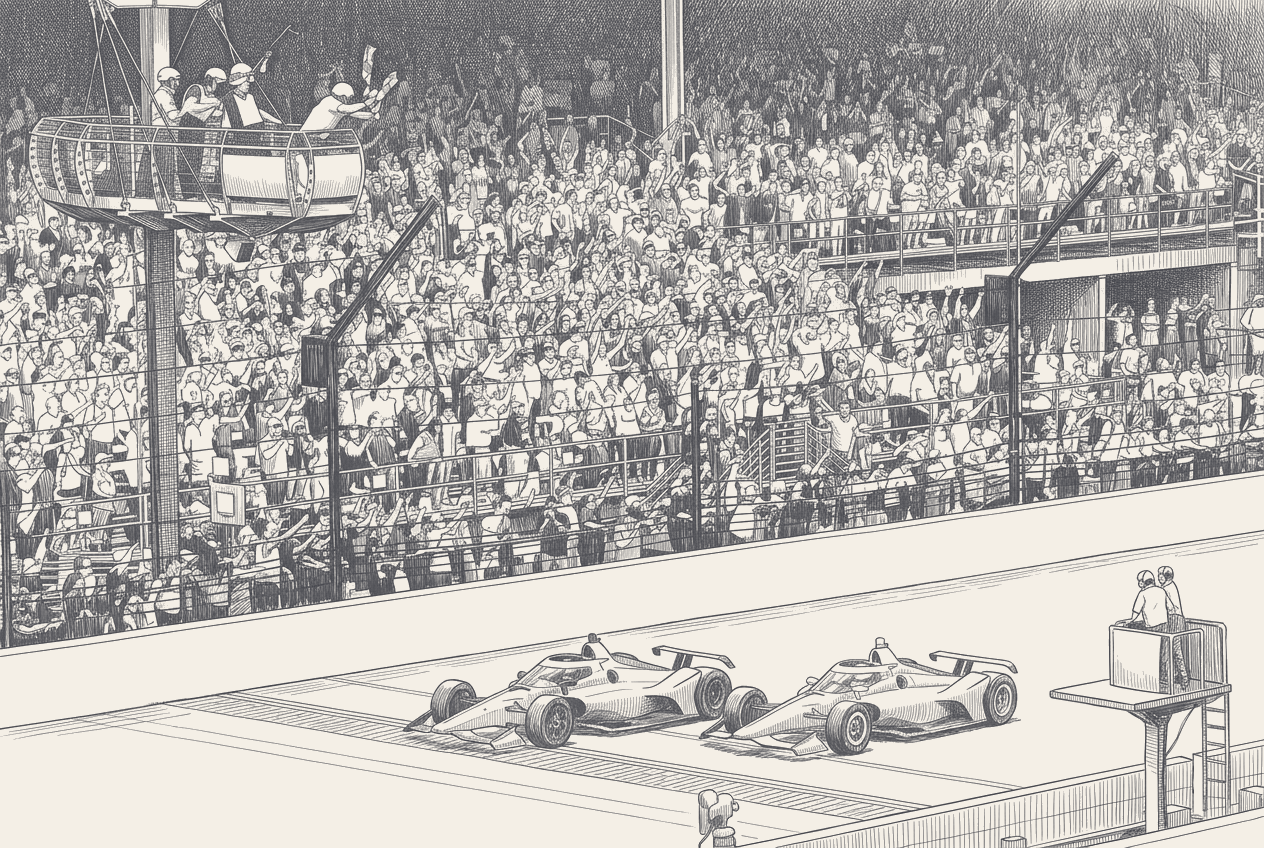
Felix Rosenqvist won the Indianapolis 500 by 0.0233 seconds, breaking the 1992 record. He is the first driver to win both a Formula E race and the 500.
Felix Rosenqvist beat David Malukas by 0.0233 seconds on the run to the chequered flag at the 110th Indianapolis 500. Per the Indianapolis Motor Speedway communication on the result, the margin surpasses the 1992 Al Unser Jr over Scott Goodyear finish of 0.043 seconds, the prior record, and is the closest in the race's 110-year history. Rosenqvist's win is the second Indy 500 victory for Meyer Shank Racing in five years. It is also the first time the winner of an Indianapolis 500 has previously won a Formula E race.
Rosenqvist's career reads as a sequence of pivots away from rooms that had stopped offering him a seat. He won the FIA Formula 3 European Championship for Mucke Motorsport in 2015 and did not graduate into a Formula 2 seat through the conventional academy-funnel route. He raced in Super Formula in Japan instead, took the 2016 series runner-up spot, and built the rapid-formula CV that the F1 academy programmes did not pay to develop. Mahindra Racing signed him in Formula E for the 2016-17 season, where he finished the championship as Rookie of the Year and took Mahindra's first Formula E race win at Berlin. His Formula E career closed in 2019 with a move to IndyCar through Chip Ganassi Racing, where he was the 2020 series runner-up to Scott Dixon at his first attempt and stayed inside the IndyCar paddock through Arrow McLaren and now Meyer Shank Racing for 2026.
The Formula 1 paddock did not produce a seat for him at any point in that arc. The Formula E paddock did. The IndyCar paddock did.
What the F2-to-FE-to-Indy pathway looks like in 2026
The pulse is not new. The 2026-05-22 PN read on Pepe Marti's Monaco ePrix podium (placeholder, to-be-linked at publish) framed the F2-to-Formula-E pathway as a 2026 graduation route for a driver without an F1 academy badge. Rosenqvist's Indy 500 is the Formula-E-to-IndyCar continuation of the same pattern, viewed across a longer timescale. F2 graduates of the 2020-2025 cycle who could not find an F1 seat have at least two routes the academy funnel does not curate: Formula E for the European paddock, IndyCar for the North American one.
What the audience saw
The F1-side audience tracked the result thinly. The /r/FormulaE community thread on Rosenqvist's result ran at 173 upvotes; the thread's framing was the cross-discipline first, not the on-track margin. The /r/formula1 reaction to the Russell DNF at the Canadian Grand Prix captured the F1-side attention surface of the Sunday. The Indy 500 finish, the closest in the race's 110 years, did not produce a comparable post on the F1 sub.
The pulse files from the last two months produced the Verstappen Nordschleife 24 cross-series sell-out frame (placeholder, to-be-linked at publish), the Marti Monaco ePrix podium frame, and now the Rosenqvist Indianapolis 500 frame across three separate disciplines inside thirty days. The third data point is the one that turns the pattern into a pipeline question.
What it changes
It does not, immediately, change the F1 academy funnel. The Red Bull, Ferrari, Mercedes, McLaren, and Alpine junior programmes will keep cutting and signing F2 graduates on the F1-conventional criteria they have used since 2015. The change is downstream. The F2 graduates currently being shut out of F1 will know, by Monday morning, that the discipline-crossing route their predecessors used produced an Indianapolis 500 winner and a record-margin finish at the 110th running of the race. The 2026 F2 grid carries five rookies in its top eight. The fastest two of them, in any season, will probably not graduate to F1. They will graduate to something. The Rosenqvist arc is now an option with a current-year datum at the top of it.
The next Formula E round is Sanya on June 20.