Austria is the first high-altitude race of the no-MGU-H era. Honda says the turbocharger will feel the missing motor..
Honda trackside chief Shintaro Orihara used the team's Austrian Grand Prix preview to name a problem most of the grid will only meet once it shows up in the data. At the Red Bull Ring, he warned through GPFans, the thin mountain air forces the turbocharger to work harder than at almost any circuit on the calendar, and the 2026 rules have removed the single component that used to help manage that. "We no longer have the MGU-H to assist the turbocharger, which may make it more challenging to operate both the turbocharger and the engine correctly at high altitude," Orihara said, adding that Honda "may see a deficit here to other PU manufacturers."
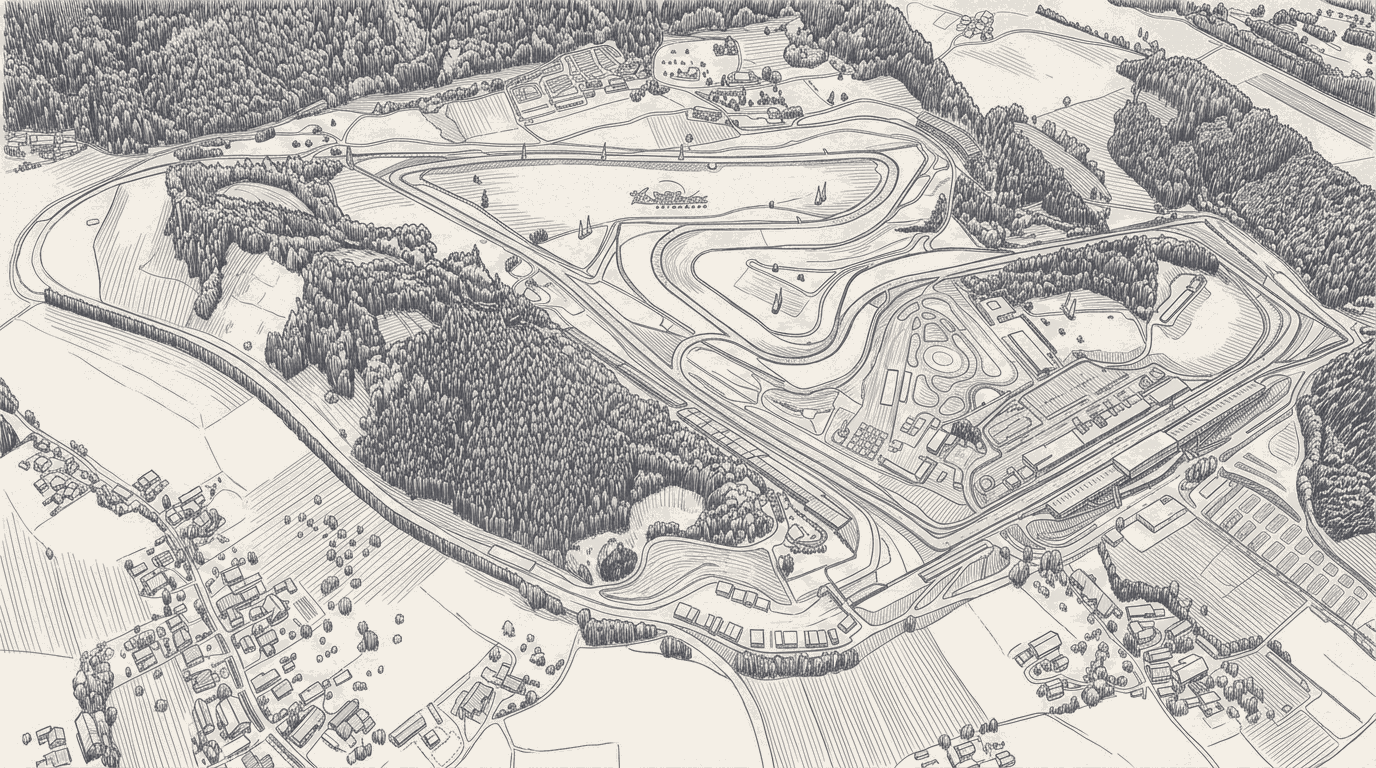
That warning lands on June 26, when Formula 1 opens round eight at a track it has never raced under the current power-unit formula. The Red Bull Ring sits 677 metres above sea level, roughly 2,200 feet. Spielberg has always thinned the air enough to cost downforce and complicate cooling. This is the first time the grid arrives there with no MGU-H to lean on, which turns a familiar altitude quirk into a live question about the new engines.
What the missing motor actually did
The MGU-H joined Formula 1 with the V6 turbo-hybrid formula in 2014, and it sat where few fans ever saw it: on the turbocharger shaft, between the exhaust-driven turbine and the compressor that feeds the engine. Its first job was recovery. Exhaust gas that would otherwise be wasted spun the turbine, and the MGU-H harvested the surplus as electrical energy. Its second job mattered more on a day like Austria. The same motor could drive the turbo, spinning it up before the exhaust had built enough flow to do it alone.
Engineers now have to keep the turbo spinning another way. Technical analyst Craig Scarborough, writing for Motorsport Technology, notes the MGU-H held the turbocharger above 100,000rpm, which all but eliminated the lag between a driver asking for power and the turbo delivering it. Take the motor away and that lag returns, unless an engine builder finds another route to keep the compressor wheel up to speed.
Those routes exist, and none is free. Burning fuel in the exhaust to spin the turbo is the classic anti-lag trick, but the 2026 rules cut the race fuel allowance by roughly a third, so torching fuel to manage a turbo is a luxury no team can spend on race day. Holding the throttles open on a closed throttle, what engineers call cold blowing, helps but costs efficiency. Shrinking the turbine and compressor so they spin up faster trades away top-end headroom. Every fix is a compromise the MGU-H used to make disappear, and the Red Bull Ring exposes the compromise where it hurts, through a layout of slow corners feeding long uphill drags where a turbo even a beat behind the throttle bleeds time lap after lap.
Why thin air is the exam, not the lecture
Altitude is where all of that stops being theory. Air at 677 metres is measurably less dense than air at sea level, and a turbocharged engine cares about mass of air, not volume. To deliver the same charge to the cylinders, the compressor has to spin faster and push harder to pack thinner air to the target pressure. That is precisely what Orihara means when he says the turbo has to work harder at Spielberg.
A power unit that can summon electrical help on the turbo shaft barely notices the extra demand. The 2014-to-2025 cars had exactly that help, and altitude rounds passed without anyone flagging a turbo problem, because the MGU-H simply spun the compressor to whatever speed the thin air required. Remove it, and the engine has to find that extra turbo speed through exhaust energy and engine mapping alone, in conditions that already give the turbine less to work with.
Honda's caution, then, is specific rather than vague. It is not saying its engine is slow; it is saying the one variable that altitude stresses, turbo response, lost its dedicated electrical assistant under the new rules. Track temperatures near 35 degrees Celsius, forecast across the weekend as Europe's heatwave holds, only stack a cooling load on top of the same components.
Aston Martin, not Red Bull, carries the Honda engine into Red Bull's home race in 2026, the works relationship having moved to Silverstone for the new rules. Red Bull instead runs its own first-year Red Bull Ford Powertrains unit. So two of the grid's freshest power-unit projects meet Spielberg's altitude as relative newcomers, and one of their engine partners has already said out loud that the thin air plus the missing MGU-H could cost it.
Half of a 2026 power unit does not care about any of this. The MGU-K's 350kW is electrical, drawn from the battery, and a battery is indifferent to air density; it delivers the same shove at 677 metres as at sea level. That is the quiet cushion under Honda's warning, since close to half of the car's peak output is altitude-proof by design. It is also what concentrates the problem. Whatever deficit the thin air opens falls entirely on the combustion-and-turbo half of the engine, the precise half the 2026 rules stripped of its electrical helper.
The trade Formula 1 chose to make
Dropping the MGU-H was a deliberate decision, not an oversight, and the reasoning is worth holding next to Honda's warning. The component was expensive, fiendishly complex, and, as Formula 1's own regulations briefing put it, it never produced especially large gains for the cost of mastering it. Cutting it lowered the barrier to entry for new manufacturers and simplified the hardware everyone has to build.
What the rules gave back, they routed through electricity instead. The 2026 MGU-K, the motor geared to the crankshaft rather than the turbo, jumps from 120kW to 350kW, tripling its output, while the combustion engine's contribution falls from around 550kW to 400kW. The result is close to an even split between electrical and combustion power, against roughly 20 per cent electrical in the old formula. Scarborough frames the swap as a return to the simpler KERS philosophy of 2009: harvest hard under braking through the MGU-K, deploy hard down the straight, and stop trying to reclaim heat from the exhaust.
Recovery is what made the heat motor expendable. Energy harvested under braking doubles to around 8.5 megajoules per lap, and a driver within a second of the car ahead can call on a manual override that holds the full 350kW out to 337km/h, an overtaking aid the previous formula never carried. Formula 1 judged the lap time it could bank through a bigger MGU-K worth more than the heat it would forfeit by deleting the MGU-H. Altitude management was not the scenario that calculation was built around.
Six manufacturers signed up to build under those terms, including Honda, Audi and the new Red Bull Ford Powertrains project. The trade they accepted was real power moved to the rear axle and a cleaner rulebook, in exchange for losing the device that quietly handled the turbo.
The road-car turbo that went the other way
The electrically assisted turbocharger did not die when Formula 1 wrote it out of its rules; it moved onto the road. Supplier Garrett Motion, which built turbo hardware through F1's hybrid era, developed a production electric turbocharger that Mercedes-AMG put into the 2022 C43, the first series car to carry one. The idea the paddock once dismissed as too exotic for road use found a showroom before the rules that birthed it ran out.
Garrett's road unit does almost exactly what the MGU-H did. A slim 48-volt electric motor, about four centimetres thick, sits on the charger shaft between turbine and compressor and spins the turbo to as much as 170,000rpm, holding boost even when the driver lifts or brakes. The goal is the one every turbocharged engine chases: the response of a small turbo with the top-end of a large one, and no lag in between. Road performance cars adopted that solution in the same window Formula 1 discarded it.
That divergence captures the race-to-road story of the 2026 rules, and it runs against the usual direction of travel. A showroom e-turbo suggests the concept was sound and only F1's implementation was too costly to keep, a more interesting verdict than the component having simply failed. Formula 1 held onto the half of the hybrid that transfers most cleanly, the high-output MGU-K and braking recovery that map onto road EVs, and discarded the half that production engineering had just shown it wanted.
Austria runs on June 26 to 28, and the variable to watch is narrow. Listen for whether Honda's customer cars, Aston Martin among them, give back lap time through the long uphill drags out of Turns 1 and 3, where a turbo fighting thin air has the most ground to lose.