Ford's first F1 podium since Fisichella at Interlagos 2003, on a chassis Ford does not own, after a 23-year gap that the 2026 PU regulation rewrote.
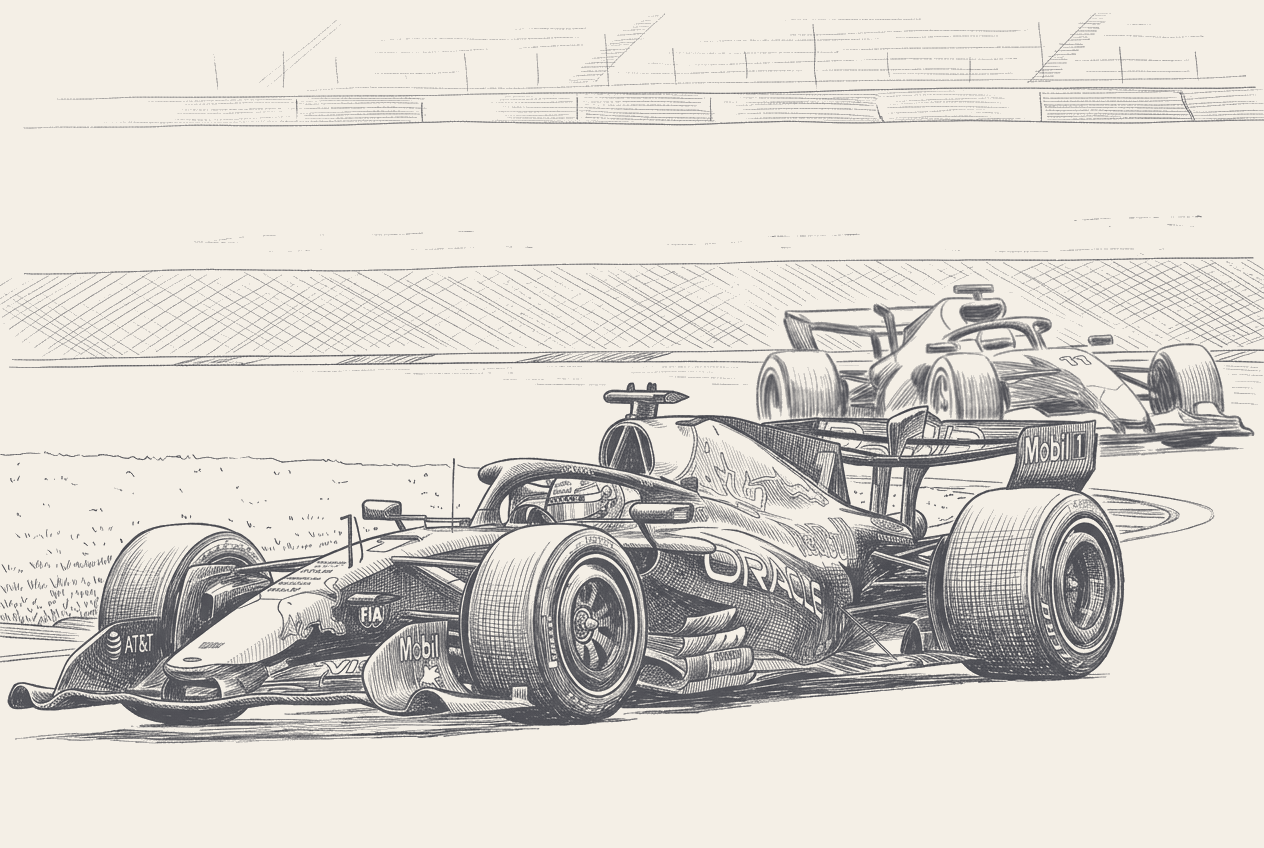
Max Verstappen converted P6 on the Canadian Grand Prix grid to P3 at the flag, holding Lewis Hamilton at a 0.508-second average gap for 21 laps before yielding into the Turn 1 lapwise undercut on lap 62 of 68. The classification carries no asterisk; the result is the first F1 podium for the Red Bull Ford Powertrains engine programme in its fifth race of the 2026 PU regulation. Per RACER's Monday Ford celebration piece, it is also the first F1 podium carrying the Ford name on the result sheet since Giancarlo Fisichella's wet Sunday at Interlagos on April 6, 2003. Per Ford Authority on the same Monday Mekies briefing, team principal Laurent Mekies framed the result as historic in the team's own words: "To claim our very first podium with our own PU, in only its fifth race, is truly a historic moment, especially when you consider the pedigree and experience of our competitors."
"Red Bull Ford Powertrains" is not the same shape of manufacturer arrangement that the Ford-Jordan Cosworth combination represented in 2003. The 2026 PU regulation, finalised by the FIA in 2022 and published as a new technical regulation for the first time since 2014, opened a window for new manufacturer entrants under a redefined cost-capped allocation. Red Bull, having spent the back end of the V6 era as a Honda customer through the HRC operating arrangement, used that window to register a wholly-owned engine programme at Milton Keynes and to bring Ford in as a co-developer under a multi-year strategic partnership that retained Red Bull's IP control. The chassis is Red Bull's. The bodywork carries Ford branding on the engine cover and the rear wing endplate. The result sheet at the Canadian Grand Prix carried "Red Bull Ford Powertrains" as the power-unit attribution. That is the form the Ford name has now returned in.
The 23 years between Fisichella and Verstappen are not an arithmetic line
Giancarlo Fisichella won the 2003 Brazilian Grand Prix in a Jordan-Ford EJ13 in wet conditions. Per The Race's account of the chaos, the stewards brought out the red flag just as Fisichella began lap 56 of a planned 71-lap distance. Race control had logged the race as ending on lap 55, which placed the classification on lap 53 (per the FIA's two-laps-before-stop rule) and made Kimi Raikkonen the initial winner. Jordan provided timing data downloaded off the car's ECU showing Fisichella had started lap 56 about 12 seconds before the red flag. An FIA court in Paris on April 11 reawarded the win to Fisichella, with the classification correctly taken from lap 54. The trophy ceremony was held at the Imola paddock the following weekend. Fisichella's Brazil win was the only Jordan victory of the Ford-engine era and the last F1 podium with a Ford name on an engine until Sunday in Montreal. Eddie Jordan's team carried Ford-branded Cosworth power units through 2003 and 2004 before the team folded its operational structure into Midland and then into Spyker.
The 23 years between that wet Brazilian Sunday and Verstappen's Canada third place is not a continuous line. Jaguar Racing, Ford's own factory team, withdrew from F1 at the end of 2004 after five seasons that produced no podiums. Per Firstsportz on the published terms, Ford sold the operation to Red Bull in late 2004 for a published one US dollar on the condition that the buyer absorb the operational cost base Ford had been carrying (the figure widely cited at the time was around $400 million in run-rate commitments over three years). That operational entity became Red Bull Racing for 2005. The Ford name disappeared from F1 result sheets at the same moment. Cosworth, the Northampton engineering company that had carried the Ford branding through the V8/V10 era as a customer supplier, withdrew from F1 at the end of 2013 ahead of the 2014 V6 hybrid switch, the economics of which were unworkable for an independent specialist. The 2003 Brazil podium is the last F1 result with a Ford name in the published power-unit field before the 2026 Canadian Grand Prix.
Three distinct FIA power-unit regulation sets sit between Fisichella's 2003 podium and Verstappen's 2026 one. The 2.4-litre V8 era ran from 2006 to 2013 on engine-frozen development. The 1.6-litre V6 hybrid era ran from 2014 to 2025 with Mercedes, Renault, Ferrari and Honda as the only homologated manufacturers across the 12 seasons. The 2026 PU regulation, designed across the 2022-2024 working-group window, reset the V6 hybrid architecture to a roughly equal split between ICE thermal output and MGU-K electrical output, removed the MGU-H entirely, and opened the homologation window for new manufacturer entrants for the first time since the 2014 switch. The actual return on that policy intent has so far landed two names on the 2026 grid: Audi, which absorbed the Sauber chassis and runs its own works programme; and Ford, which sits as the named co-development partner on the Red Bull chassis without taking on the chassis-side investment. Audi runs a full works programme. Ford pays Red Bull for engine-cover branding on a power unit Red Bull owns.
What Mekies's "our own PU" line is actually doing
Per Red Bull's own Canadian GP race report on the team site, Mekies's post-race quote in the team's content carried the same "our own PU" framing the Ford Authority Monday piece lifted. The phrase is the one piece of the 2026 communications strategy that requires careful reading. Red Bull's "our own PU" is the assertion that the team is no longer a Honda HRC customer; the engine in the back of the RB22 is built at Red Bull Powertrains' Milton Keynes facility and runs on a Red Bull-controlled IP base. Ford's co-developer arrangement provides electrification and battery technology under the same multi-year deal that puts Ford branding on the engine cover. The "Red Bull Ford Powertrains" attribution is the published combination. Mekies's verbal frame, "our very first podium with our own PU," elides the Ford-side technology contribution into the Red Bull-side IP claim, which is a corporate communications move that has been the team's consistent positioning since the 2023 partnership announcement.
The reason that elision matters is the 2026 ADUO monitoring window 1 cycle. Per PaddockNotes' own May 20 deep-dive on the AduO classification at the Canadian GP, the FIA's first ADUO window 1 closed at Round 5 with three published candidates for a +2% or +4% performance allocation: Audi PU fire-rate, Aston-Honda vibration patterns, and Red Bull Ford ICE deficit. The Red Bull Ford candidacy had been the most-covered of the three through the Imola-and-Canada window, with Verstappen on the public record across both rounds describing straight-line speed in negative terms. A podium in the fifth race of the 2026 PU regulation is a counter-argument against an ICE-side ADUO designation. It does not remove the question. It puts the answer in the FIA's filing tray with the May 25 race-time data attached, and that is the document the technical group will read against the Audi and Aston-Honda candidates when window 1 is formally classified at the back end of the Spanish-Austrian build.
The cultural line that Mekies's quote frames against the Fisichella 2003 anchor is more interesting than the technical one. Red Bull Ford Powertrains is the only 2026 entrant whose power-unit attribution carries a non-Red-Bull manufacturer name without the chassis-side investment that historically came with it. The Audi works model brings the entire factory programme. The Mercedes works model has run a continuous customer chain since 2014. Ferrari has run a Maranello-build PU since the V8 era. Red Bull Ford Powertrains is the first new template the 2026 regulation has delivered, where an OEM returns to an F1 result sheet by co-developing a power unit on a chassis platform it does not own. The Fisichella 2003 anchor is the publication's bookend; the more interesting bookend is the 2004 Jaguar sale that produced this chassis platform in the first place. Ford left F1 by selling its chassis programme to Red Bull for one dollar. Ford has returned to F1 by paying Red Bull to put Ford branding on the engine.
What the 2003 Fisichella podium does not transfer
The Mekies-Fisichella anchor has a piece of risk attached. Fisichella's Brazil win was a wet-race inheritance, a result that came in the FIA's review tray and a finish that the Jordan team had not been positioned to take in dry conditions on a normal Sunday. The Jordan-Ford EJ13 was a customer-engine chassis on a customer-engine platform that had finished sixth in the 2002 Constructors' and would finish ninth in 2003. The 2026 Red Bull Ford Powertrains podium is a wholly-owned IP chassis with a co-developed power unit, on a manufacturer cost-capped allocation the 2025 Red Bull was not subject to, in dry conditions at a circuit where the team's race pace matched Mercedes through the first stint and dropped through the medium-tyre window. The result is a converted P6-to-P3 finish on a circuit that has not historically rewarded conversion.
The 2026 Red Bull Ford Powertrains is the regulation's first design experiment in OEM co-development without chassis-side investment. The design experiment is not yet complete; the fifth-race podium is the first data point that it is producing results inside the manufacturer-cost-capped envelope.
The Monaco fortnight is the test of whether the line holds
Verstappen sits seventh in the Drivers' Championship on 26 points entering the Monaco fortnight, 23 points behind Isack Hadjar in fifth and 88 points behind Antonelli at the top of the table per yesterday's daily brief. The numerical title fight is not the question the Canadian podium opens. The question the Canadian podium opens is whether the 2026 Red Bull Ford Powertrains chassis package can repeat the Round 5 result inside the next four rounds. The May 24 community pulse logged the audience reading: the Red Bull Racing "Reunited on the podium" gallery on r/formula1 carried 19,834 upvotes and read the result as a 23-race podium drought broken (Verstappen had not stood on a Red Bull podium since the 2025 Abu Dhabi GP). The Mekies "our own PU" frame is the team-comms response to that audience read. The Ford Authority lift of the Fisichella line is the OEM-comms response. The fortnight between Canada and Monaco is the first window in which both readings are tested against the next on-track result.
The Monaco circuit is also where the 2003 Fisichella line collapses as a comparable. Jordan's 2003 Monaco GP, two weekends after Brazil was reawarded, produced an eighth place for Fisichella and a retirement for Ralph Firman. The customer-engine package did not transfer from Interlagos's wet inheritance to Monaco's qualifying-decides-the-race profile. Verstappen goes into Monaco on the record per Motorsport.com on the Saturday set-up disagreement that the team had overridden his chassis-side feedback in Canada. Set-up will decide Monaco. The Ford-branded engine cover will not.
What the 23-year gap between Fisichella and Verstappen actually rewards is the 2026 PU regulation that opened the window for a Ford-named OEM to take a co-development position on a chassis it does not own. The policy intent (attract OEM re-entry under a manufacturer cost cap) has produced one new manufacturer at the works level (Audi) and one new co-development manufacturer at the partnership level (Ford); only the second has now scored a podium in the regulation's first five races. Round 7 in Spain is the next test of the package.