Finland's 200th WRC win came at home, and one of the original Flying Finns was at the stop line to meet it.
Ari Vatanen was standing at the stop line of the Himos-Jämsä Power Stage on August 2, waiting to greet Sami Pajari as the young Finn brought his Toyota GR Yaris in. Vatanen won the World Rally Championship in 1981, one of the original Flying Finns whose names still function as shorthand for a certain kind of gravel driving. Pajari is 24, and he had just sealed his home rally. The greeting was the story before the result was, because it is the clearest picture the sport produced this year of one generation handing something to the next.
Pajari's win was Finland's 200th in the World Rally Championship, the country's milestone victory landed at the one event where it would mean the most. His maiden win in Estonia a fortnight earlier had been the 199th, and this made him the 14th different Finn to win Rally Finland in the championship era. Those are countable facts, not sentiment. The Flying Finn idea gets dismissed as a marketing line, but it has a ledger, and Pajari just wrote the round number onto it.
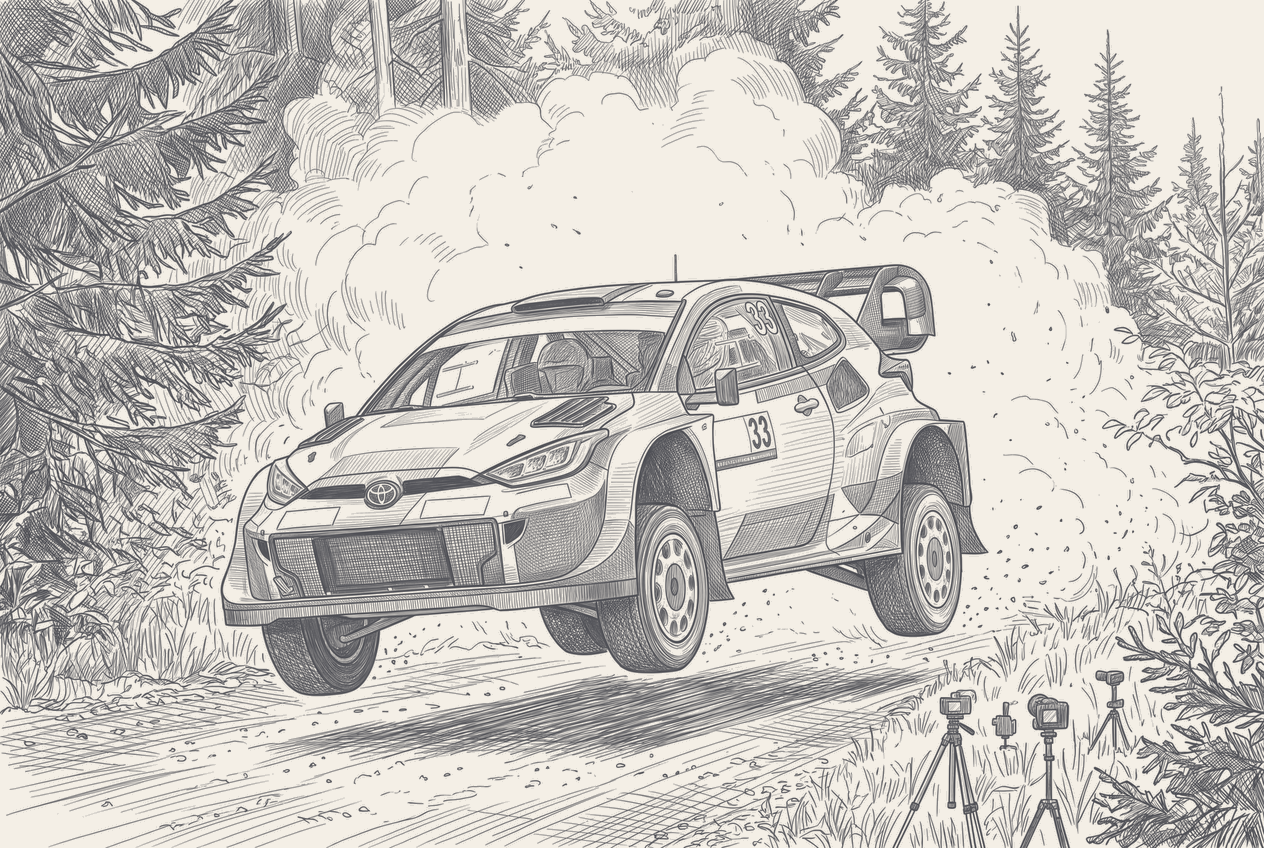
Rally Finland is the one round on the calendar where a home winner still moves the national needle. The gravel is the fastest the championship runs, the jumps are the ones every rally fan can name, and it is the event Finnish drivers have historically owned. Pajari beat Toyota team-mate Oliver Solberg by 26.7 seconds, with championship leader Elfyn Evans third to complete a Toyota one-two-three on home soil. A Finn winning here is not the same as a Finn winning anywhere else, and the crowd that pushed Evans's rolled car back onto the road on Saturday knew exactly which result it wanted.
Fourteen different Finns have now won Rally Finland in the championship era, which is also why the 200th national win landed here rather than anywhere else. A country that produces home winners at that rate on its own fast gravel was always the likeliest to reach a round number on the roads outside Jyväskylä. The milestone and the venue are close to the same fact stated twice: Finland makes rally drivers, and this is the event where they are counted.
Kalle Rovanperä, the last Finn to win Rally Finland, was not in the field. The two-time champion left the WRC for Super Formula, saw a medical issue postpone that campaign, and is now declared fit with a competitive return targeted for 2027. The seat at the top of the sport that a Finn is expected to fill has been vacant all season, and the significance of Pajari's weekend is partly that he won the home round while its most recent holder is watching from another category on another continent.
Consecutive WRC wins by a Finn had not happened since Rovanperä took Poland and Latvia in 2024, and Pajari has now matched it with Estonia and Finland. Add Rovanperä's 2025 home victory to Pajari's this year and Finland has back-to-back Finnish winners of its own rally for the first time since Jari-Matti Latvala in 2014 and 2015, per DirtFish. The lineage is not a feeling. It is a pair of measurable streaks that had lapsed and just restarted inside a month.
Pajari inherited the lead on Saturday afternoon when Sébastien Ogier crashed out of first place, then carried a 46.4-second overnight margin down to the 26.7 he finished with. That reads like a gift, and it was not one. Ogier and stand-in co-driver Julien Ingrassia walked away and were cleared by precautionary checks, and Pajari then held the front with a string of stage-winning runs on Sunday rather than nursing a lead he had been handed. Winning the home round from the front, on the fastest gravel there is, is the version of this result that earns the Vatanen handshake.
WRC resumes with a South American double-header, Rally del Paraguay from August 27 to 30 and Rally Chile from September 10 to 13. Pajari leaves Finland 30 points behind Evans with four rounds left, per RACER's post-event standings, so the question of whether this is a changing of the guard or a good fortnight gets its next answer far from the forests he grew up on.