The rule says what the rule says: Marquez's Jerez pit-entry win and the MotoGP regulation that did not stop him.
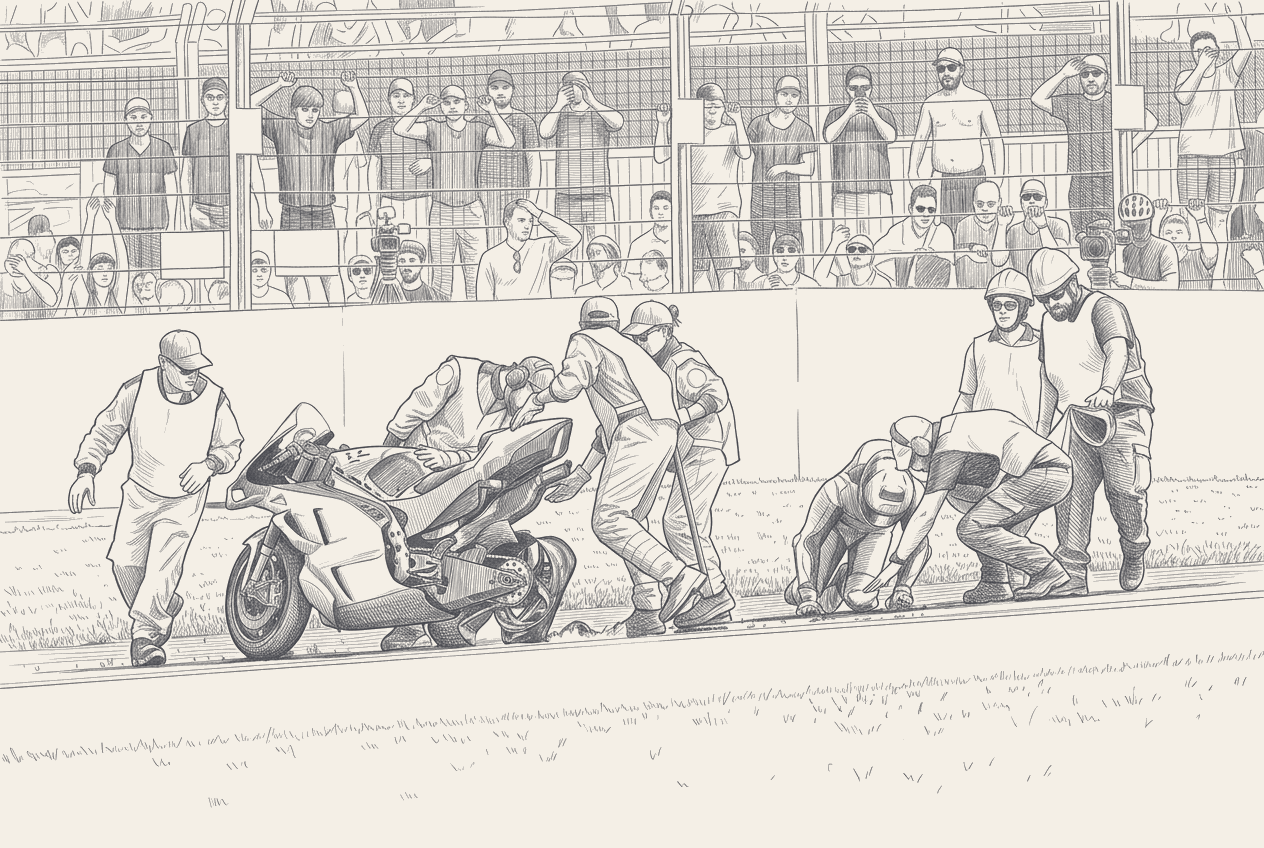
The MotoGP Spanish Grand Prix sprint at Jerez ran in mixed conditions on the afternoon of April 25. Marc Marquez crashed his Ducati GP26 at Turn 13 with six laps to go, the rain intensifying. He picked the bike up. Instead of returning to the racing line and continuing, he cut across the outside grass and tarmac and entered the pitlane to swap to his wet-set bike, then rejoined the race and won the sprint by riding through the field on grooved tyres while half the grid pitted for the same swap a lap later. He took no penalty. Johann Zarco's reaction, "He shouldn't win," anchored a Reddit thread that cleared 695 upvotes and 276 comments, the heaviest comment-to-upvote ratio on r/motogp this season.
The rule the stewards applied, and the one fans expected to apply, are not the same rule. The gap between them is the next four weeks of regulation pressure on the FIM ahead of Le Mans.
What the regulation actually says
The MotoGP pit-entry definition lives in Article 1.21 of the 2026 FIM Grand Prix Regulations. The article specifies that pit entry occurs at a timing-line marker, the same kind of magnetic-loop detection point used to measure sector splits. The marker sits at the conventional pit-entry slip-road throat. The article does not specify that a rider must cross any particular section of the track to reach the marker. It does not specify a single physical path. It defines an event, the crossing of the timing line, and what happens after that crossing has registered.
Autosport's explainer post-incident was the cleanest articulation of the steward decision. The regulation describes pit entry as the moment the timing line registers the rider. Marquez's GP26, after the Turn 13 incident, traversed the outside grass run-off and the tarmac apron at the pit-entry throat, and crossed the timing line as defined by the regulation. There is also a separate provision banning the crossing of the inside white line at pit entry, which constrains the geometry of the slip road itself but not the geometry of the approach. Marquez did not cross the inside white line. The slip-road geometry he respected. The approach geometry the article does not regulate.
The community read of the gap was sharp. The line that won the r/motogp thread, from a user identified as saintcrazy, was "the rule says what the rule says, but the rule should not say what the rule says." That is the joke-of-the-week packaging on a real argument, and the argument is correct. Pit-entry definition by timing point alone has been adequate for a decade because no rider in the modern era had attempted to cross the timing line from a non-conventional approach. Marquez's incident is the first time that approach has been pressure-tested in a championship round.
Why the regulation reads the way it reads
The timing-point definition is inherited from the F1 and World SBK pit-entry conventions of the 1990s. Both championships migrated to magnetic-loop detection because the previous physical-line definition had produced ambiguous calls when riders or drivers strayed off the apex of the slip road. A magnetic loop is unambiguous: either the transponder crossed it or it did not. The regulation drafters in 2003 wrote the pit-entry article around the unambiguous detection event, on the assumption that the conventional slip-road geometry would always be respected because there was no plausible reason to do otherwise.
Two changes since 2003 broke that assumption. The first is that pit-stop tyre changes in MotoGP, originally a feature of long-distance races, became a routine sprint-race contingency once the championship's flag-to-flag wet rules were extended to Saturday formats in 2024. The second is that the run-off geometry at modern circuits, including Jerez Turn 13, has been resurfaced in tarmac rather than gravel in the post-2018 safety push. A rider going down at Turn 13 in 2003 lost time and possibly the bike. A rider going down at Turn 13 in 2026 stands the bike up on grippable tarmac, looks at where the pitlane geometry sits, and discovers that the slip-road timing line is reachable from a path the regulation has not contemplated.
That is the structural read on Marquez's no-penalty. The regulation's definition was written for a different incident profile and has not been updated to track the run-off geometry it now coexists with. The stewards applied the rule as written. The fans read the rule as intended. Both reads are coherent. They simply describe different rules.
What the FIM can change before Le Mans
The French Grand Prix at the Bugatti Circuit runs Sprint Saturday May 9 and Race Sunday May 10. Le Mans is a circuit defined by first-gear corners, hard braking and rear traction. It has a long pit straight and a conventional pit-entry slip road. The relevant question is whether Marquez or any other rider can run a similar approach at Le Mans and produce the same result. The geometry says yes. The pit-entry timing line at Le Mans sits at the conventional throat, and the run-off at the final turn before the pits is full tarmac. A crash at the final corner with race-tyre damage and a rain front incoming could plausibly produce a Marquez-pattern recovery into the pits.
The FIM has roughly four weeks. The two routes available are a clarifying interpretation, posted as a stewards' notice, that defines the conventional approach as part of the pit-entry definition for the duration of the 2026 season; or a regulation amendment for 2027 that rewrites Article 1.21 to specify both the timing line and the approach corridor. Stewards' notices have been used twice in the modern MotoGP era to address mid-season interpretation gaps, including the 2019 long-lap-penalty clarification and the 2022 cooling-air-vent definition. The procedural template exists. Whether the championship reaches for it before Le Mans is a political question, not a regulatory one.
The political question is whether the FIM is prepared to absorb a second Marquez-shaped incident and the precedent it would set, or whether it would prefer to issue a clarifying notice that closes the gap. A second incident at Le Mans, with a different rider, on a different bike, and a different beneficiary, is the worst outcome for the championship's regulation credibility. The Marquez incident has been read as a Marquez incident; a second one would be read as a regulation incident.
The three lines of damage
There are three pieces of regulation credibility currently in motion. The first is the no-penalty itself, which is now in the public record and cannot be reversed without a procedural overturn the championship has not signalled. The second is the comment thread, which has produced a coherent fan-side argument that the rule needs to be redrafted, and which the FIM will read in the standard ways. The third is the rider-side response, anchored by Zarco's "He shouldn't win" line. Zarco is a former premier-class podium-finisher and a credible voice; his framing is the rider-paddock pressure point the FIM cannot dismiss as media noise.
The same week Marquez crashed out of the Sunday race itself, 475 upvotes and 193 comments, so the controversy is now decoupled from the championship-points headline. The argument is purely about regulation text, not about race results. That is the cleanest possible context in which to address the gap, because the championship can make a redraft without it reading as a rebalance of points already on the board.
What Paddock Notes will track at Le Mans
Three signals at Le Mans will tell us whether the FIM has moved. First, a stewards' notice posted in the Friday morning briefing pack, addressed to all riders, addressing pit-entry approach geometry. Second, the absence of such a notice paired with explicit Race Direction commentary on the broadcast acknowledging the Jerez precedent. Third, no public statement at all and a wait until the post-race steward bulletin if a similar incident occurs. The third signal is the worst. The first is the cleanest.
The Marquez sprint result stands. The points are recorded. The rule the stewards applied is the rule on the regulation page. The question is whether Article 1.21 reads the same way at Le Mans on May 8 as it did at Jerez on April 25, and the FIM has the next four weeks to decide that question without a fresh test case forcing the answer.