A 50-minute meeting at Balaton settled MotoGP's next five years, and the bill lands in the garage.
At 9am on Sunday at Balaton Park, in the offices of MotoGP Sports Entertainment Group, the manufacturers' association convened for roughly 50 minutes and settled the commercial and operational shape of grand prix racing through 2031. Motorsport.com's account of the meeting lists the room: Gigi Dall'Igna and Mauro Grassilli for Ducati, Takahiro Sumi and Paolo Pavesio for Yamaha, Mikihiko Kawase and Alberto Puig for Honda, Jens Hainbach and Pit Beirer for KTM, Massimo Rivola for Aprilia, plus Biense Bierma, the man who carries the manufacturers' position into Grand Prix Commission votes.
Two linked decisions came out of that room and the meetings around it. The commercial half is a framework agreement governing 2027 to 2031, built on a fixed annual payment rather than the revenue share the manufacturers originally pushed for. The operational half removes one of each rider's two bikes from Friday and Saturday practice, shortens sessions, and adds a personnel curfew. The first half is the headline. The second half is where the money actually moves, because the one-bike rule began life as a bargaining chip in the negotiation that produced the first.
The fee that replaced the share
On June 8, Motorsport.com reported that the MSMA manufacturers and MotoGP SEG approved a framework commercial agreement running 2027 through 2031, with an option extending to 2036. Instead of an F1-style share of championship revenue, the parties settled on a fixed annual sum of about 8 million euros split across the categories. Ratification is scheduled for the Czech Grand Prix at Brno, and GPOne reported an official announcement is expected there. The option through 2036 deserves as much attention as the headline term, because it tells you who wanted what: a promoter planning a decade of investment sought cost certainty on the longest horizon available, and got it.
A fixed fee buys the manufacturers certainty and costs them upside. Under a revenue share, Liberty Media's growth in MotoGP would have flowed proportionally into the factories' racing budgets; under a flat number, every incremental dollar the promoter adds to the championship's top line stays with the promoter. That arithmetic explains why cost reduction, not revenue, became the manufacturers' lever in the talks. If the income side is capped, the spending side is the only variable left to negotiate.
Negotiating posture was never really in doubt on the other side of the table either. "The manufacturers already have riders and bikes for 2027; they're just negotiating," Carmelo Ezpeleta said back in May, in comments carried by GPOne. Nobody in the room at Balaton was deciding whether to race from 2027. The meeting decided on what financial terms, and the answer turned out to be terms that make the garages, not the commercial-rights account, the place where the saving gets found.
One bike, and the spare goes in the truck
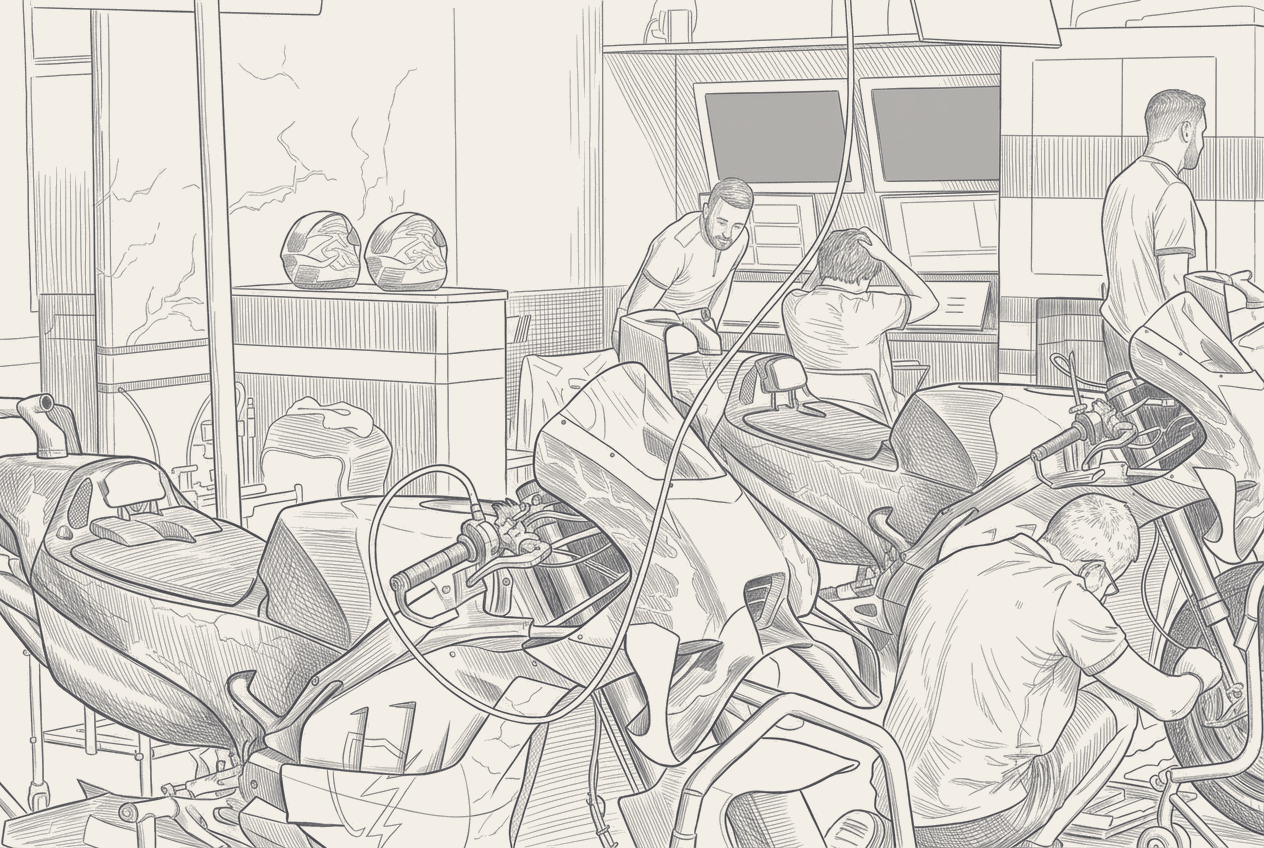
From 2027, each rider runs a single bike in practice, Motorsport.com reported on June 9, with the second machine kept out of use until technical inspectors release it, inspectors understood to be appointed by IRTA. Sprints and grands prix retain two bikes, which preserves flag-to-flag swaps in mixed conditions and means a first-corner pile-up on Sunday still meets a garage holding a spare for every rider. The same incident on a Friday could park its rider for the rest of the session, until the spare clears inspection. Shorter practice sessions and an F1-style curfew limiting working hours travel in the same package, all of it pending Grand Prix Commission approval.
Roughly 1.5 million euros per team is the savings estimate attached to the measure, according to executives consulted by Motorsport.com, drawn from two areas: smaller staffing requirements and lower accumulated mileage on the prototypes. The spare would not leave the team's possession. It would sit at the back of the garage or inside the transporter, visible to nobody, working for nobody, until the rulebook lets it out.
The proposal's origin matters more than its mechanics. Manufacturers first floated the one-bike idea as leverage in the commercial negotiation, the same report notes, with cost reduction presented as the central argument. Teams left Mugello with a verbal consensus, a Thursday meeting at Balaton running past three hours consolidated it, and the Sunday session formalised it. A device invented to extract a better commercial deal survived the deal's conclusion and became policy on its own.
The development bill comes due in 2027
"From a development perspective, it would double the time needed to evaluate new parts," a KTM engineer told Motorsport.com on condition of anonymity. "At the moment, if we receive a new swingarm or chassis, we fit it to one bike and compare it directly against the other. With only one machine available, that process becomes much longer and far less efficient."
Timing is the problem inside that quote. The 2027 season is not a continuity year. Engine capacity drops from 1000cc to 850cc, the season engine allocation falls from seven to six per rider, fuel tanks shrink from 22 to 20 litres, the grid runs 100 percent non-fossil fuel, and aerodynamics come under tighter control, per motogp.com's published 2027 framework. Every factory will arrive at every 2027 weekend with unproven hardware and questions to answer, and the back-to-back comparison that answers those questions fastest will have been regulated out of the garage.
Nor is this the Grand Prix Commission's first cut in the same direction. The GPC banned MotoGP wildcards outright from 2027 in its April round of updates, removing the test riders' race outings that factories historically used as rolling development sessions. Less machinery, less track time, fewer parallel data streams: the championship is converging on a leaner operating model from several regulatory angles at once, in the exact season its technical variance peaks.
An engineering constituency for the cut does exist, and fairness requires naming it. Fewer practice kilometres ease the squeeze of the six-engine allocation, and a curfew spares mechanics the all-nighters that the current two-bike rebuild culture demands of them. The objection from inside the garages is not that the savings are imaginary. It is that the rule extracts them from the development programme in the one season when development is the championship.
Liberty's contradiction
Since acquiring MotoGP in 2025, Liberty Media has run a growth strategy aimed at expanding the series' global audience and maximising the on-track product. Motorsport.com's analysis lands on the contradiction directly: it is difficult to reconcile that objective with a regulation that removes half the machinery from public view for most of the weekend.
A rider who falls in FP1 under the proposed system could sit out the rest of the session while the spare clears inspection, which means less running for the riders fans bought tickets to watch and less exposure for sponsors who, as the report puts it, negotiated their agreements under very different assumptions. The race-day exemption protects the Sunday product. The Friday and Saturday product, the part of the weekend the promoter sells to broadcasters and ticket-holders across three days, absorbs the full cost.
Sponsorship is where the operational rule loops back into the commercial deal. A title partner buys a season of visibility calculated on two liveried machines per garage and a rider who returns to the track after a crash; the new framework quietly halves the first number on practice days and conditions the second on an inspection queue. Motorsport.com's report raises the prospect of commercial partners revisiting agreements struck under the old assumptions. The factories' 1.5 million euros of annual savings has a counterparty, and the counterparty has lawyers.
Two weeks to Brno
MSMA members reconvene by video conference on Wednesday, and Motorsport.com expects the agenda to cover the remaining details, curfew hours and restrictions on which personnel can touch the bikes, rather than any reversal. The Grand Prix Commission, the four-party body where MotoGP SEG, the FIM, IRTA and the MSMA each hold a seat, still owns the formal vote, since the measures touch the technical regulations. Most teams already regard passage as highly likely, despite what the same report describes as significant reservations inside the garages; the manufacturers who would cast the dissenting argument are the parties who proposed the rule.
Ratification also opens a door the rider market has been leaning on all spring. With the framework approved, Motorsport.com listed the dominoes now expected to fall: Marc Marquez's Ducati renewal, Pedro Acosta's promotion to the factory Ducati team, Fabio Quartararo's move to Honda, Jorge Martin's switch to Yamaha and Francesco Bagnaia's arrival at Aprilia, all reportedly agreed and waiting on the commercial certainty the Brno signing provides.
So the Czech Grand Prix on June 19 to 21 now carries three threads at once: a signature on the fee structure, the first formal step toward the one-bike weekend, and the opening of the 2027 silly season in public. Watch the order in which they land. If the announcements arrive together, the package was always one negotiation, and the bike at the back of the transporter was its price.