Monaco's resurfaced Turn 19 came apart under the cars, and it was not the only new surface that misbehaved this weekend.
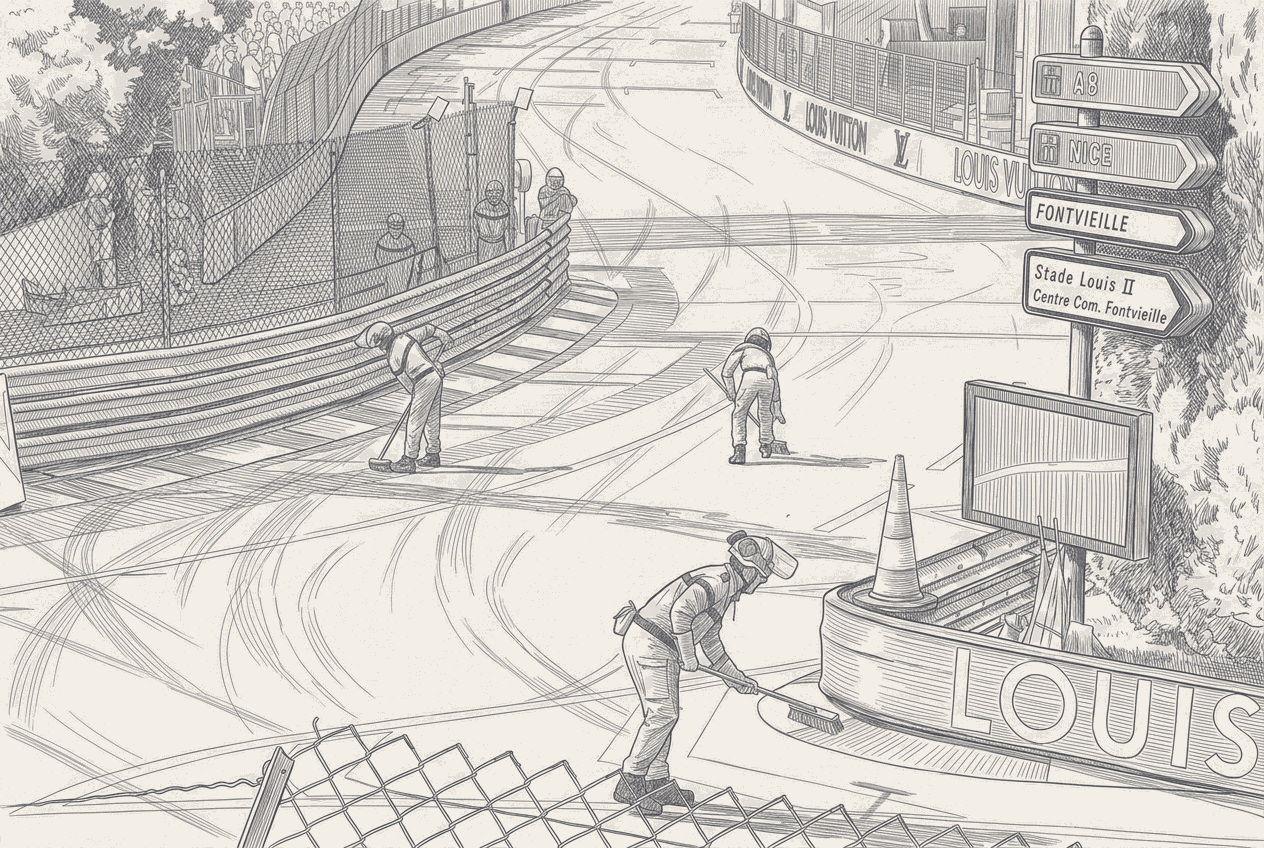
On lap 68 of 78, the Monaco Grand Prix stopped under a red flag, as Crash.net reported, after the newly resurfaced asphalt at Turn 19 began breaking apart under the cars. Lance Stroll hit the wall there first. Charles Leclerc went off at the same corner on the safety-car restart, a sequence The Race tied directly to the failing surface. The FIA suspended the race to inspect what its own report called track break-up at the final corner, then confirmed Kimi Antonelli's win only after temporary repairs and a restart.
A newly laid track surface can fail in two opposite directions. It can stay slick, because fresh bitumen-rich asphalt offers little grip until months of traffic and weather scrub the binder off the stone and expose the aggregate a tyre keys into. Or it can come apart, because the new layer bonds to the one beneath it only as well as its compaction and curing allow, and a corner that loads the surface hard finds any weakness in that bond. Monaco got the second failure on Sunday. At Balaton Park in Hungary, MotoGP spent the weekend fighting the first.
Monaco: the surface came apart
Turn 19 was relaid over the winter, and it is the worst corner on the lap to get wrong. The final turn feeds the cars onto the pit straight under power, loading the new surface with traction and lateral force at once, the exact combination a weak bond cannot take. Crash.net reported the red flag came on lap 68 after Stroll and then Leclerc crashed at the corner, and RacingNews365 captured Leclerc's fury at ending his home race in the wall again, his point on the radio being that the failure felt mechanical rather than a mistake of his own. A driver error and a disintegrating corner leave the same picture, a car in the barrier, and only one of them is the circuit's to answer for.
The FIA did not abandon the race; it patched it. Officials laid temporary repairs at Turn 19 and restarted, confirming Antonelli's win on the resumed race. That call carried its own risk: a surface that had already failed once got a full field sent back over a repair laid in minutes. The alternative, abandoning a points-paying grand prix at its blue-riband round, is the pressure every such decision runs against, and it is the reason the standard a surface meets before the start matters more than the repair after it fails.
Balaton: the surface would not grip
At Balaton Park, the resurfaced Turn 1 drew an official start warning over what riders called zero grip, Crash.net reported, before a wheel had turned in anger. Marc Marquez crashed at that corner on his first flying lap in qualifying and still took pole; Fabio di Giannantonio fell at the same place minutes later, per Crash.net's qualifying report. In the grand prix the same Turn 1 caught Jorge Martin under braking, and The Race recorded the front-end loss that took down four other riders. The failure mode was the inverse of Monaco's, too little grip rather than a loss of integrity, but it traced to the same line in the works schedule: a corner resurfaced and raced on within months.
A licensed circuit is not the same as a proven surface
Both venues are licensed to host. Formula 1 runs only on tracks holding an FIA Grade 1 licence, and MotoGP on circuits the FIM homologates, processes that certify a layout, its barriers and its run-off. What those licences do not visibly cover is the case both corners presented this weekend, a surface relaid after homologation and re-accepted on a test the public never sees. The cars and the bikes found the gap between a circuit that is certified and a surface that is new.
Two responses, one omission. The FIA stopped the Monaco race to inspect Turn 19; MotoGP's officials warned about Balaton's Turn 1 and ran the grand prix regardless. What neither produced was an account of how a relaid surface gets tested and signed off before cars run on it, and by whom. A circuit decides when to resurface and which contractor lays it; a championship decides whether to race on the result. Neither series put the join between those two decisions on the record, which is the join that failed twice.
Why it lands hardest at Monaco
Monaco's surface failure dropped a physical data point into the oldest argument on the Formula 1 calendar, the one about whether the race still earns its place, which Crash.net had already laid out as a case for and against and RacingNews365 sharpened into a question about axing it. The timing carries its own irony: Formula 1 extended Monaco's contract to 2035 last year, so the loudest version of that argument now attaches to the one circuit locked in for another decade. The verdict that matters next is narrower than the calendar. It is whether the FIA publishes a cause for the Turn 19 break-up, and a standard that stops a relaid corner failing under load again, before Barcelona's surface gets loaded on June 12 and Brno's on June 21.