Monaco becomes the first 2026 circuit with zero straight-mode zones, leaving overtake mode the only active-aero lever on the calendar's slowest lap.
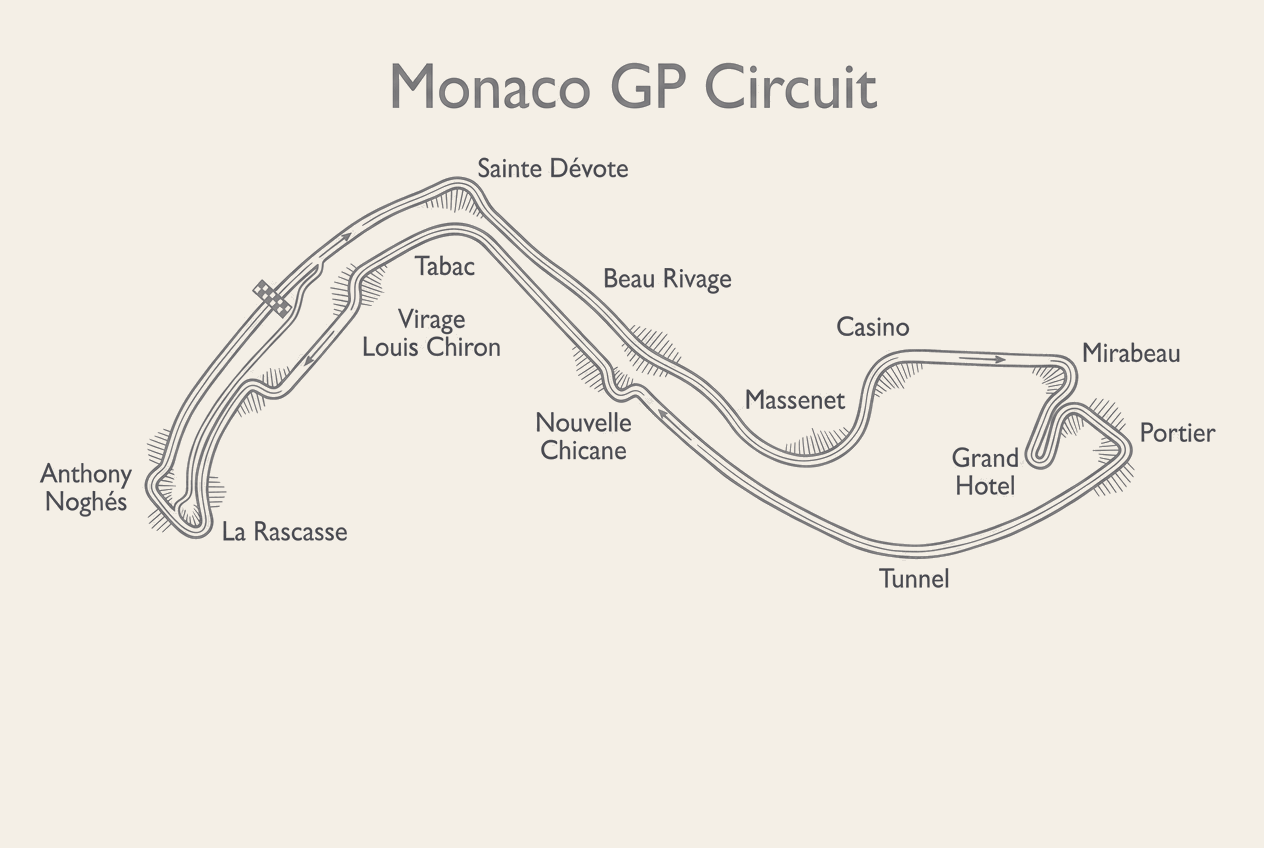
F1's published layout for the Monaco Grand Prix carries zero straight-mode zones, the first track on the 2026 calendar to show none. The Canadian Grand Prix, run two weekends earlier, carried three. Per GPFans' May 28 report on the published Monte Carlo layout, drivers retain only an overtake-mode detection sequence entering Turn 17, La Rascasse, and approaching Turn 19, Anthony Noghes. The absence of a low-drag zone is not an oversight. It states plainly what the season's new active-aero package does, and does not, do on a circuit where the longest flat-out stretch is the run from the tunnel exit to the Nouvelle Chicane.
Two levers, and Monaco gets one of them
Under the 2026 regulation, DRS is gone, replaced by two distinct tools that the Monaco layout now separates cleanly. The first is active aero. Both front and rear wings move: corner mode keeps the flaps closed to hold downforce through a turn, and straight mode opens them into a low-drag setting at pre-defined points on the lap before the car re-enters corner mode to brake. Per Motorsport.com's explainer on the 2026 active-aero system and Formula 1's own beginner's guide to the regulations, the key change from DRS is that straight mode is available to every car at every designated zone on every lap, not only to a chasing driver inside a one-second gap.
The second lever is overtake mode, and it is the one Monaco keeps. Per ESPN's breakdown of the 2026 terminology, a driver within one second of the car ahead can deploy extra electrical energy, the season's replacement for the old DRS overtaking effect. Unlike DRS, overtake mode is not locked to a fixed activation zone; a driver can spend it in a single burst or spread it across a lap. The Monaco layout's detection sequence between La Rascasse and Anthony Noghes is the only place on the lap the tool is framed against a fixed reference, and it feeds the one corner pairing that empties onto the start-finish straight.
Why the rule-writers had no zone to give Monaco
Monaco was already the circuit where DRS moved the needle least, and the 2026 package does not change the geometry that made it so. The tunnel-to-chicane straight is the only stretch where a low-drag mode would buy meaningful top speed, and braking into the Nouvelle Chicane arrives quickly enough that the trade between a straight-line gain and corner-entry stability runs against opening the wings at all. Publishing a layout with no straight-mode zone formalises a conclusion the paddock has carried for years: the active-aero rule set adds nothing to overtaking around Monte Carlo, on a lap where the average speed is the lowest of the calendar.
In practice the consequence sits in qualifying. With straight mode absent and overtake mode confined to a window that feeds corners where a pass is already close to impossible, grid position remains the race-deciding variable it has been at Monaco for decades. The community read has already converged on the same point. On r/formula1, the dominant Monaco preview question was how the new formula manifests at the year's hardest circuit, and the framing the audience settled on was blunt: Monaco is not pole-or-nothing, it is top-three-or-miracle. The zero-zone layout is the regulatory confirmation of that framing.
The test case the regulation could not avoid
Sold as the overtaking-focused rule set, the answer to a decade of DRS-trains, the 2026 package meets its hardest venue with the headline tool switched off. The championship arrives with Andrea Kimi Antonelli leading George Russell 131 to 88, Charles Leclerc on 75, Lewis Hamilton on 72, and Lando Norris on 58. Whichever of them converts Saturday into the front row inherits the strongest hand for Sunday.
That is the value of a zero-zone layout. Every other 2026 round has carried at least one straight-mode zone, the test of whether active aero delivers the passing the rules promised. Monaco is the control case: one lever, pointed at a corner pairing where it cannot work. For a regulation written to make overtaking easier, the most instructive round of the European leg may be the one where it was handed nothing to do.