
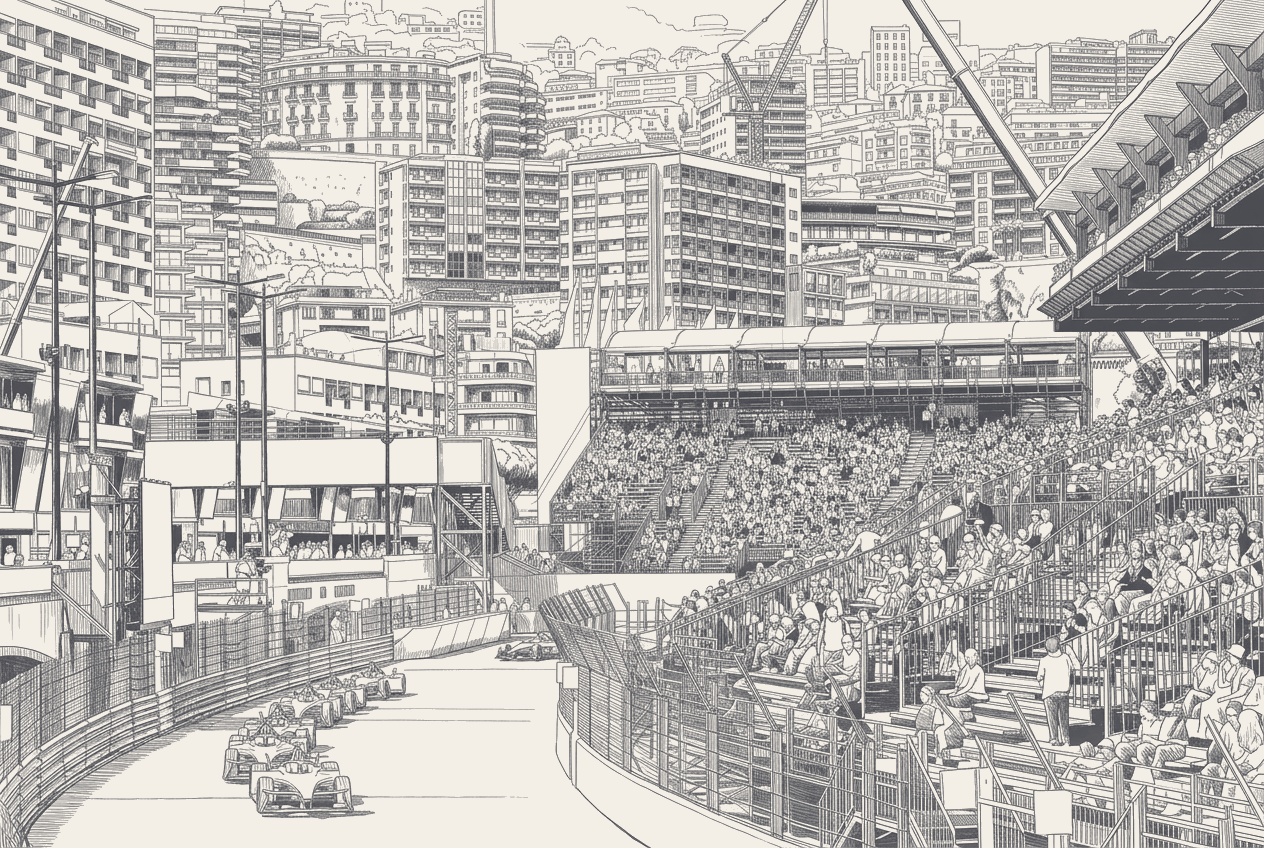
Mitch Evans takes a 19-point Formula E lead out of Monaco, and a 30-day gap before the title fight resumes.
Mitch Evans crossed the line fourth in Monaco Race 2 on Sunday, May 17, and left the principality 19 points clear at the top of the Formula E Drivers' standings. Per the RacingNews365 standings update after the Monaco wrap, Evans sits on 128 points, Oliver Rowland (Nissan) on 109, Edoardo Mortara on 103, and Pascal Wehrlein (Porsche) on 101. Two weeks earlier in Berlin, Evans extended the Formula E all-time wins record to 16 with the Race 2 comeback from outside the points. The Jaguar TCS Racing driver entered Monaco three points behind Wehrlein and left it the first driver in Season 12 to open a multi-race-maximum gap at the top of the standings.
The Monaco numbers, in the order Formula E publishes them
Oliver Rowland took Race 2 on Sunday, per the Motorsport Week race-2 results, with Felipe Drugovich second for his maiden Formula E podium and Antonio Felix da Costa third for Jaguar. Drugovich's Race 2 second is the Brazilian's first Formula E podium full-stop, scored in his rookie full-time campaign with Andretti after his 2025 substitute debut for Mahindra at Berlin. Nyck de Vries won Race 1 on Saturday for Mahindra, per the Motorsport Week race-1 results, his first Formula E victory since Seoul 2022, with Evans second and CUPRA KIRO's Pepe Marti third for the Spaniard's first FE podium from 15th on the grid.
The Marti podium reads as the F2-to-Formula E pipeline's first 2026 conversion. The Campos F2 graduate ran 12 places forward (from 15th on the grid) through energy management and Attack Mode deployments rather than a top-tier qualifying lap; the published Race 1 strategy was CUPRA KIRO's first podium weekend of the Season 12 programme. Marti's teammate Dan Ticktum had been on for the podium himself before a post-race penalty for contact with da Costa dropped Ticktum to 12th, elevating Marti to third.
The Evans-side mathematics is the longer-running read. 19 points is more than a Race 1 maximum (the maximum scoring opportunity is 25 race points, 3 pole position, 1 fastest lap, for 29 total inside a single race). One bad Sanya weekend for Evans plus one good Sanya weekend for Rowland still leaves Evans on top. Two bad weekends in a row, or one zero-score round, is what closes the gap.
Why the standings shape is unusual for Formula E
The Gen3 Evo era has not previously produced a multi-race-maximum gap at the standings top this deep into a season. Across Season 10 (Gen3) and Season 11 (Gen3 Evo year 1), the published championship-leader gap at the round-10 mark never exceeded 12 points. The 2024 Season 10 lead changed five times before Mexico City; the 2025 Season 11 lead changed seven times before Berlin. Evans's 19-point gap is therefore the first time the Gen3 Evo era has produced a meaningful single-driver lead at the round-10 mark of a season.
The structural reason is the Gen3 Evo reliability variance. The Gen3 Evo platform doubled regen capacity over Gen3 (from 600 kW to 700 kW combined regen) and added a redesigned front-axle motor that produced a Season 11 mid-season reliability cycle the published manufacturers (Jaguar, Porsche, Nissan, Mahindra, McLaren, Stellantis customers) all worked through. Season 12 entered with the Gen3 Evo packages in their second full season; the published reliability cycle settled enough to produce one-driver dominance, which is what Evans is converting now.
Jaguar TCS Racing's 2026 architecture is the second structural read. The team enters Monaco with a deep customer-supply share in the Formula E grid (Envision and CUPRA KIRO both run Jaguar I-TYPE 7 Evo hardware); the supply-chain depth produces a published parts-and-software pool that the lead-team's race-day reliability draws on. The Jaguar I-TYPE 7 Evo platform that won Berlin Race 2 in the Evans hands is the same platform CUPRA KIRO ran for Marti's Race 1 podium two weekends later. The lead-customer-supply position is the structural reason a Jaguar driver is the first multi-race-maximum championship leader of the Gen3 Evo era.
The 30-day Sanya gap and what it asks of the title fight
Sanya opens on Saturday June 20, the longest mid-season break on the 2026 Formula E calendar. The 30-day gap between Monaco Race 2 and Sanya FP1 is also the longest break Formula E has run since the Season 5 mid-2018 cycle. The Haitang Bay Circuit has not seen a Formula E car since Season 5 in 2019; the published 2.235-kilometre layout is the shortest race-distance lap on the Gen3 Evo calendar, with a published top-speed estimate of 230 km/h and three published Attack Mode activation lines per race.
The 30-day pause complicates the Evans-Rowland-Wehrlein arithmetic in two directions. The first is testing: the Formula E in-season testing regulation (Sporting Regulations Article 23) caps full-day permitted running at 1 day per team between rounds, with the testing day inside a 5-day window centered on the published calendar. The Sanya 30-day gap therefore opens a single testing window for each team to convert into pace, which Jaguar uses against an effective 19-point head-start the rest of the grid has to chase.
The second is the no-running-data variable. Haitang Bay has not run a Gen3 Evo car. The published Gen3 Evo simulator data the manufacturers have run against the published 2019 lap-time baseline; the no-running-data variable produces a Sanya FP1 timing screen where every car arrives with a simulator-only setup baseline. The team with the largest customer-supply pool (Jaguar) has the most simulator hours available; the team with the most-aggressive single-car development cycle (Porsche) has the deepest simulator-to-track conversion record. The Evans-Wehrlein arithmetic at Haitang Bay therefore reads as a Jaguar-Porsche simulator race that the rest of the grid catches inside the practice sessions.
Pascal Wehrlein, Nyck de Vries, and the second-tier read
Pascal Wehrlein's Porsche position is the published second-tier read. The German manufacturer entered Monaco leading the Teams' championship by 13 points, 176 to Jaguar's 163; Wehrlein left Monaco fourth on 101 after a pointless weekend, one finish outside the points and one DNF. Porsche's Gen3 Evo reliability cycle through Season 11 produced the deepest published in-season Attack Mode usage rate (84% activation completion across 14 rounds), the lever Porsche pulled most aggressively against Jaguar's lap-time consistency. Wehrlein's Monaco package did not convert; the 30-day Sanya window is Porsche's largest in-season testing block of the year and the published recovery point Porsche has to convert into a back-to-back wins block.
Nyck de Vries's Race 1 win is the third-tier read. The Mahindra driver's first Formula E victory since Seoul 2022 runs against a four-year drought; de Vries paired with Edoardo Mortara at Mahindra for 2026 and converted Monaco Race 1 from a published mid-field qualifying lap into a race win. Mahindra's victory ended the Indian manufacturer's roughly five-year win drought; the published Mahindra calendar through Tokyo (Round 14, July 25) is the team's largest in-season points-conversion window of the season.
The fourth-tier read is Oliver Rowland's Race 2 win and Felipe Drugovich's Race 2 second. Rowland's Race 2 conversion (Nissan's first 2026 victory) reads as the structural Nissan answer to a Jaguar-customer-supply dominance pattern; Drugovich's Race 2 second, in his rookie season with Andretti, is the Porsche-Andretti programme's first podium of a year in which the manufacturer's factory side (Wehrlein) has produced a DNF and a single points-finish across the same weekend.
Seven rounds, four standings tiers, one calendar gap
The 2026 Formula E calendar runs seven rounds from Sanya to the London double-header that closes the season. The published double-headers are Shanghai (Round 12 and Round 13, July 4 and 5), Tokyo (Round 14 and Round 15, July 25 and 26), and London (Round 16 and Round 17, August 15 and 16). Sanya is the only single-race round inside the seven-round remainder, which produces 25 race-points-equivalent of single-day exposure inside a single weekend versus 50 race-points-equivalent across each double-header.
The structural reading of the seven-round map against Evans's 19-point lead is that the championship leader needs to bank one more multi-podium weekend before the Shanghai-to-Tokyo double-header pair compresses the calendar. Evans's published Jaguar pace at Haitang Bay is unknown; the 2019 Season 5 Sanya was an Audi-and-Renault Gen2 event with no Jaguar-customer data point. The Jaguar-Mahindra-Cupra customer-supply group enters Sanya with the broadest published telemetry pool, and the Porsche-Maserati-Nissan single-supply group enters with the deepest published single-team simulator runs.
The Monaco wrap therefore reads as the inflection point. Evans converted a record-setting Berlin (16 career wins, the all-time Formula E record) into a record-setting standings lead at the round-10 mark (the first multi-race-maximum lead of the Gen3 Evo era). The 30-day pause is the structural variable the rest of the grid uses, against a championship leader who has not yet shown a published weakness at the round-by-round level of the 2026 calendar.
Sanya, on June 20, is the first round any 2026 Formula E driver returns to with a pre-published standings target inside their own team's published arithmetic. The 19-point gap is the document. The pre-Sanya 30 days is the meeting room. The chequered flag at Haitang Bay is the test.
That is the title fight Evans takes out of Monaco. The 30-day silence between the two is the structural anomaly the rest of the grid has to convert into a points-recovery event before Tokyo's double-header closes the runway.