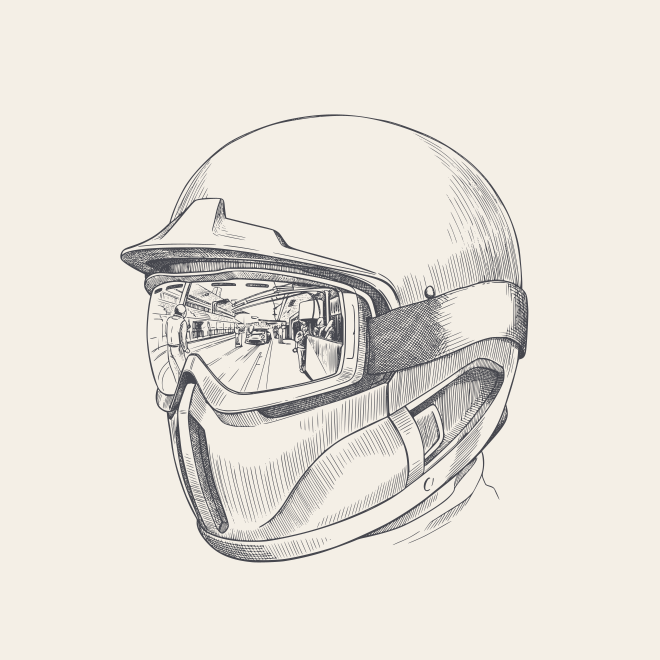
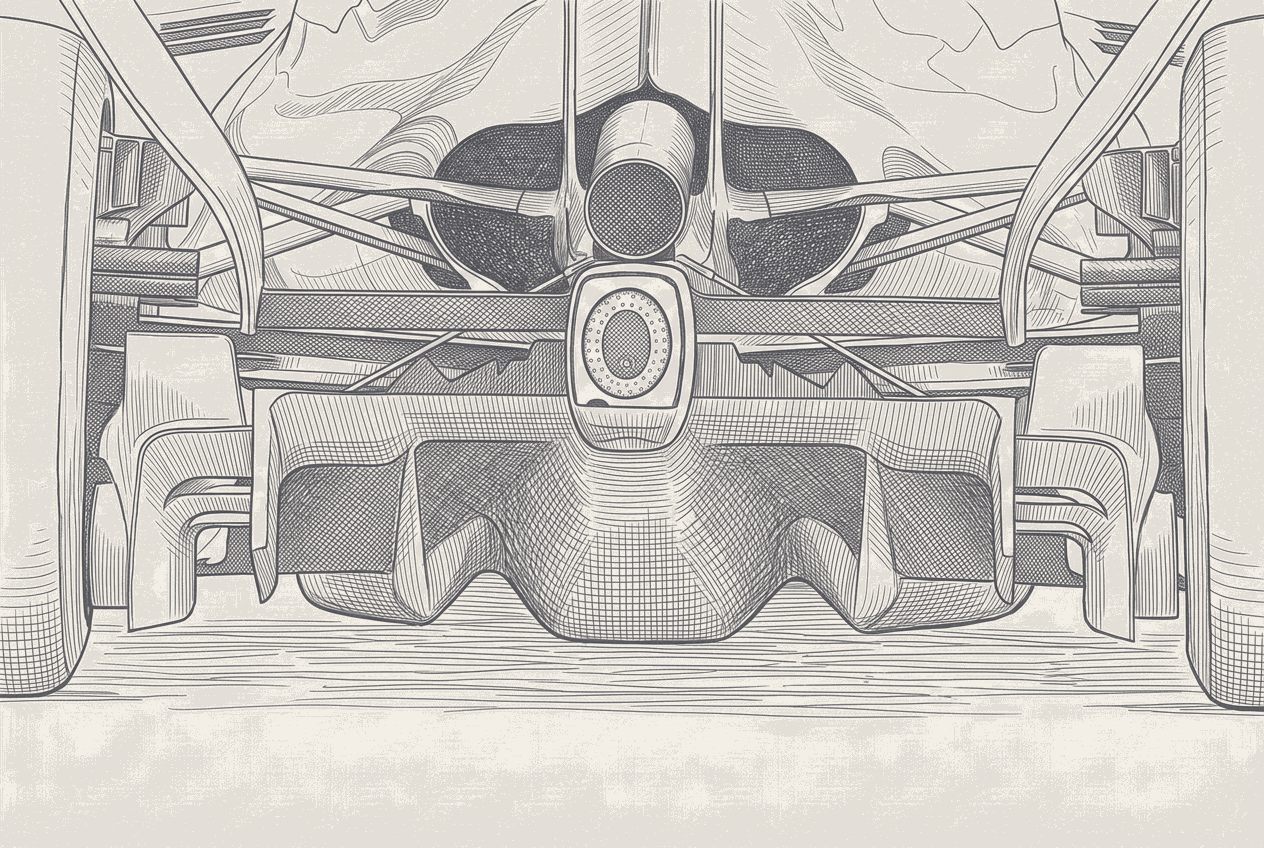
Mercedes put teeth on the W17's diffuser, and no other team on the 2026 grid has tried the idea.
More than half the width of the Mercedes W17's diffuser now carries a serrated upper edge, per Autosport's analysis of the Montreal package, and no other car on the 2026 grid runs anything like it. The same analysis details a second novelty in the same region: an outward-facing deflector on the diffuser's top waterfall element. One team, two unique solutions, on the single most performance-sensitive surface of a ground-effect car. That combination is either a direction the rest of the grid will be copying by August or a detour Mercedes will quietly walk back, and the next two race weekends decide which.
What the teeth are for
Serrations on an aerodynamic trailing edge are separation management. A diffuser works by expanding the airflow under the floor, and the harder it expands, the closer the flow runs to detaching from the surface, at which point the downforce it generates collapses. Autosport's read of the Mercedes design is that the serrated profiles condition how air leaves the diffuser's upper edge, shedding a row of small vortices that keep the boundary layer energized where the expansion is most aggressive. The prize is a diffuser that can be run harder before it lets go, and that degrades progressively rather than all at once when it does.
Stability, not peak load, is the tell for what Mercedes is chasing. A diffuser that stalls abruptly produces a car that snaps at its driver mid-corner; one that bleeds load gradually produces a platform a driver can lean on. The 2026 regulations made that trade more valuable, because narrower cars and active aero phases mean the floor does proportionally more of the work over a lap. Whatever lap time the serrations are worth in isolation, the consistency of the floor's behavior is the asset the rest of the package is built around.
A Red Bull idea, run further
Precedent for the concept comes from Milton Keynes. Giorgio Piola's design analysis traces the Montreal solution to the RB13 of 2017 and the RB16B's Monaco 2021 specification, which carried triangular teeth on the diffuser's trailing edge, and describes the W17 version, with its oval bulges joined by serrations, as a more extreme iteration of the same family. Red Bull used the idea selectively, at maximum-downforce rounds. Mercedes has built it into the car's core specification across more than half the diffuser's width, which converts an occasional circuit-specific trick into a permanent design philosophy.
Borrowing five-year-old geometry from a rival is not regression; it says something about where the 2026 rules sit. The first season of a regulation set is when teams raid the archive for every previously-explored idea that the new geometry might reward differently. A serration concept that earned its keep on a high-rake 2021 car at Monaco is being asked a new question by a 2026 floor, and Mercedes is the only team whose answer came back yes.
The package around the part
Canada was Mercedes' first substantial upgrade of the season, and the diffuser was its centerpiece rather than its entirety. Formula 1's own technical review lists a reprofiled floorboard for better local pressure distribution, re-optimized floor corner slots, and reworked diffuser roof and sidewall surfaces aimed at flow quality. Outside reporting valued the package at roughly three tenths of a second per lap, a figure no team confirms and every team would take.
Toto Wolff promptly talked the number down. The team principal admitted the package did not bring the gains Mercedes expected, while noting the genuine difficulty of separating the parts' contribution from the peculiarities of the Circuit Gilles Villeneuve. The result sheet complicates the caution: Kimi Antonelli won the race, his fourth victory in a row, and leads team-mate George Russell by 43 points at the top of the championship. A team winning by this margin upgrading this aggressively, then declaring itself unsatisfied, is the most informative sentence of the European season so far.
Why Barcelona is the real exam
Montreal is a poor laboratory. Low-grip surface, long straights, kerb-riding chicanes: the circuit rewards straight-line efficiency and punishes nothing about a floor's mid-corner consistency, which is the exact quality the serrated edge exists to protect. Monaco this weekend is worse on every axis, the slowest layout of the year and an outlier in any aero evaluation. The first circuit that will load the W17's floor through the long, fast, steady-state corners the design targets is Barcelona, where the Spanish Grand Prix runs June 12-14, the track that has served as F1's de facto aero reference for three decades.
Watch the wind tunnels of ten other teams, not the Mercedes timing screen. Serrated edges are cheap to prototype and quick to introduce as floor-area updates, and if rival aero departments saw something in Montreal's data they liked, copies surface within two or three rounds. Imitation is the only verdict that matters in Formula 1 design, and it reports on a schedule: either the W17's teeth have offspring up and down the pit lane by midsummer, or they stand as the season's most interesting dead end.