
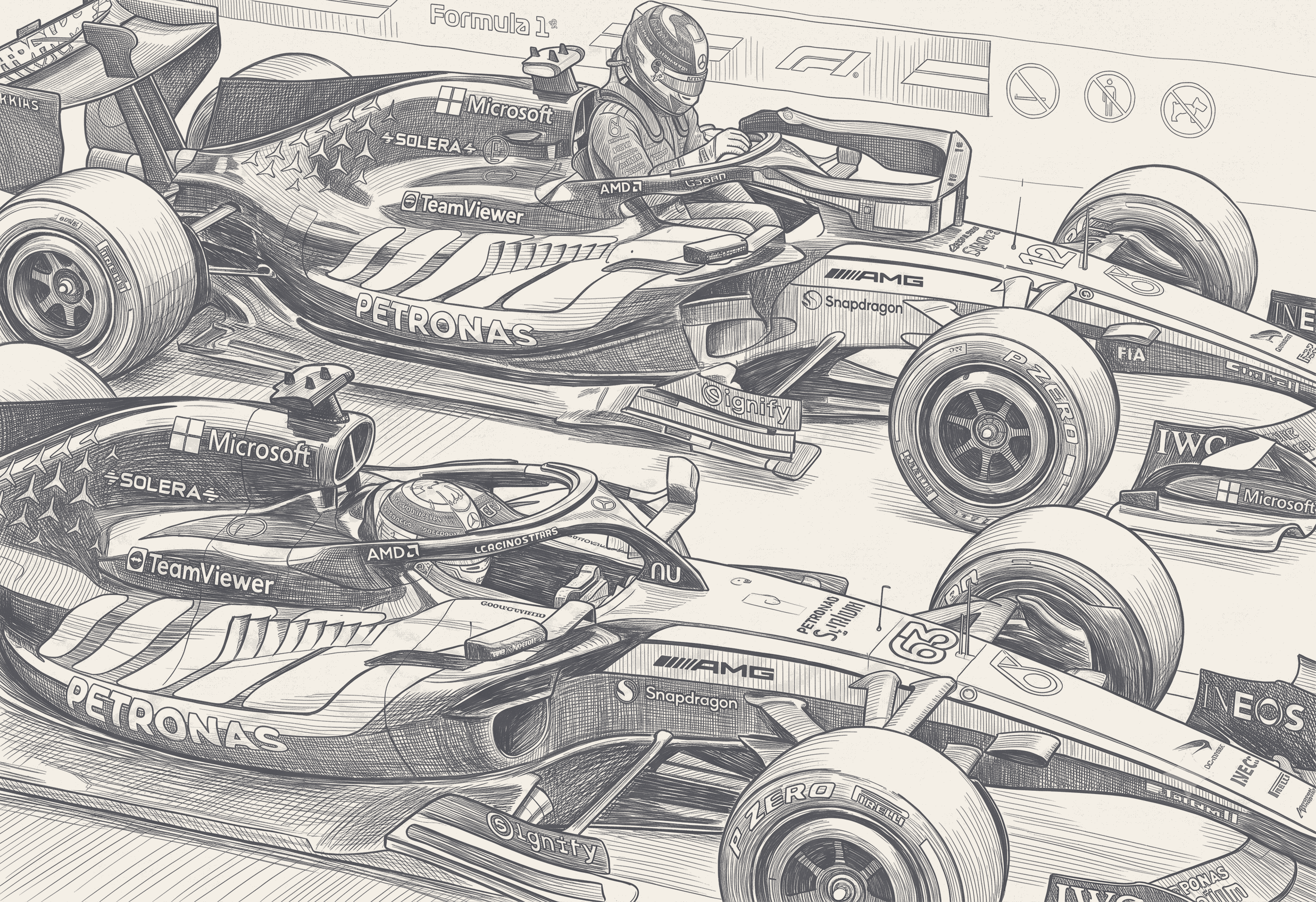
Three Mercedes failures in recent rounds have turned a title lead into a liability.
Kimi Antonelli was running second at Barcelona with three laps left when his W17 coasted to a halt, the failure that ended a five-race winning streak and handed Lewis Hamilton the clear run to his first Ferrari win. It was Antonelli's first retirement of the season, and it cost the championship leader a podium he had already secured on the road. "I feel a bit empty," he said afterward.
The single retirement is not the story. The pattern is. Antonelli's stoppage was the third time in recent rounds a Mercedes or Mercedes-powered car has failed while running for a podium or a win, and Toto Wolff named the problem directly after the flag. "We can't DNF cars in a kind of regular, or continued way," he said, before reducing the run to its arithmetic.
The arithmetic Wolff did out loud
Wolff counted the lost points himself. "Losing 25 points in a Constructors' Championship in Montreal, and losing another 18 points today," he told Sky Sports F1, the Montreal figure pointing to George Russell's retirement from the lead in Canada and the Barcelona figure to Antonelli. The same Formula1.com report traces a third leg, a Mercedes power unit failure that ended Lando Norris's race at Monaco, which folds a customer team into a problem that started at the factory. Three points-leading or podium-bound cars, three stoppages, all traceable to the same power unit supplier.
His conclusion was blunter than the count. Mercedes "just can't compete for a championship if every second race a car is losing fat points," Wolff said. A team principal does not reach for that sentence when one car breaks. He reaches for it when the failures have started to rhyme.
Why the leaders are the ones who stop
There is an uncomfortable logic to which cars have failed. Russell led in Canada, Antonelli ran second at Barcelona, and both were extracting maximum energy deployment from the 2026 power unit at the moment it gave out. The current regulation splits a car's output far more evenly between the internal combustion engine and the electrical side than the formula it replaced, leaning on a battery and an enlarged MGU-K that now carry a much larger share of a lap's work. The harder a driver runs at the front, the more of that work the energy store does, and the more heat and load it absorbs.
Paddock Notes flagged the energy-store design in May, when Russell's W17 went dark in Canada with a battery-module failure, the first reliability retirement of the 2026 regulation year. The Canada piece argued the failure was a symptom of the regulation's design rather than a one-off defect, an energy store the 2026 rules made central to how the car makes lap time. Barcelona reads as the second data point on that line. Mercedes has told reporters it has identified the cause of Antonelli's stoppage, but a confirmed component does not undo a trend, and the trend is what Wolff was describing.
The customer dimension sharpens it. A Mercedes power unit that fails in the works car can also fail in the cars Mercedes sells, which is why Norris's Monaco retirement belongs in the same column as the two factory failures rather than in a footnote. A supplier reliability problem is a wider exposure than a chassis one, because it ships to every garage the engine reaches.
What it does to the title
Mercedes still holds the lead, but by a margin that is shrinking from the inside. Antonelli leads on 156 points, with Hamilton second on 115 and Russell third on 106, per Formula1.com, which means the lead has fallen to 41 points from a Monaco peak that had Antonelli 68 clear of the second-placed driver. Every one of those eroded points was lost to a car stopping, not to a rival going faster.
Wolff added a second admission that moves the problem off the dyno and into the pit wall. Letting Antonelli and Russell race each other hard before the stops, he conceded, "maybe cost us the win," which means Mercedes is now managing two threats at once. The first is a power unit that keeps failing under load. The second is an intra-team fight that the team can no longer indulge while the cushion is this thin and this dependent on both cars finishing. A 41-point lead reads as comfortable only until you subtract the next failure from it.
Mercedes carries that pair of problems to the Red Bull Ring on June 28, a power-hungry circuit that asks a great deal of exactly the energy-management hardware that has been breaking. The reliability fix is an engineering question with an engineering answer, given time. Whether the answer arrives before the lead does is the question the title now turns on.