
McLaren built its 2026 car about 150mm under the wheelbase limit to save weight, and says the 2027 car will be longer.
Article C2.3.2 of the 2026 Formula 1 technical regulations reads, in full: "Wheelbase. The distance between the planes XF = 0 and XR = 0 must be less than or equal to 3400mm at Legality Ride Height." That is the only place the word wheelbase appears in Section C. It is a ceiling, and McLaren has spent the season a long way underneath it.
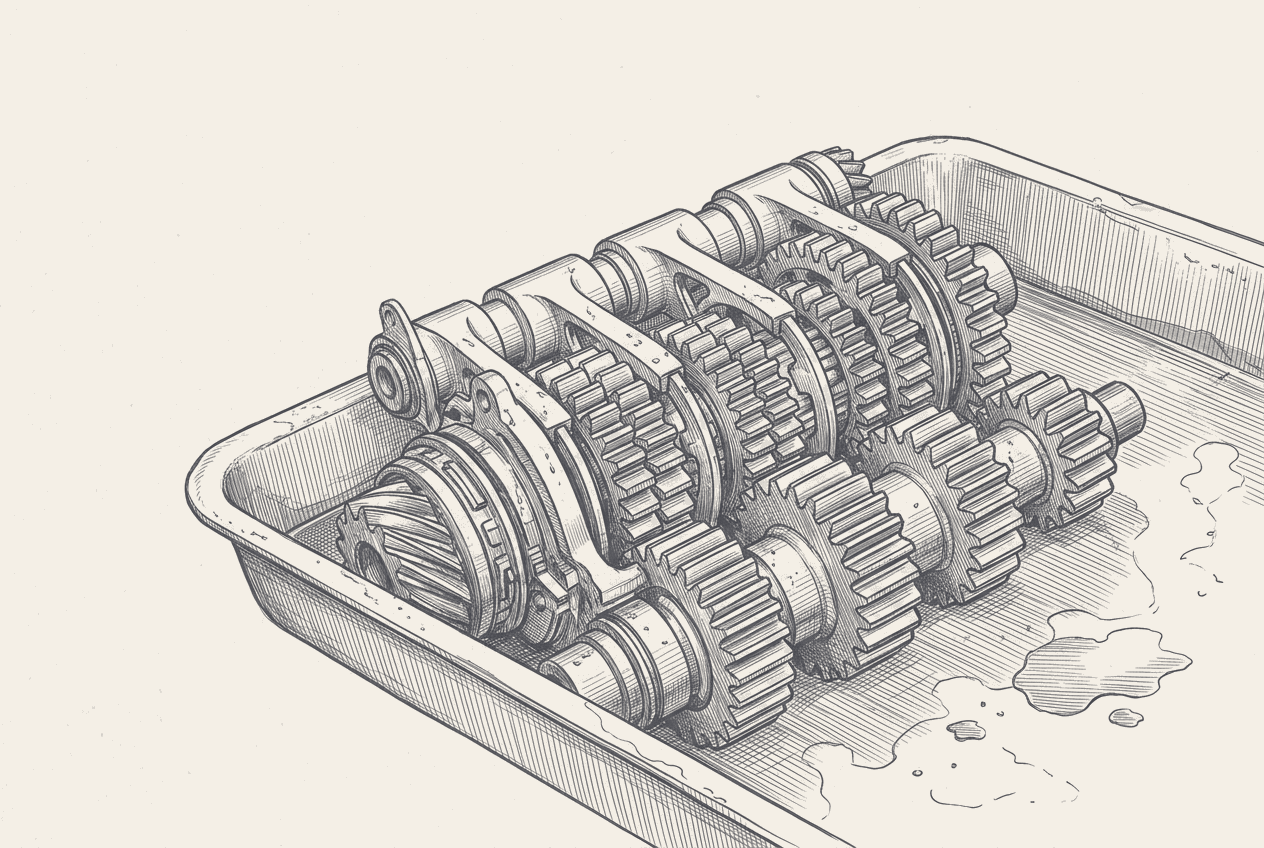
Giorgio Piola Design put a number on the gap in March, measuring the MCL40 by photogrammetry at about 15cm under the 3400mm limit, and 35cm shorter than the 2025 MCL39. The measurement was confirmed to that outlet by Andrea Stella and Rob Marshall. The car shrank by more than a foot in one winter, and it did so at one end: the rear axle moved toward the chassis while the distance from the front axle to the cockpit and the leading edge of the sidepods stayed where the rest of the grid keeps them. Compacting the gearbox casing and spacer assembly bought the length back, and paid for it with a full redesign of the cooling system and the sidepod and engine cover surfaces.
Neil Houldey, McLaren's Technical Director, Applied Engineering, has now said on the record why they did it, and what it cost. "Initially, we put a shorter car together because it's lighter and we knew that the weight regulations were going to be a big, big challenge so that gave us a nice head start and it allowed us to put performance in different areas," he told The Race on 15 August. The next sentence is the one that travelled: "I think for next year we'll end up with a longer car, because aerodynamically you give yourself a little bit more plan area on the floor."
The weight problem that made length the lever
Article C4.1 sets the 2026 Minimum Mass at 724kg plus the Nominal Tyre Mass, rising to 726kg plus tyres for qualifying and sprint qualifying. The number teams had to hit went down while the hardware they had to fit went up. Piola's accounting of the squeeze runs to a roughly 30kg cut in the mandated minimum against power units weighing about 34kg more, plus mass added by stiffer roll hoop tests and a new two-stage frontal crash test, for what that analysis puts at a combined penalty of approximately 64kg. Against an exchange rate the same analysis puts at two to nearly four tenths of a second per lap for every 10kg, overall length becomes the biggest single lever a designer holds.
McLaren pulled it and still missed. "We were a little bit overweight on the launch car and had to spend some time managing this before the first race in order to get the car down to the limit," Houldey said in early August. "Of course, that takes resource away from other areas where we could have been adding performance." A team that cut 35cm of wheelbase to buy weight margin arrived at the first race having spent that margin twice.
Floor plan area is what the shortening bought weight with. Houldey's account of the trade is that it looked cheap at the time and has become less so as the floor matured: "As we've developed the floor more and more it seems like we can manage that, which initially it looked like actually it wasn't much of a laptime penalty to shorten the car." The judgement was made against a floor McLaren had not yet developed, and the developed floor changed the answer.
Nothing in the rulebook says stay short
Article C12.1.2 requires that "the Survival Cell must be homologated in accordance with the provisions of Article C13". Article C9.4 homologates gearbox internals, and its own words scope that to "before the start of the 2027 season", not this one. The wheelbase ceiling in C2.3.2 carries no companion clause freezing a team at its declared figure, and Section C names wheelbase nowhere else.
So the thing stopping McLaren from lengthening the MCL40 in September is not a regulation forbidding it. It is a survival cell that would need designing, building and crash-testing again, a gearbox casing and spacer assembly whose compaction was the mechanism of the shortening in the first place, a cooling package and bodywork designed around the short dimension, and a cost cap that has to absorb all of it while the same engineers develop next year's car. Article C4.2 adds a further constraint that a moved rear axle would disturb: in qualifying the front axle must carry at least 0.44 of Minimum Mass and the rear at least 0.54.
The distinction matters because the language around this story has hardened into "cannot correct", and cannot is doing a lot of work. What McLaren has is a choice it has already made about where to spend a fixed budget, presented as a physical impossibility. The 2027 car will be longer because 2027 is when a new survival cell was going to be built anyway.
The ratios were nominated before the engine existed
Article C9.6.2 requires each team to nominate its eight forward gear ratios and declare them to the FIA technical delegate "at or before the first Competition of the Championship". One change is permitted, and only this year: "During 2026 only, the nominated set of forward gear ratios may be changed once during the Championship Season." The clause that follows is the one nobody quotes. "Changes to the forward gear ratios under the provisions of this Article may involve changes to either the gear ratio pairs defined in Article C9.6.3, or to the final drive, but not both at the same time."
McLaren nominated short. Stella confirmed the direction in May: "There are definitely pros and cons with the ratios. Your observation is correct, we are on the shorter side compared to Mercedes." Toto Wolff had said the same thing from the works side in March, that McLaren "have taken some decisions that are very different to ours, when it comes, for example, to gear ratios". McLaren can diverge because it designs and builds its own gearboxes, where Mercedes' other customers, Alpine and Williams, take the works ratios or last year's.
Houldey's explanation of how the nomination went wrong is a statement about calendars, not engineering, and it turns on Mercedes' engine division at Brixworth. "HPP won't know their final power curve until whatever date it might be, which is way beyond after we've chosen our ratios." A customer team must commit its ratios before the first race of the season, and the engine supplier finishes learning what its own engine does some time after that. The Race reports that McLaren set its ratios against a projected power curve supplied by Mercedes that the delivered unit did not match, which is that outlet's characterisation rather than a Houldey quote. What Houldey does say is: "If we had our time again, we'd re-ratio to be closer to where Mercedes are. There are some performance opportunities that we can't take because the ratios are shorter."
Then he prices it. "We made a good decision with the information we had around us at the time; with the information that we have around us now the decision might be slightly different, but we're talking milliseconds, not tenths."
That last clause is worth holding against the headlines. The man who made the call values the error in thousandths, and McLaren has spent the season declining to spend the one change the regulations give it. Stella explained the refusal on 24 May: "At the moment, we are happy with where we are. We are not considering to review our availability, even though the regulations would allow you to do so. But we think that some of the advantages that we cash in in other conditions than the longest straights are overall a positive." The joker is still in hand in August, and under C9.6.2 it is half a joker, good for the ratio pairs or the final drive but not both.
Mercedes answers a different question
Asked about the gap between works and customer performance, Mercedes deputy team principal Bradley Lord gave an answer on 17 August that never mentions power curves. "Where there have perhaps inevitably been perceptions of differences, or they have felt potentially one step behind is in the simulation tools, the ability to predict behaviour of the power unit and the chassis and things like that." His prescription is that customers "are needing to do work and spend, invest their own cost cap resource into developing the tools to be able to get the most from the power unit."
Read alongside the ratio story, that is a bill rather than an explanation. Under a cost cap, a customer team is told to fund the predictive tooling that the works team already has, out of a budget that also has to build the longer 2027 car. Mark Temple, McLaren's technical director for performance in The Race's rendering, describes the same asymmetry as a scheduling one. "We're a little out of the main loop in that respect, working in a side loop that feeds into the programme, but it means we don't always get the configurations we want and that would suit us." And on timing: "In the run-up to a race, we receive information from HPP, but there's decision-making and evolution we're not part of. When we find out what we've got, there's often not a huge amount of time to react and respond."
McLaren's response has been organisational. "We have a power unit performance team now, which we didn't have before," Temple says, adding that "these are things we didn't really need to worry about before." A regulation change turned an engine into a variable a chassis team has to model, and the customer built a department to do it.
What arrives at Zandvoort
McLaren goes to the Dutch Grand Prix, round 12 of the 2026 season on 21 to 23 August, third in the constructors' championship. Its own preview puts the team on 220 points and 87 behind second, with Lando Norris fifth and Oscar Piastri seventh in the drivers' table. RaceFans' post-Hungary standings fill in the rest after 11 of 23 races: Mercedes 379, Ferrari 307, McLaren 220, Red Bull 177, and a drivers' order led by Kimi Antonelli on 219 from Lewis Hamilton on 169 and George Russell on 160, with Norris fifth on 128 and Max Verstappen sixth on 109.
The parts list for Zandvoort is short and comes from McLaren directly. Houldey: "We have also worked hard as a team on continued development, with some parts available this weekend, focusing on the rear side, to complete the package introduced in Hungary with a new rear wing and new rear brake ducts." The upside-down rotating rear wing McLaren ran in Hungary practice, and has never raced, is reported as likely for Monza on 4 to 6 September, though Stella has declined to name the circuits it will appear at.
None of that is a floor. The floor is the thing the wheelbase decision constrained, and the floor is where 2026 aerodynamic performance lives. Zandvoort is round 12 of 23, and the answer to the question Houldey raised arrives in a car that has not been built yet.