The faster Toyota lost Le Mans in the pitlane, not to team orders.
The #8 Toyota led the 2026 Le Mans 24 Hours after seventeen hours and finished third, 20.417 seconds behind the winning sister #7 and 9.504 seconds behind the second-placed #20 BMW. By Monday the result had hardened into a single explanation among enthusiasts: a manufacturer had chosen its own winner, and team orders had cost Brendon Hartley, Ryo Hirakawa and Sebastien Buemi the race. The team's own timing sheet tells a less tidy and more instructive story.
Sebastien Buemi, who needed 20 fewer seconds across 24 hours for a fifth Le Mans win, walked through the actual losses afterward. None of them was an order. All of them were time, taken in small amounts in the pitlane and never recovered on a circuit where 20 seconds is a rounding error over a full day.
A loose screw and a 0.2km/h penalty
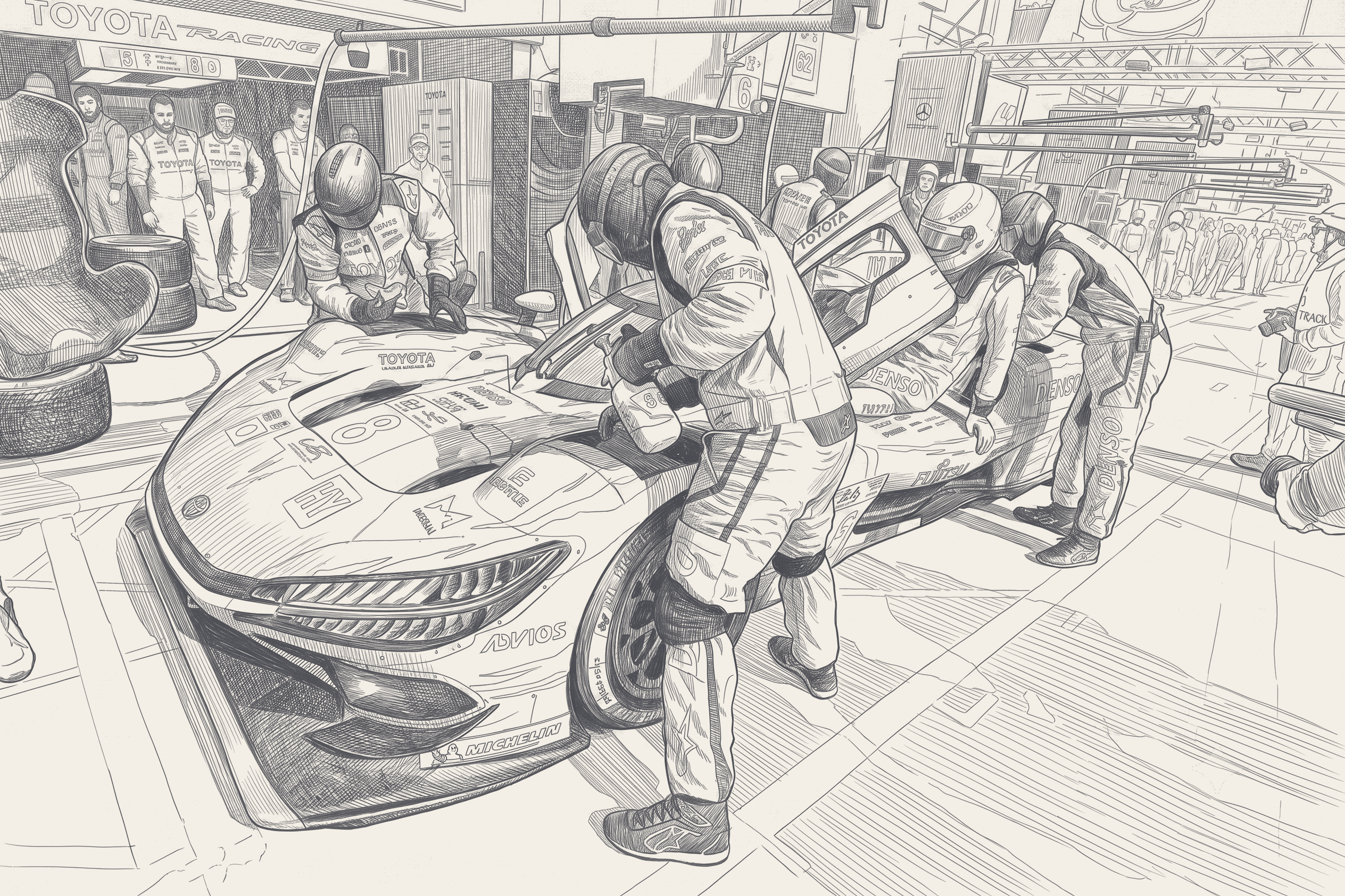
Two mechanical events did most of the damage. A screw came undone on the cover around the carbon brake components, Buemi explained, and it began tattering the rim, forcing a repair that cost the crew about a minute. Hirakawa then took a drive-through penalty for exceeding the 80km/h pit limiter, by Buemi's account, by 0.1 to 0.2km/h. A minute here and a drive-through there are the kind of losses that vanish in a sprint and decide a marathon.
By Hour 17 the #8 was leading, and the extended stop dropped it to fourth before a second safety car compressed the field and pulled it back into contention. Bad luck did the rest. The crew was caught inside a slow zone at the moment it was activated, Buemi said, the sort of timing accident that no strategy call can pre-empt and no driver can drive around.
The pitlane ledger
Pitlane time, not the finishing margin, is the decisive number, and it shows in how long each car spent stationary. The #8 Toyota spent 45 minutes and 36 seconds in the pitlane across the race, the #7 spent 42 minutes and 56 seconds, and the winning-margin gap is smaller than the difference between those two totals. The #20 BMW was the most efficient of the lead trio at 41 minutes and 17 seconds, which is how a runner-up LMDh car finished within ten seconds of a Toyota that was demonstrably quicker on track.
Look only at the final five hours and the picture inverts, which is the detail that complicates the team-orders reading. Over that closing stretch the #8 was actually the most efficient of the three, stationary for 7 minutes and 56 seconds against 8 minutes and 38 seconds for the #7 and 8 minutes and 2 seconds for the #20. The #8 did not lose this race at the end. It lost it in the middle, to the brake repair and the penalty, and spent the last quarter of the event recovering ground it had already conceded.
Why "team orders" is the wrong word
Tyre timing, not a radio instruction, decided the intra-Toyota fight. The #7 fitted fresh rubber shortly before the #8, Buemi said, and the #8 then sat behind a Cadillac for a long stint, which let the #7 close the gap and clear its sister car easily. A faster car stuck in traffic on older tyres is a strategy outcome, not a governance one, and it is the opposite of a manufacturer staging a result.
Buemi's own framing was about luck and timing rather than orders. "You need a bit of luck and good timing," he said, describing himself afterward as "a bit disappointed" while pointing at decisions he could not control. He was pointedly unimpressed with race control, questioning how the stewards chose between safety cars, slow zones and full-course yellows for what looked to him like near-identical incidents. That is a complaint about consistency in officiating, the variable that genuinely moved the #8's race, and it is a more substantive grievance than the one the Monday conversation reached for.
The result that matters for the season sits underneath the internal argument. Toyota won Le Mans for the sixth time and the first since 2022, ending Ferrari's three-year run, and Buemi made the case that the manner of it counts. "Beating all those teams today earns more respect," he said, a nod to a Hypercar field deep enough that a win no longer comes against thin opposition. The lesson the #8 carries out of La Sarthe is the oldest one in endurance racing, restated in a modern timing readout. The pitlane decides more 24-hour races than the racetrack does, and a single loose screw can outweigh a faster car.