
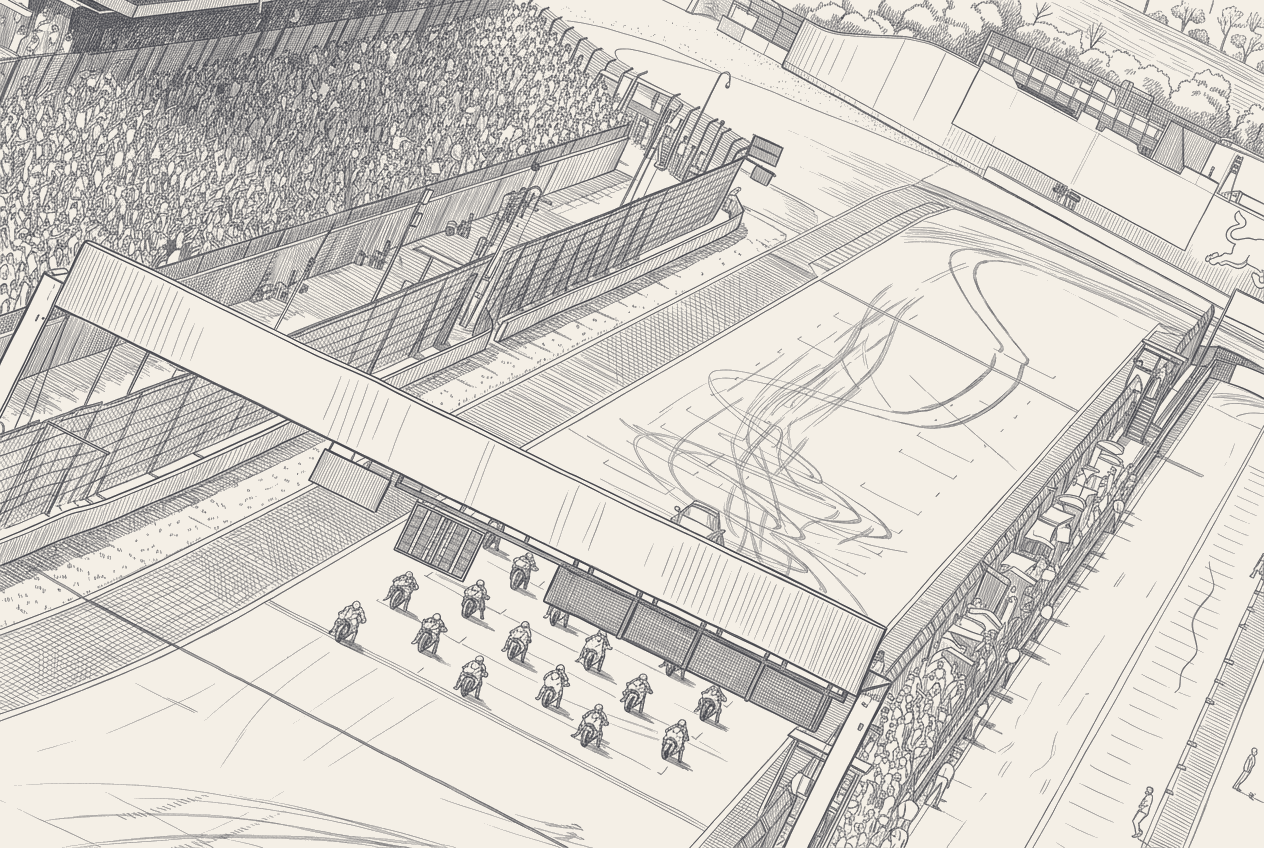
Three empty seats at the Bodegas Gonzalez Byass: how the MSMA turned MotoGP's Concorde fight into a Le Mans deadline.
Three of the five MotoGP manufacturers no-showed Liberty Media president Derek Chang's MSMA dinner at the Bodegas Gonzalez Byass on the eve of the Spanish Grand Prix. Yamaha, Aprilia and KTM gave no prior notice. The seats were laid, the food was served, and the room ran with two factories present out of five. Eight days later, the championship's promoter has set the French Grand Prix at Le Mans (May 8 to May 10) as the deadline for a joint commercial agreement. If that date passes without a deal, MotoGP enters its European leg with five separate side-deals running in parallel, an outcome that is the structural opposite of every public position Liberty has taken since closing the MotoGP Sports Entertainment Group acquisition in 2024.
What the manufacturers are actually demanding
Motorsport.com first surfaced the no-show on April 30 and laid out the MSMA's negotiating brief. The manufacturers want the existing fixed-allocation seasonal payment replaced with a share of the overall MotoGP business, plus formal co-determination rights modelled on F1's Concorde Agreement. The fixed-allocation model is the inheritance from the Dorna era. Each factory receives a flat seasonal subsidy regardless of the championship's commercial performance, and the manufacturers carry no contractual mechanism to vote on the technical or sporting regulations that govern the class. F1's Concorde, by contrast, is a three-way governance contract between the FIA, FOM and the teams that hard-wires teams into both the revenue split and the rule-making process. The MSMA's brief is to import that architecture into a championship that has never had it.
The fixed-allocation versus revenue-share question is the load-bearing one. A revenue-share model exposes manufacturers to upside (more streaming subscribers, more global races, larger sponsorship inventory) and to downside (a poor commercial year shows up in the factory budget). A fixed-allocation model insulates the factories from both directions. For Yamaha and KTM, the two manufacturers most exposed to the existing model on Motorsport.com's read, the calculation is simple. Their on-track results in 2026 are not paying back the fixed allocation at the level Liberty has implied is sustainable, and they want a contractual claim on the upside Liberty is now selling to investors as the reason it bought the championship in the first place.
Why Le Mans, and what happens if Le Mans passes
Liberty has framed the French GP as a soft deadline rather than a hard one, but the published consequence of slippage is firm. Crash.net's April 30 follow-up read noted that the promoter's fallback plan is to negotiate manufacturer-by-manufacturer side deals, an outcome the MSMA explicitly does not want and that the promoter has spent the spring framing as a worst case. The MSMA's leverage in the standoff is collective. A side-deal track gives Liberty the ability to break the unified bargaining position and trade off contract length against revenue-share percentage on a factory-by-factory basis. That is the negotiation Yamaha and KTM are most exposed to losing.
The four-week window from the Jerez no-show to the Le Mans deadline is short by F1 governance standards but long by MotoGP standards. The closest historical analogue is the 2009 Concorde renegotiation, which ran nine months from FIA letter to signed document, with the championship's then-FOTA bloc threatening a breakaway series in the middle. Autosport's read of the MotoGP Concorde delay factors traces the standoff back to a stalled drafting process that began in late 2025 and has slipped twice already. The Le Mans framing is the first time the promoter has attached a public date to the document, which is itself the negotiating signal: a promoter that publicly names a deadline is a promoter willing to move first if the deadline lands without a deal.
Aprilia leads the championship the same fortnight it walks out of dinner
Marco Bezzecchi's Aprilia leads the riders' table after Round 4 with Jorge Martin four points behind, which means the manufacturer with the most political leverage in the negotiating room is also the manufacturer with the most on-track leverage. Aprilia have not led a riders' championship after four rounds since 2022. Their no-show at Bodegas Gonzalez Byass reads, on Motorsport.com's framing, as the cleanest expression of that leverage. Yamaha and KTM are absenting themselves to register grievance with the existing model. Aprilia is absenting itself to register that the existing model has not paid back its on-track investment in 2026 either, even with a championship lead, and that the revenue-share argument is not a Yamaha and KTM grievance the factory leaders can dismiss.
The presence and absence ledger is, accordingly, useful as a forecasting tool. Honda attended with full factory representation. Ducati sent its paddock-level leadership (team manager Davide Tardozzi, communications director Artur Vilalta) but its corporate top brass, CEO Claudio Domenicali, general manager Gigi Dall'Igna and sporting director Mauro Grasilli, were all absent. Honda is the manufacturer whose long F1 timeline has been most publicly diagnosed and whose factory budget is the most exposed to a poor revenue-share year. Ducati is the manufacturer with the largest current commercial advantage under the fixed-allocation model and the deepest interest in keeping that model intact, although the leadership absence is the wrinkle that makes Ducati's posture less clean than a single-line "attended" entry would suggest. The MSMA's negotiating bloc is therefore three factories pushing for a structural overhaul, one factory (Ducati) sending split signals, and one factory (Honda) firmly inside the promoter's room. Liberty's task between now and Le Mans is to find the version of the document that gets one of the three back into the room without giving up so much that Honda moves to the other side and Ducati's leadership stays out.
What the deadline actually buys
A signed MotoGP Concorde by Le Mans buys Liberty exactly what it bought F1 between 2009 and 2013: a contracted bloc of factories with a defined relationship to the commercial pie, and a stable platform on which to grow streaming revenue, race fees and sponsorship inventory. It also buys the FIM the political cover to rule on technical regulations (front-fairing aero, the pit-entry definition the Marc Marquez Jerez sprint exposed, the rear ride-height device window) without the manufacturers treating each ruling as a side-fight. A signed agreement is therefore not just a commercial document. It is the precondition for the FIM to do its job in the second half of 2026 without the standoff rolling forward into every regulatory question.
A missed Le Mans deadline is a different document. Five side-deals running in parallel give Liberty short-term price flexibility and cost the championship its unified governance posture for the entire 2026 European leg. The downstream cost is paid in regulation drift, in factory-by-factory technical concessions, and in the optic that the championship's commercial structure is now fragmented at the moment Liberty is selling its acquired asset to public-market investors. That optic is the one the MSMA holds in reserve and the one Liberty cannot afford to wear. The French GP is six days away. The dinner that did not happen at the Bodegas Gonzalez Byass is the meeting the championship now has to recreate, with all five chairs filled, before the lights go out at Le Mans.