
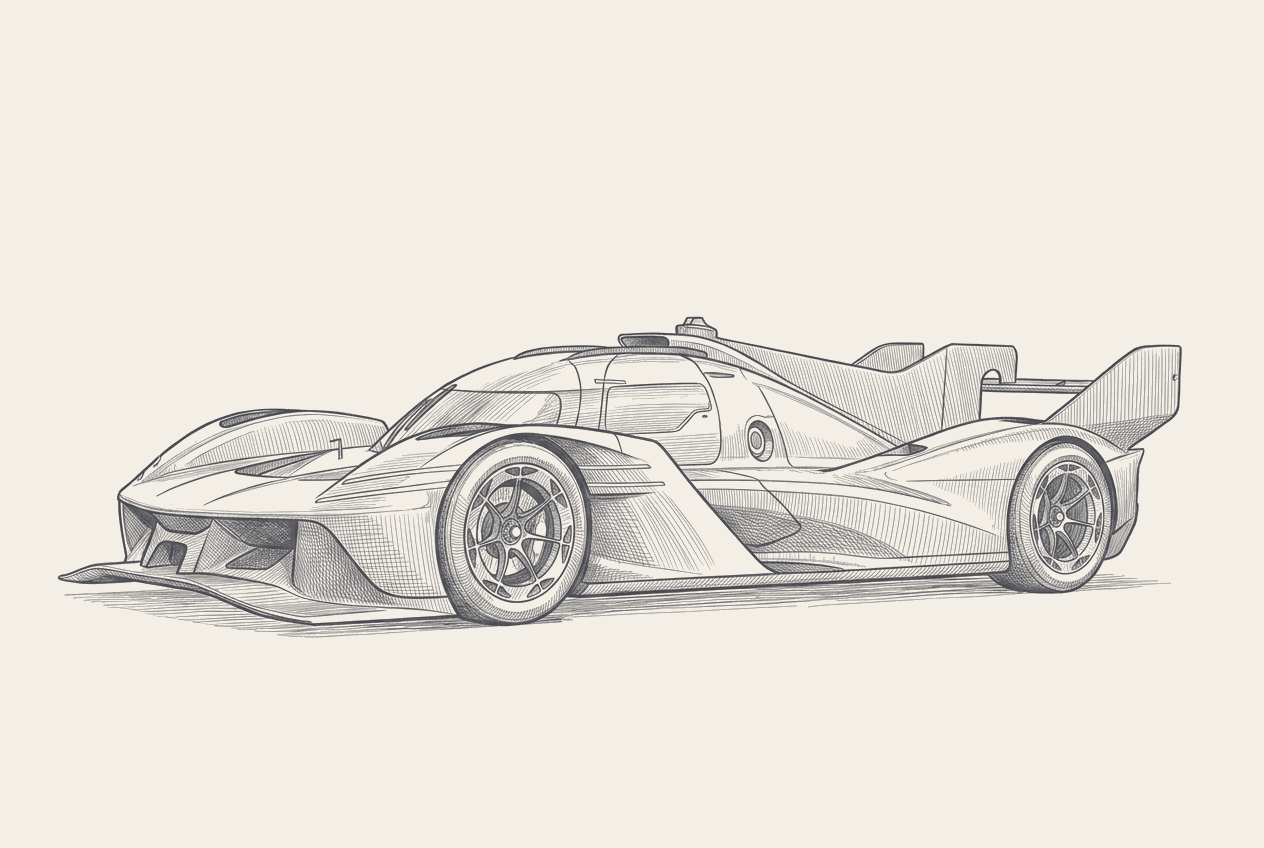
Sixty-two cars at Le Mans, eighteen Hypercars, and the leaked BoP table the FIA stopped publishing.
The ACO published the final entry list for the 94th 24 Hours of Le Mans on Tuesday, May 12. The list closes at 62 cars: 18 Hypercars, 19 LMP2s and 25 LMGT3s. Per the ACO press release, the final list is the closing administrative marker for the four-week build window into the June 11-13 race weekend.
The Hypercar count is the smallest since 2023
Per the Motorsport.com Hypercar piece, the 18-Hypercar field reads Toyota (2), Ferrari (3), BMW (2), Cadillac (3), Peugeot (2), Alpine (2), Aston Martin (2), and Genesis (2). The count is the lowest Hypercar entry since 2023, the year the regulation absorbed its third full-season manufacturer (Cadillac, joining Toyota and Ferrari). The two-year run of 19-Hypercar entry lists at Le Mans (2024 and 2025) closes at 18; the published reading is that the field shape is consolidating rather than expanding inside the second half of the 2026 to 2031 LMH cycle.
Genesis is the only first-time manufacturer on the entry list. The Korean OEM debuted at the Imola opener in April and scored its first WEC championship points at Spa on Saturday, May 9 (covered in the May 11 brief story 6). The 24-hour cycle is the first published Le Mans test for the GMR-001 platform, with Pipo Derani, Mathys Jaubert and Andre Lotterer on the #17 entry and the #16 sister car running the Boutsen-Smith-Pla rotation. The Genesis programme is the cleanest race-to-road read on the Hyundai Motor Group's parallel motorsport-portfolio strategy (Genesis Hypercar, Hyundai WRC, Hyundai N Vision 74 development), with the Le Mans full-distance result the first 24-hour data point the manufacturer has produced.
The BoP table the FIA stopped publishing
The 2026 WEC cycle runs without published BoP data. Per the Motorsport.com piece on the no-public-BoP decision, the FIA WEC stopped publishing the Balance of Performance table after Round 1 to limit paddock speculation on inter-manufacturer parity. The Le Mans BoP table sits inside that no-public-publication policy.
Per the Sportscar365 leaked-BoP piece, the leaked Le Mans BoP shows Toyota at 520kW maximum power and the heaviest minimum weight at 1057kg, 15kg over Ferrari at 1042kg. Ferrari is at 515kW below 250km/h with the largest above-threshold cut at 14.9kW. The leaked table covers all eight manufacturers; the spread between Toyota's weight handicap and Ferrari's power cut is the published-leak's read on the FIA's pre-Le Mans rebalancing decision after the Spa round.
The leaked-but-not-published cycle reads as a transparency question rather than a BoP-arithmetic question. The Sportscar365 leak is the third instance of the 2026 cycle's BoP data leaking outside the FIA's published-policy window (Imola pre-round, Spa pre-round, Le Mans pre-round); the policy of not publishing the table has not changed the practical outcome of the table's circulation through the paddock. The Toyota +15kg, Ferrari -14.9kW spread is the leak's headline; the policy's failure to keep that spread inside the FIA's authoritative channel is the published structural reading.
Toyota's "virtual championship" cycle into Le Mans
Per the Sportscar365 Toyota piece, Toyota Gazoo Racing's published post-Spa communication framed the manufacturer's championship cycle as a "virtual championship" reading, after both Toyotas finished outside the podium at Spa and BMW won the round 1-2. Toyota's stated Le Mans target is a 50th WEC race victory (per the Toyota Europe Le Mans preview), with the manufacturer's last 24h win being 2022. The 15kg-over-Ferrari weight handicap sits inside that ambition; the Toyota Hybrid TR010's published Le Mans pace from the leaked BoP table is approximately 1.0 to 1.5 seconds per lap slower than the Ferrari 499P at the regulation's published power-and-weight envelope.
The four-week build runs inside that frame. Toyota arrives on the largest Hypercar weight handicap in the field; Ferrari arrives on the largest above-threshold power cut; BMW arrives on the Spa double-event podium-and-win cycle; Cadillac arrives on the Spa #38 retirement and #12 outside-points read (covered in the May 9 brief story 6). The published-leak BoP table is the spreadsheet the manufacturers are reading inside that build week; the FIA's no-public-publication policy is the institutional cover that does not absorb the leak's effect.
What the closing entry list does not include
The 62-car closing list is two cars short of the 64-car capacity ceiling the ACO published for the 94th edition. The two unfilled slots sit inside the LMP2 class at 19 entries (one short of the 20-car target) and inside the LMGT3 class at 25 entries (one short of the 26-car target). The published reading is that the supplier-side pipeline for both classes has not absorbed the 2026 cycle's full expansion target; the LMP2 supplier cycle (Oreca, Ligier, Aurus chassis from a single ORECA supplier) and the LMGT3 manufacturer-supplier cycle (nine homologated manufacturers) have produced the available platform-and-driver inventory that the ACO's published entry-list capacity does not fully absorb.
The Hypercar 18-car count is the published reading of the regulation cycle's manufacturer commitment. McLaren joins for 2027 (covered in the May 7 mclaren-mcl-hy piece); Hyundai Motor Group's Genesis is on its first full-cycle entry; the published reading is that the 2027 field could read 20 Hypercars or 22, but that the 2026 field's contraction to 18 sits against the published expansion-target slope the ACO has carried inside the LMH regulation's launch cycle.
What the Test Day reads against
The Le Mans Test Day runs Sunday, June 8. The first published BoP iteration since Round 1 will arrive at the Test Day, since the FIA's published-policy cycle places the next official BoP update at the pre-Le-Mans Test Day window. The leaked table the Sportscar365 piece carries is a draft; the Test Day's published times will read against the leak as the first numeric verification of whether the no-public-publication policy holds the FIA's published-authority window or whether the leak compresses the published-policy's window further.
The published-test-day reading will set the four-week build's race-day expectations. Toyota's +15kg weight is intended to compress the manufacturer's stint-economics inside the 24-hour cycle (heavier car, more fuel burn per stint, fewer laps per fill); Ferrari's -14.9kW power cut is intended to compress the manufacturer's straight-line top-end inside the Mulsanne and Tertre Rouge zones. The leak's arithmetic is published; the Test Day's published number is the four-week verification.
The 62-car entry list arrives at the ACO's administrative ceiling. The 18-Hypercar count is the lowest the regulation cycle has produced since 2023. Genesis closes the manufacturer roll at eight names; the leaked BoP table reads inside a policy that has stopped publishing the table. The four-week Le Mans build window opens with the published-closure of the entry list and the published-leak of the BoP arithmetic in the same Tuesday news cycle. The Test Day on June 8 is the first verifiable data point.