
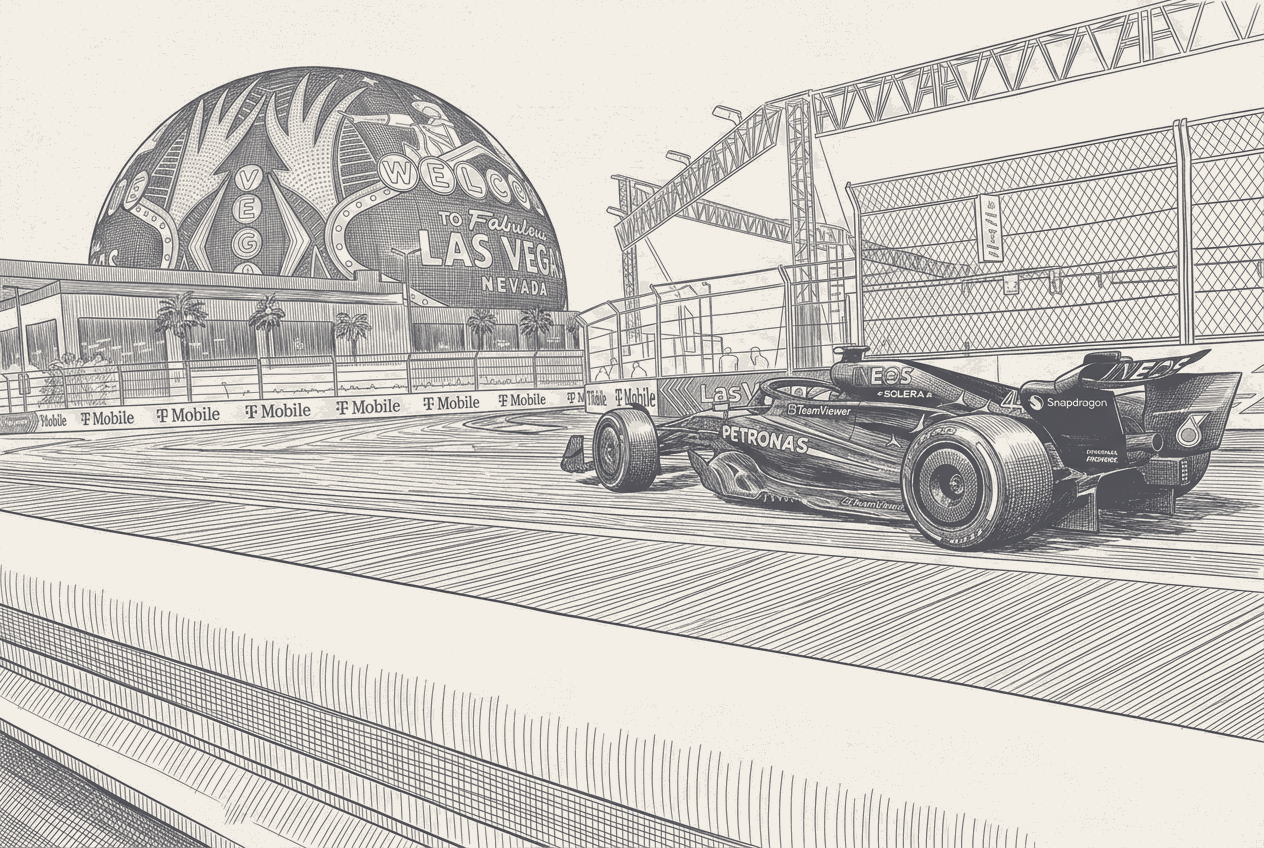
F1 signs Las Vegas through 2037, and the sport's one self-promoted race stops being an experiment.
On Thursday, two days before qualifying at Monaco, Formula 1 announced the Las Vegas Grand Prix will run through 2037 under a new 10-year extension. The choreography deserves a moment of attention before the deal does: the sport picked its most European week, the one where its oldest race fills every camera frame, to announce a decade of commitment to its newest American one. F1's own corporate release paired the news with a record-setting drone show over Monaco's harbour, in case the message about where the sport sees its future needed underlining.
Twelve more races, minimum
The term sheet's quiet detail is the start date. The new agreement begins after the current two-year deal expires following the 2027 race, which puts 12 more editions of the Las Vegas Grand Prix under contract from this November forward. Clark County and the Las Vegas Convention and Visitors Authority committed alongside Las Vegas Grand Prix, Inc., the civic half of an arrangement that closes public roads through the heart of the Strip every November. "Securing a 10-year extension through 2037 is a defining moment for the Las Vegas Grand Prix and a reflection of the strength of our local partnerships," said Emily Prazer, the race subsidiary's president and CEO, in the announcement.
Behind the quotes sits the civic math. Formula 1's announcement cites $3.2 billion in cumulative economic impact for Southern Nevada across the first three editions, with the 2025 race alone generating $43 million in state and local tax revenue, $15 million of it allocated to K-12 education. All three runnings, 2023 through 2025, sold out. Those are the promoter's own figures, and economic-impact accounting always flatters its commissioner, but the direction of the relationship is not in dispute: a county that spent 2023 grumbling about construction disruption just signed up for ten more years of it.
The race F1 cannot walk away from
Every other event on the calendar pays Formula 1 for the privilege of hosting it; a local promoter assumes the risk, writes the fee, and hopes ticket revenue covers both. Las Vegas inverts that model. The championship promotes this race itself through its own subsidiary, on real estate it bought, which means F1 carries the costs and books the revenue that a promoter would anywhere else. A 10-year horizon does different work in that structure. For a conventional race, a long extension is a future income stream. For Vegas, it is an amortization schedule, the timeline over which the permanent paddock building and the land under it stop being a speculative capital expense and start being infrastructure.
Stefano Domenicali's framing, "a cornerstone of our presence in the United States," per Formula 1's explainer on the deal, places Vegas as the anchor of a three-race American footprint alongside Austin and Miami. The on-track product carries more of that argument than it did at the start. The 2024 race produced a reported 113 overtakes, the kind of number the commercial deal now banks on, and the first three editions split between Max Verstappen, who won in 2023 and 2025, and George Russell in 2024. Verstappen's fourth world title was sealed under the Strip's lights in 2024, the sort of championship moment a November date will keep manufacturing, and the cold-night tyre behaviour that embarrassed the 2023 opening has since become part of the race's competitive identity rather than a flaw in it.
A Saturday-night race in Nevada sells scheduling as much as sport. The late slot lands in US prime time and European breakfast, the inverse of the sport's normal broadcast geometry, and it hands American television an F1 property that does not require waking up for. Whatever the purists make of that trade, the championship has now signed up to defend it for a decade, and three consecutive sellouts suggest the local market, at least, has already voted.
The previous time Formula 1 raced in Las Vegas, the Caesars Palace Grand Prix of 1981 and 1982, the event lasted two editions in a hotel car park before the sport retreated from the city for four decades. This time the commitment runs through paper rather than rhetoric: twelve more races, minimum, with the county and the tourism authority co-signing.
What the decade has to prove
November 19 to 21 brings the first edition raced under the new certainty, seven months from now. Year four is where novelty economics usually meet gravity: the first three sellouts came with debut scarcity, a title decider, and the sport's biggest marketing push behind them, and the $3.2 billion impact claim will be retested annually by a city that audits its spectacles ruthlessly. The extension answers the question of whether F1 still believes in its Vegas bet. The next twelve Novembers answer whether the belief was priced correctly.