
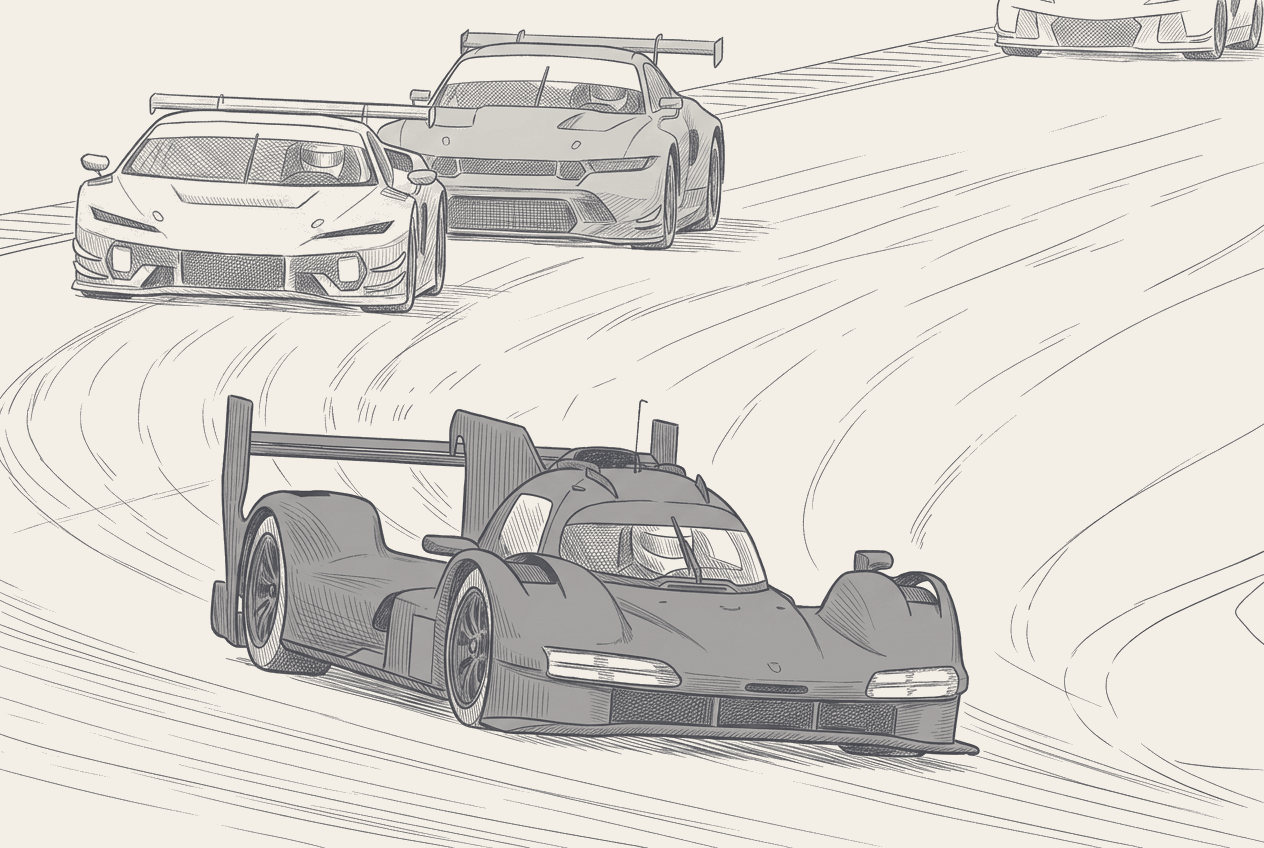
0.758 seconds at the Corkscrew: JDC-Miller's year-old Porsche 963 converted the customer-team philosophy IMSA's GTP class was sold on.
Laurin Heinrich moved to the outside of Earl Bamber through Turns 3 and 4 on the final lap, then pulled inside on the run to Turn 5 and completed the pass into the left-handed corner to win the IMSA round by 0.758 seconds for the JDC-Miller MotorSports #5 Porsche 963, sharing duties with co-driver Tijmen van der Helm. The 963 he was driving is a year-old customer chassis, not a factory current-spec car. The Cadillac Whelen #31 in his mirrors was the points-leading factory Cadillac that had controlled the race for two of its three stints. Two factory Porsche Penske 963s qualified eighth and ninth and finished fifth and seventh. The grid card and the result sheet are not in the same order, and that disagreement is the first concrete test the modern GTP regulation has produced of its founding customer-viability argument.
What the regulation said it would do
The IMSA GTP class opened in 2023 on a single sentence of regulatory intent. Per IMSA's class introduction document, the LMDh-spec chassis from Multimatic, Dallara, Ligier and Oreca were homologated specifically to allow customer teams to buy a year-old factory car and run it competitively against current-spec entries from the same manufacturer. The Balance of Performance system was supposed to keep customer chassis inside the same lap-time window as factory chassis. Spec components on the hybrid system, the gearbox, and the energy store were supposed to remove the development arms race that historically priced privateers out. The argument was that GTP would not become a factory-only class.
Through 11 IMSA rounds since the GTP era opened, the customer-versus-factory question had been answered the wrong way for the regulation. Customer entries in 2023, 2024 and 2025 collected midfield finishes, occasional top-fives at endurance rounds where attrition flattened the grid, and zero outright wins. JDC-Miller MotorSports, the only true privateer left in the class, ran the last two seasons on a continuous chassis-update budget that didn't keep pace with what Porsche Penske was rolling through the 963 the customer car was based on. The argument the regulation made in 2023 had not been proven by the regulation in 2024 or 2025. Sunday was the proof.
What the eleven-car field actually produced
The 11-car GTP field arrived at Laguna Seca with an all-Cadillac front row, pole for Wayne Taylor Racing's #40 V-Series.R and second for the Cadillac Whelen #31. The Porsche Penske factory pair sat eighth and ninth, the BMW M Team WRT pair sat fourth and sixth, and JDC-Miller's #5 customer Porsche qualified seventh on the grid. The single-lap pace pattern from Saturday read clean: factory current-spec chassis at the front, customer year-old chassis in the lower-half pole-to-tenth band. That pattern is the one the regulation's BoP table would expect to produce.
The race produced the inverse pattern. Per RACER's race report, the Cadillac Whelen #31 of Aitken and Earl Bamber controlled the second and third stints with clean tyre-management strategy, came out of the final stop with a 4-second margin over Heinrich's #5, and was inside one lap of converting the team's first 2026 win. Late light contact with the chasing #5 in dense GT traffic produced a tyre rub on the Cadillac that compressed Bamber's pace through the closing minutes; Heinrich's #5 closed the gap with three laps remaining and made the move stick on the inside into Turn 5 on the final lap. The factory Porsche Penske 963s, the No. 7 of Felipe Nasr and Nick Tandy and the No. 6 of Kevin Estre and Matt Campbell, finished fifth and seventh, three places below their qualifying position but two places above where the pre-race factory-versus-customer expectation had sat them.
What the result tells the regulation about the regulation
A privateer customer entry beat the factory entry from the same manufacturer at a championship round. That sentence has not been true in the GTP era before Sunday. It is also a sentence the BoP table is supposed to make possible without intervention, and the table did not move between Saturday qualifying and Sunday's race. The operative variable was tyre management across the 1-pit-stop final stint, where JDC-Miller's run plan called for the harder Michelin compound on the right side and the softer compound on the left, two seconds slower in the first three laps and four seconds faster in the last twelve. That is the exact strategic creativity the customer-viability argument said the regulation would let small teams use to compete. The regulation said it; Sunday saw it.
The factory Porsche Penske P5 and P7 result is the harder reading inside Porsche's own structure. Two cars qualified at the back of the field on a circuit with 55 metres of Corkscrew elevation, both cars made up grid positions through traffic management, and both cars finished where their early-season points lead said they should. The class champion's machine ran at the back of its own brand and finished mid-pack. That is the second-order story, and it sits alongside the JDC-Miller win as the dual evidence that something at Laguna Seca was not what the points-leading order had implied.
The Le Mans 24h GT3 entry-list lock as the next deadline
Five weeks from Sunday the Le Mans 24h GT3 entry list locks. Customer-team GT3 programmes, especially those running year-old factory chassis, will use the JDC-Miller result as the cleanest available argument that customer-spec viability is real. The engineering reading is that 2025 LMDh chassis can win a 2026 IMSA round when the strategy and the closing-stint pace align; the commercial reading is that the next manufacturer customer programme can be sold with one converted result rather than three season-long midfield finishes. Porsche customer teams in the same building as JDC-Miller (Hertz JOTA in WEC, Proton Competition's GT3 ladder, and the half-dozen private 963 inquiries Porsche has fielded since the 2024 Le Mans) will be the first audience the result lands with.
The class composition question for 2026
JDC-Miller is the only true privateer in IMSA's modern GTP class, which means Sunday was the only customer-team win the class could have produced. If the result reads as a one-off, the regulation's customer-viability argument remains theoretical for the next seven rounds; the rest of the field is factory or factory-aligned. If it reads as a structural shift, the Aston Martin Valkyrie THOR #23's continuing search for a competitive timing surface becomes the second concrete data point on whether non-LMDh and customer entries can both find a foothold inside the same BoP envelope. The JDC-Miller weekend is one piece of evidence on a thesis the regulation has been arguing for three seasons. Detroit is the next round; the chassis Heinrich drove will be in the same paddock with the same year-old hardware. The thesis either holds at Detroit or Sunday at Laguna Seca was the high-water mark of the customer-team era. Both readings sit on the same 0.758-second margin from the final lap.