
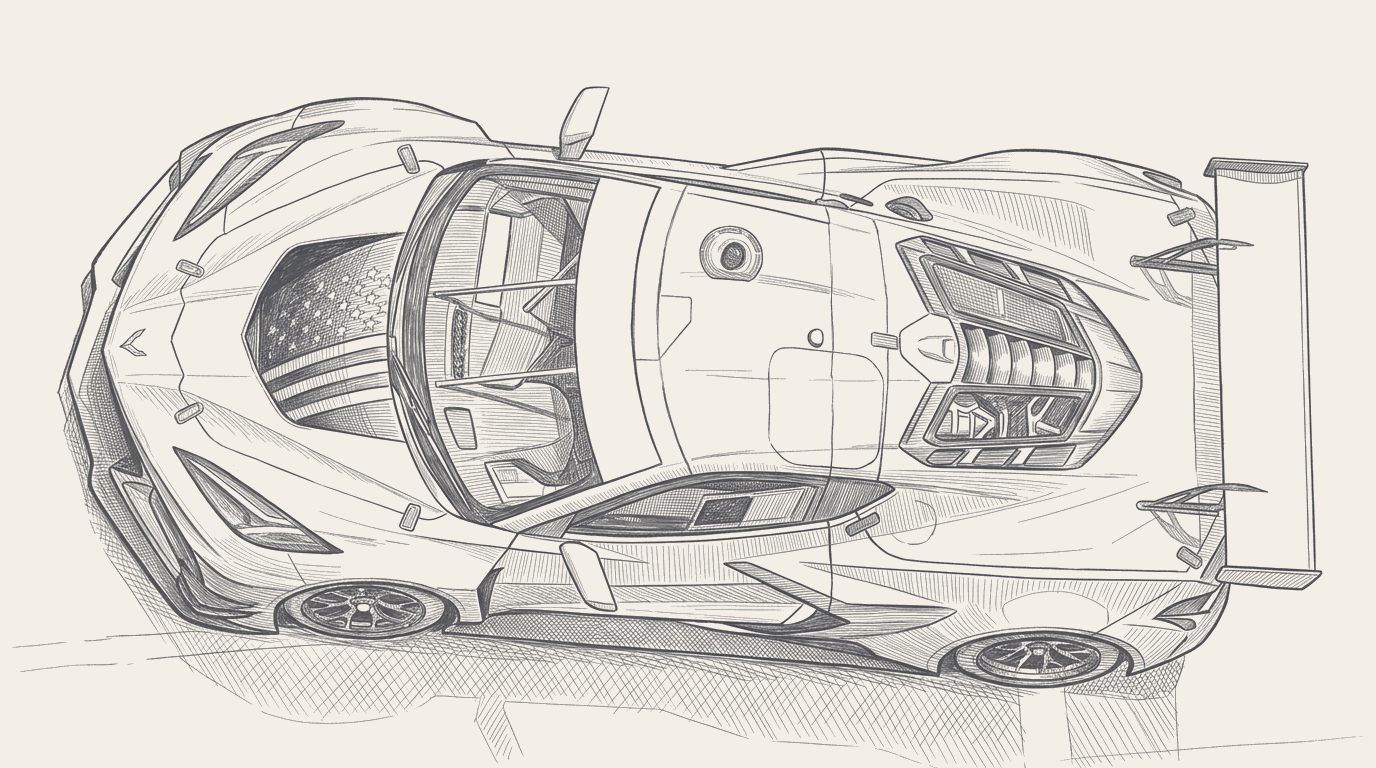
One axle, one truck, twenty-five percent of the season: how a transporter fire on Interstate 5 took DXDT and Robert Wickens out of Laguna Seca.
A suspected left-rear axle failure on the DXDT Racing transporter ignited a fire on Interstate 5 north of Bakersfield on Wednesday morning. The rig had stayed on the West Coast after the Long Beach Acura Grand Prix two weeks earlier. No injuries, no other vehicles involved, and the rig was about three hours short of WeatherTech Raceway Laguna Seca when the failure happened. By Thursday afternoon team manager Bryan Sellers had told Sportscar365 the damage was too substantial for the team to continue moving forward, and the entry was withdrawn from Sunday's race. The Sunday grid drops from 34 cars to 33. The GTD class drops from 14 to 13. Robert Wickens's five-race 2026 GTD program loses one of its four remaining outings before the green flag falls.
What the fire actually destroyed
Sportscar365 confirmed the withdrawal on April 30 and laid out the working theory on the fire's origin. The team's mechanical inspection on the I-5 shoulder tracked the cause to a left-rear axle assembly that failed under load on the freeway, ignited the fire, and burned the rig and its contents through the morning. RACER's reporting on the fire and the team statement had Sellers walking through the salvage decision in detail. The Chevrolet Corvette Z06 GT3.R itself, the GTD entry that Wickens, Mason Filippi and Sellers had been running, was inside the trailer. The team's spare chassis was on the East Coast at DXDT's home shop in South Carolina. Trucking the spare to Monterey was floored as an option, but the 2,600-mile, 40-hour drive would not have arrived until Friday evening at the earliest. The decision tree from there was short.
Sportscar365's original Wednesday report on the transporter fire had the team still hoping for a Thursday recovery path. The Thursday Sellers quote ended that hope. The damage was too substantial for the team to continue moving forward, on his own framing, which is the careful language a privateer team manager uses when the chassis is past repair and the team is still working through insurance disclosure with the trucking company and the chassis manufacturer.
The single-truck logistics of an East-Coast IMSA privateer
The unwritten budget on a privateer IMSA program is the logistics line. Most factory-aligned operations run a two-truck rotation across the country, with one rig at the upcoming round and the second rig either positioning to the next event or recovering at home. The cost of a second truck is the cost of a second driver, a second tractor, a second insurance package, and a second set of crew flights. For a privateer-run GTD entry on a five-race calendar, that cost is not amortisable. A single-truck operation is the default, and the default carries a single-axle exposure. DXDT was running with that exposure. Wednesday's failure was the exposure converting from theoretical to actual.
The pattern is not unusual for privateer GTD runs. The 2024 GMG Racing transporter incident at Watkins Glen, the 2022 Conquest Racing brake-line incident en route to Daytona, and the 2019 Compass Racing trailer roll-over incident on Highway 401 are the most-cited prior cases. None of them resulted in a chassis loss of the magnitude DXDT's Wednesday fire produced. The compounding factor for DXDT was the Long Beach-to-Laguna positioning. The team had elected to leave the rig on the West Coast for two weeks rather than truck it back to South Carolina between rounds, which is the cost-rational decision under any single-truck operating model and which removes the parallel-recovery option a two-truck team would have had on Wednesday afternoon.
The Wednesday-to-Thursday recovery window was therefore the question. With the spare chassis on the East Coast and a 40-hour drive blocking any Friday-morning unload, the team would have arrived after Friday's open practice and would have entered Saturday qualifying with no on-track running and an unhomologated chassis. That is not a viable competitive entry. It is not a viable safety entry either. The withdrawal decision was, accordingly, the right one before lunch on Thursday.
What Wickens loses, and what the program loses
Wickens's 2026 GTD program was announced on March 31 as a five-race calendar. Long Beach was the opener and the program's pole position was the calendar's loudest moment. Laguna Seca was Round 2 of the five. Losing it removes 25 percent of the on-track sample the program was built to produce, and it lands the loss at the program's highest-leverage event. Long Beach pole is a marketing-stage outcome. Laguna Seca is a development-stage outcome, the first chance to read whether the pole was driver-on-form or program-on-trend. The program now has to wait for CTMP, VIR or Indianapolis to resolve that read.
Wickens himself has been the human-interest backbone of IMSA's 2026 sprint program from the season opener. The Bosch hand-controls Pratt Miller-engineered for the Z06 GT3.R, the program-narrative Wickens has carried through eighteen months of public framing, and the disability-pathway story IMSA has reached for in every Long Beach press release are all paused for the next two months. The pause is not a loss in the sporting sense. The story is intact and Wickens's program continuity does not depend on a single round. The pause is a loss in the calendar-arithmetic sense, where one of the four remaining outings was the easiest-to-televise venue on the calendar and is now gone.
The pre-race grid math
The 33-car field on Sunday's grid is the grid number the on-event coverage will read against. The 11-car GTP class is unchanged. The 9-car GTD Pro class is unchanged. The GTD class drops to 13, with the AO Racing "Sketchy" #77 carrying the marketing weight, and with the Paul Miller Racing throwback livery and the Wright Motorsports #91 absorbing the visual coverage that the DXDT entry's white-side-panel tribute would otherwise have shared.
The throwback weekend's other story stays where it was on Wednesday morning. The Apple Computer livery on the Porsche Penske 963s is intact, the 50th Apple anniversary peg is intact, and the 75th Porsche Motorsport anniversary peg is intact. The DXDT withdrawal sits adjacent to those pegs without displacing them. It does displace the GTD class's loudest 2026 narrative for one weekend, and it leaves the IMSA press office with a story they did not budget for: a Wednesday-morning axle failure on a single rig, on a two-week-old positioning decision, that took a 25-percent chunk out of the year's most-anticipated disability-pathway program before the green flag.