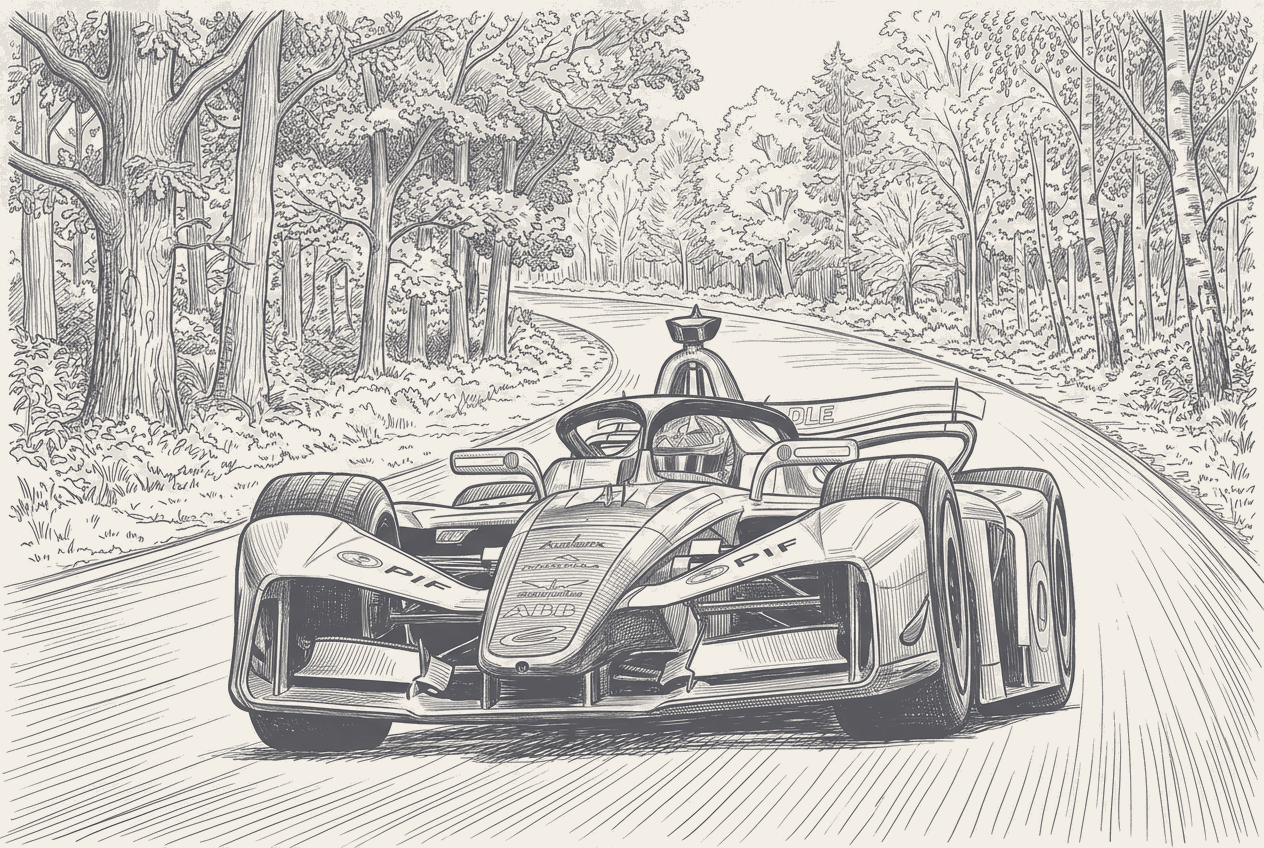
Dan Ticktum ran Formula E's GEN4 car up Goodwood in 42.46s. The quickest combustion car on the hill was 3.85 seconds slower..
Dan Ticktum went up the Goodwood hill in 42.46s on Sunday, driving a prototype of the GEN4 car that Formula E races from next season. Romain Dumas beat him by 0.48s, with a 41.98s run in the Ford Super Mustang Mach-E that broke the 42-second barrier and gave Dumas a third consecutive Timed Shoot-Out win. Alex Summers was third in a Shadow-Chevrolet DN4, on 46.31s. He was the quickest combustion-engined entrant on the hill, and he was 3.85 seconds behind the Formula E car.
Nobody set out to benchmark the GEN4. Goodwood's Shoot-Out is a hillclimb, 1.86km of narrow tarmac between straw bales, and it flatters cars with instant torque and punishes cars that need a gear. That the top two positions went to electric machinery for the first time in the event's history is a fact about hillclimbing at least as much as it is a fact about electric racing cars. Take the caveat seriously, then look at the number again.
The 3.85 seconds is the interesting one. A Shadow DN4 is a Can-Am car with an enormous, uncomplicated pushrod V8, exactly the sort of machine this hill has always rewarded, and a spec-formula single-seater built to race on street circuits put nearly four seconds on it over 42 seconds of running. That is not a marginal gap. It is a different category of performance, produced by a car whose regulations exist to control cost and equalise the grid rather than to chase an outright figure.
What the run does and does not tell you
Ticktum's time was compromised. Dust on the surface and a moment at Mulcombe cost him, per RACER's report, which means the true margin between the GEN4 and the Ford was smaller than 0.48s and the gap back to combustion was larger than 3.85 seconds. Both of those corrections push in the direction that flatters Formula E, which is a reason to hold them lightly rather than to lean on them.
Set against that: the Ford Super Mustang Mach-E is not a racing car in any meaningful sense. It is a bespoke electric hillclimb device, built without a rulebook, aimed at exactly one job. The GEN4 has to complete a season of street racing, survive contact, run to an energy allocation, and be affordable enough that eleven teams can buy it. It is also, at 87kg heavier and 90mm wider than the car it replaces, big enough that Formula E rebuilt its calendar around it, dropping the tightest street venues for permanent circuits. Getting within half a second of the purpose-built object, in a discipline the purpose-built object was designed around, is a more useful result than winning would have been.
Why the series wanted this specific scoreboard
Bringing the GEN4 to Goodwood was one choice, and entering it in the Shoot-Out rather than parading it up the hill between demonstration runs was a second, as The Race set out before the event. Both carry downside. A championship whose central credibility problem has always been the suspicion that its cars are slow put one of them on a public clock against machinery it does not control, in front of an audience predisposed to be sceptical, with no way to manage the result.
Romain Dumas was the specific risk. He has now won the Shoot-Out three years running and five times overall, and the Ford Super Mustang Mach-E exists to do nothing except go up hills quickly. Losing to him by half a second is a considerably better outcome for Formula E than the alternative it was courting, which was losing to him by three, and being handed a headline about it.
Where the number matters next
The GEN4 races from the 2026-27 season, and the honest position today is that a hillclimb tells you about acceleration and traction and almost nothing about the things that will decide races: energy management over a stint, tyre behaviour on a hot street surface, how the car behaves in a pack. Goodwood measures none of that.
What it does establish is a floor. Whatever else the GEN4 turns out to be, it is a car that can put four seconds on a big-block Can-Am machine in three-quarters of a minute, and Formula E now has one performance claim it did not have to make itself. The next real test is a race weekend, where the same car will be asked to do the opposite of what a hillclimb rewards, and where the number that matters will not be the fastest anybody goes.