Genesis arrives at Le Mans with a V8 built from its rally engine twice over, and a ten-year-old luxury brand riding on the result.
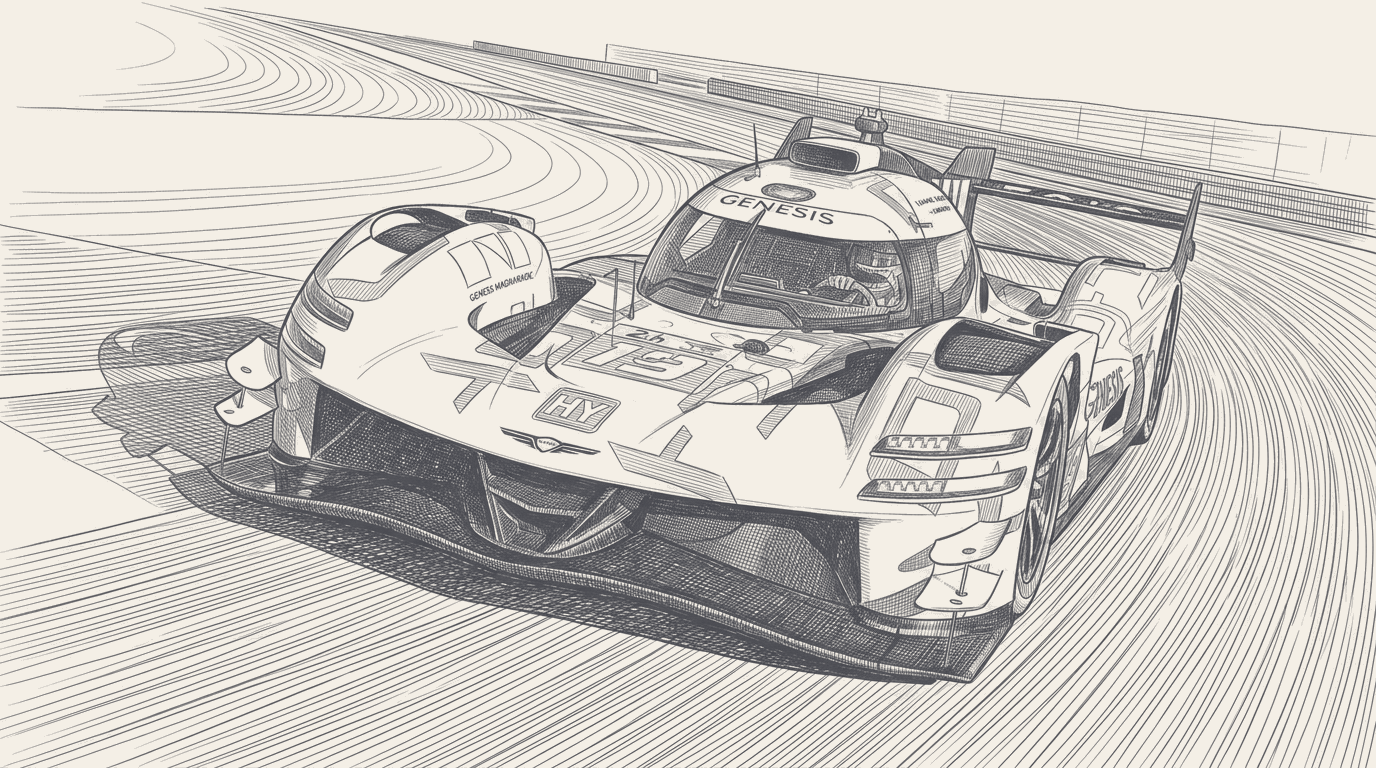
In ten days the 24 Hours of Le Mans gets its eighth Hypercar manufacturer, and the newest one on the grid is powered by the oldest trick in its parent company's racing playbook. The Genesis GMR-001, one of 18 top-class entries at the 94th running, carries a 3.2-litre twin-turbocharged V8 created by doubling the 1.6-litre inline-four from Hyundai's i20 N Rally1. Roughly 60 percent of the parts are shared between the rally engine and the endurance V8 built from it.
Two rally fours, one endurance V8
Hyundai Motorsport's engine shop in Alzenau began work on the G8MR in June 2024, taking the four-cylinder that powered Thierry Neuville to his first World Rally Championship as the starting point rather than designing a bespoke unit. The logic is the same one customer-racing departments have used for decades: a proven combustion architecture, known failure modes, and an existing supply chain beat a clean sheet when the deadline is fixed. The V8 fired for the first time in February 2025, per Genesis's own development log, on schedule.
Around that engine sits the standardized LMDh kit. The G8MR drives through a spec hybrid system: Bosch's motor generator unit, a Williams Advanced Engineering battery, and an Xtrac gearbox, all bolted to an Oreca-built LMP2-derived monocoque. Genesis designs the bodywork, the engine, and the identity; the regulation supplies the rest. That division of labor is exactly why LMDh exists, and why a brand with no prototype-racing history can be on a Le Mans grid 21 months after announcing the program.
Eighteen months from Dubai to La Sarthe
Hyundai announced the project in September 2024, placing it under its Genesis luxury marque with Oreca as chassis partner. Three months later the GMR-001 was unveiled at a launch event in Dubai, where team principal Cyril Abiteboul confirmed the twin-turbo V8 and hybrid driveline and set the schedule that is now coming due: WEC in 2026, IMSA's GTP class in 2027.
A staging program ran underneath the headline project. Genesis placed an Oreca 07 LMP2 in the 2025 European Le Mans Series with IDEC Sport, using the season to train its operational core and its young drivers in endurance routine before the Hypercar ever turned a wheel. Jamie Chadwick and Mathys Jaubert carried that LMP2 campaign, and its one casualty foreshadowed the race roster: Logan Sargeant, originally named in the lineup, stepped away from the program before the season began, and Daniel Juncadella, the man who replaced him, converted the stand-in year into a Hypercar race seat the following September.
Hardware milestones stacked up in parallel. Chassis and powertrain were united for the first time in August 2025, and the GMR-001 completed its shakedown at Paul Ricard the same month, then ran 32 hours at Portimão in September in its first full endurance simulation. Wet-running and durability work continued through the winter, a program the ACO's own coverage tracked as the car logged mileage in changeable conditions.
Competition began at this season's opening round at Imola, which makes Le Mans the program's third race weekend and its first event longer than six hours. The arrival matters to the championship as much as to the brand: the Hypercar field contracted to 18 cars this year from recent 23-car peaks, and the manufacturer count held at eight only because newcomers like Genesis offset the entries incumbents trimmed. On June 1 the team revealed a bespoke livery for the debut, an occasion the ACO marked with its own feature on the field's newest manufacturer. The choreography is deliberate: the brand wants its first La Sarthe appearance to look like an arrival, not an experiment.
The people carrying it
Cyril Abiteboul runs the team while also serving as president of Hyundai Motorsport, the same double role that put him over the WRC program. Technical direction belongs to Francois-Xavier Demaison, with Hyundai Motorsport powertrain chief Julien Moncet over the engine and Genesis chief creative officer Luc Donckerwolke shaping the car's look, a designer-led structure Genesis has made part of the program's identity. Racing operations and brand operations report into the same small set of names, which is unusual among the eight Hypercar manufacturers and entirely the point: the program is the brand exercise.
Crew assignments split experience and project drivers across the two cars. The No. 17 pairs Andre Lotterer, a three-time Le Mans winner, with Pipo Derani, the four-time Sebring victor signed alongside him at the program's launch, plus Mathys Jaubert, the young Frenchman developed through the 2025 IDEC Sport LMP2 season. Lotterer's three wins, all from the Audi era, are the garage's only first-hand knowledge of what winning this race requires. Daniel Juncadella and Jaubert earned their race seats in September 2025, with Juncadella joining Mathieu Jaminet and Paul-Loup Chatin in the No. 19. One car is built around men who have won this race and this discipline; the other is built around the people Genesis wants winning it in 2030.
What a ten-year-old luxury brand wants from a 24-hour race
Genesis sold its first car in 2016, and unlike every rival on the Hypercar grid it arrives at Le Mans with no racing heritage to protect, only one to invent. Ferrari, Porsche, Toyota, BMW, Cadillac, Peugeot, Alpine, and Aston Martin all race, at some level, to ratify performance stories their road cars already tell. Genesis is running the sequence backward: the racing program exists to mint credibility that the brand's Magma performance line can spend later. Hyundai Motorsport's leadership has been explicit that the venture is "more than a marketing initiative", per the championship's own interview, but the marketing logic is plain and nobody involved pretends otherwise.
Sequencing tells you the strategy. WEC first in 2026 builds the legitimacy story in endurance racing's home market; the IMSA GTP entry follows in 2027, aimed at the United States, where a Daytona or Sebring result converts most directly into showroom traffic. The engine choice serves the same narrative economy: a V8 with rally-title DNA is a better brand story than an anonymous bespoke unit, and it ties the luxury marque to the most successful motorsport operation its parent company has ever run. Even the car's design language is sold as a preview, with Donckerwolke's team treating the GMR-001 as the leading edge of the brand's "athletic elegance" identity rather than a one-off racing object.
Beyond the circuit, the rollout extends to where new endurance fans actually live. The GMR-001 launched in the Le Mans Ultimate simulator with an online competition ahead of the race, putting the car in players' hands before it has finished its first 24-hour event. For a marque with no historic grid photos to trade on, the sim release does what heritage marketing does for its rivals: it gives people a way to drive the story. A teenager who races a GMR-001 at virtual La Sarthe this month is the Magma customer the program is designed to mint a decade out.
Ten laps, five timed
Sunday's Test Day is where the abstraction ends. All 62 cars share six hours of running on June 7, and any driver new to the race must complete ten laps, five of them timed, to validate their entry. Those will be the GMR-001's first laps of La Sarthe in any configuration: no amount of Portimão endurance running simulates a 13.6-kilometre circuit where the car spends most of its lap at terminal velocity in traffic spread across three classes of closing speed. Before that, scrutineering runs Friday and Saturday in Le Mans city centre, the most public technical inspection in racing, where the newest car on the entry list gets its first crowd.
The opposition sets the curve the debut will be graded on. Ferrari arrives with three 499Ps chasing a fourth consecutive overall win, and the other seven manufacturers on the entry all carry prior Hypercar racing mileage into the week. Genesis has two six-hour races. Six-hour events reward sprint speed and clean execution; a 24-hour event audits supply chains, spares planning, driver-change choreography at 3 a.m., and the hundred unglamorous systems a two-year-old team has never run in anger. That audit, not the timing screen, is the real debut.
What counts as success next week is unglamorous by design. Two cars running at the flag, clean pit cycles, no self-inflicted contact, and a data set that makes the 2027 IMSA expansion look like a plan rather than a hope. A 24-hour debut is the one motorsport result a manufacturer cannot stage-manage, which is precisely why a brand built on design-first storytelling chose it. The flag drops at 16:00 local time on Saturday June 13, and from that moment Genesis gets its first unscripted review.