The one part of an LMDh car the rules leave alone, and the road V8 Ford put there.
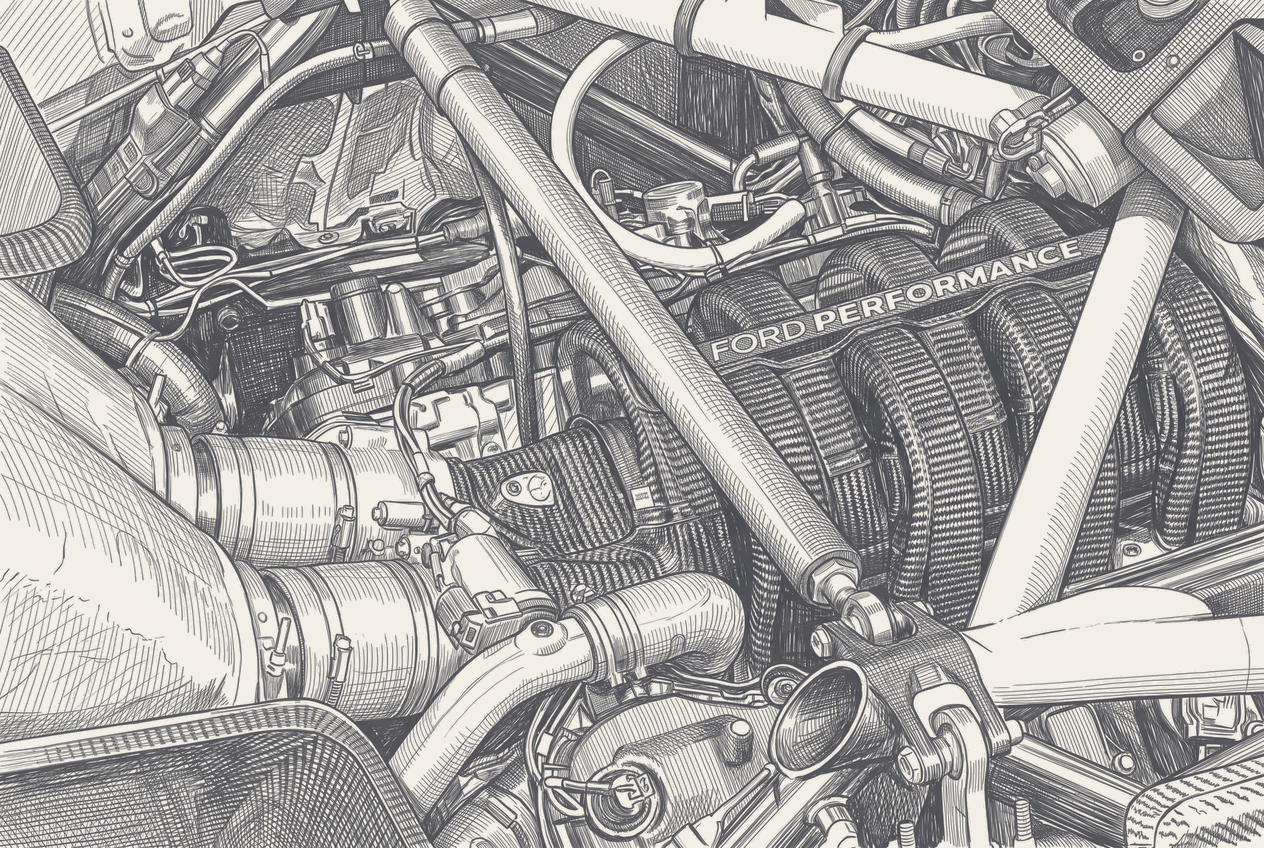
On July 16, at ORECA's factory in southern France, Ford started the V8 in its 2027 endurance prototype for the first time with the engine mounted in the car, the milestone RACER filmed after months of dyno running in Dearborn, Michigan. The 5.4-litre unit had turned over thousands of times on the bench; it had never done so inside the chassis it will race. Program manager Dan Sayers called the fire-up a "critical validation step," and what it validated is the one component the LMDh rulebook still leaves to the manufacturer to get right on its own.
What the formula shares, and what it does not
LMDh was written to make manufacturers share. A team buys its chassis from one of four approved constructors, ORECA in Ford's case, and every car in the class runs the same specified hybrid unit, the same control battery and the same standard electronics, a deliberate convergence meant to let a marque reach the top class of endurance racing without funding a clean-sheet Le Mans Hypercar. The internal combustion engine is the exception the rules carve out. It is the part no supplier hands you and no rival shares, and it is the part Ford chose to build itself.
The engine is a 5.4-litre naturally aspirated V8 built on the Coyote family that powers the road Mustang, designed, developed and assembled in-house by Ford Racing in Dearborn rather than contracted to an engine specialist. Sayers was plain about the reasoning. "We are doing everything from an engine perspective in-house and we're doing that because we can react faster, we can learn faster and we can bring that back to the production side of the business," he said. The engineers turning a racing V8 to a Le Mans deadline sit inside the same operation that builds the road block, so whatever the program learns about that engine has a short path back to the road cars that share its lineage.
An in-house engine buys the thing a late entrant lacks
Keeping the powertrain in Dearborn buys Ford speed, which is the currency a latecomer is short of. The top class it is entering has been racing since 2021, and Ford is developing its engine, its integration with the spec hybrid and its calibration in parallel against a fixed 2027 start date. The reported total system output for the class sits at around 671 bhp, the ceiling every LMDh car is balanced toward, so the development gain is not in peak power but in how quickly the team can find reliability and driveability inside that cap. A supplier engine would arrive as a fixed quantity. An in-house one can be changed on the team's own clock.
In August, Ford's prototype begins on-track testing at circuits across Europe before the program moves to the United States, with the first sessions aimed at reliability, hybrid integration and aerodynamic validation rather than lap time. Six factory drivers, confirmed in June, will share the development mileage and the simulator work that has run alongside the dyno program. None of it scores a point until 2027, when the car enters a full World Endurance Championship season that includes Le Mans.
The grid Ford is joining
Ford is not arriving alone. It joins McLaren and Genesis as manufacturers entering the top class for 2027, adding to a Hypercar field that already includes Ferrari, Toyota, Porsche, Cadillac, BMW, Alpine, Peugeot and Aston Martin. Ford's own history in the class is the GT40's run of outright Le Mans wins in the late 1960s, and its stated target this time, per Road and Track, is another overall victory rather than a class trophy. The engine that will have to deliver it fired for the first time on July 16. The next thing it has to do is run in a car that moves.