The FIA has put tyre-particle filters in Zandvoort's drains, and the plan is to leave them there.
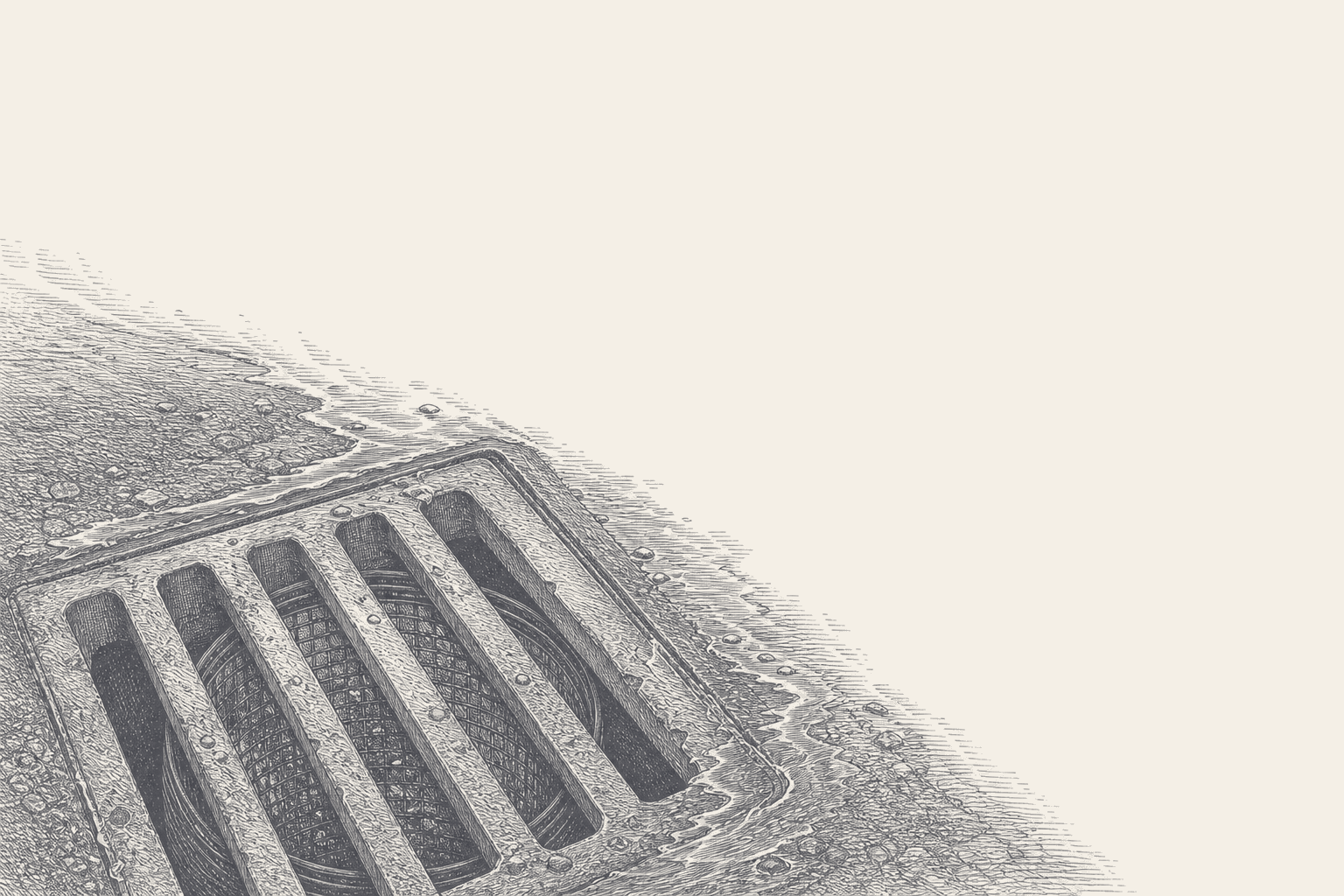
Two prototype filtration units went into the drainage network at Circuit Zandvoort ahead of round 12, covering approximately 3,300 square metres around the pit lane and the Tarzanbocht. They are not there to filter anything the Formula 1 cars do. They sit in the stormwater system, which is to say they only work when it rains, and what they are designed to catch is the material that road tyres shed onto asphalt and that runoff then carries into the water table.
Nicolas Aubourg, the FIA's head of R&D, sets out the mechanism plainly. "With road cars we've had particles being emitted not only by the power unit, but also by brakes and tyres. Those particles are released into the air and into the ground. When it rains, the stormwater collects the particles and can carry them into waterways and, potentially over time, into the sea. It is a growing problem for society, but we think that motor sport can help tackle the issue."
The FIA's own account sets the scale for you: "a grand prix weekend involves 22 cars on a closed circuit, against the hundreds of thousands of road vehicles using the surrounding road network." A governing body installing environmental hardware at its own event usually wants you to look at the event. This one points at the roads outside the gates and describes the circuit as a test bench.
The number has two different origin stories
Both organisations behind the installation give the same headline retention figure and place it in different rooms. Aubourg's version: "In laboratory testing, the system captured up to 99% of the particles in the water passing through it, with a maintenance interval of around a year. What we now need to establish is how a prototype performs in real conditions at a circuit." Audi, whose environmental foundation funds the URBANFILTER programme the prototypes come from, published its own account a day later stating that "during recent testing at the Zandvoort racetrack, a retention rate of up to 99% was achieved, depending on the intensity of the rain and the characteristics of the particles."
One says the 99 per cent came from a laboratory and the circuit test is still to come. The other says the circuit already produced it. Neither figure has been published with a method attached, and the maintenance interval rests on Aubourg alone. Take the number as a design target that two partners describe inconsistently rather than as a result.
The measurement work is asserted rather than documented
The filters are the second half of a programme whose first half is counting particles. Aubourg describes a two-year measurement effort run with Imperial College London: "This was the second year that we monitored particle emissions at the Belgian Grand Prix. They had a lab based in Stavelot and a lot of sensors in the paddock, in the pit lane, in the grandstands, etc. but also in the background, very far from track activities, to compare the level of particles with and without activities." Le Mans got a different treatment, aimed at spectator traffic rather than race cars. "What we did at Le Mans was unique in the sense that we put the machine very close to the road cars themselves and in a place where you are not polluted or disturbed by cooking, fireworks or similar sources."
Nothing published by Imperial College London names this partnership, the Stavelot laboratory or the Le Mans deployment. The only corroboration outside Aubourg's own account is a line in the FIA's 2024 activity report describing a FIA Foundation-supported project investigating non-exhaust particle emission analysis in its world championships. No named researcher, no methodology, no data. Aubourg says the intention is to release it: "The idea is to have a pool of data that will help the research community understand the phenomenon, because it is complex." Until that happens, the measurement half of this project is a claim about work rather than work anyone can check. No trade outlet had covered the Zandvoort installation by Friday morning; the only account outside the FIA's is Audi's, and Audi is a partner.
Why tyres, and why now
The reason a motorsport governing body can plausibly claim road relevance here is that non-exhaust emissions have been getting relatively larger while everything else has been shrinking. The European Commission's Joint Research Centre put tyre wear at one third to one half of unintentionally released microplastics and at 5 to 30 per cent of road transport particulate matter, with mean abrasion across roughly 300 measurements of about 110mg per kilometre per vehicle. The OECD reached the direction of travel in 2020, projecting that non-exhaust sources would make up the majority of road-traffic particulate matter as early as 2035, and noting the awkward mass arithmetic underneath it: lightweight electric vehicles emit 11 to 13 per cent less PM2.5 than combustion equivalents, and heavier ones emit 3 to 8 per cent more.
A 2024 University of Portsmouth study, cited in the FIA's own account of the project, is rendered there as putting tyre particles at around 28 per cent of microplastics entering the environment globally. Portsmouth words it as nearly one-third. That gap is small; the gap between the denominators used across this literature, global against European, all microplastics against unintentional releases only, is not, and it is why the tyre-wear share is quoted at anything from a fifth to a half depending on which paper is open.
Regulation arrived at the same subject in 2024. Euro 7, adopted by the Council on 12 April 2024 and published in the Official Journal on 8 May as Regulation (EU) 2024/1257, sets limits on tyre abrasion and brake particles for the first time. The Pew Charitable Trusts, tracking the UNECE work that supplies the abrasion test method, dates the first limits for new car and van tyres to 30 June 2028. That date could not be checked against the UNECE release itself, which would not load.
The device is designed to be abandoned
URBANFILTER started in September 2020 as a TU Berlin and Audi Environmental Foundation project, with GKD supplying the filtration mesh and ARIS the rainwater engineering, and has been deployed in Berlin, in Copenhagen and at an ADAC wet-handling track. The FIA joined and got prototypes in the ground fast by its own account: sample collection to designed and manufactured hardware in a little over a year. Sven Veit, who runs the Audi foundation, describes the racing element as reach rather than research, saying the FIA is "providing this important issue with a global stage and a testing ground under extreme conditions."
Aubourg's end state is the useful part, because it describes a product with no motorsport in it. "If we do convince the promoters of other street circuits that we could install these filters, we can race with fewer particles leaving the site and leave the filters behind afterwards for everyday road traffic. That would represent a significant quantity of particles that do not go into the environment. I think it's also a legacy from motor sport to road cars that could be implemented at scale." Circuits are the sales channel, not the beneficiary. A street circuit is a public road eleven months of the year, and the filter's working life starts when the barriers come down.
Zandvoort is a permanent circuit rather than a street one, which makes it a strange place to prove that particular thesis, and it is also the last place Formula 1 will use to prove anything. The championship leaves the Netherlands after this weekend, a departure confirmed by the promoter in December 2024. If the prototypes stay in the ground at Tarzanbocht, they will spend the rest of their maintenance cycles filtering runoff from a circuit F1 no longer visits, which is either the clearest possible demonstration of Aubourg's point or an accident that happens to look like one. The FIA says it will start approaching other circuits next year. Rain at Zandvoort between now and Sunday is what decides whether it has anything to approach them with.