
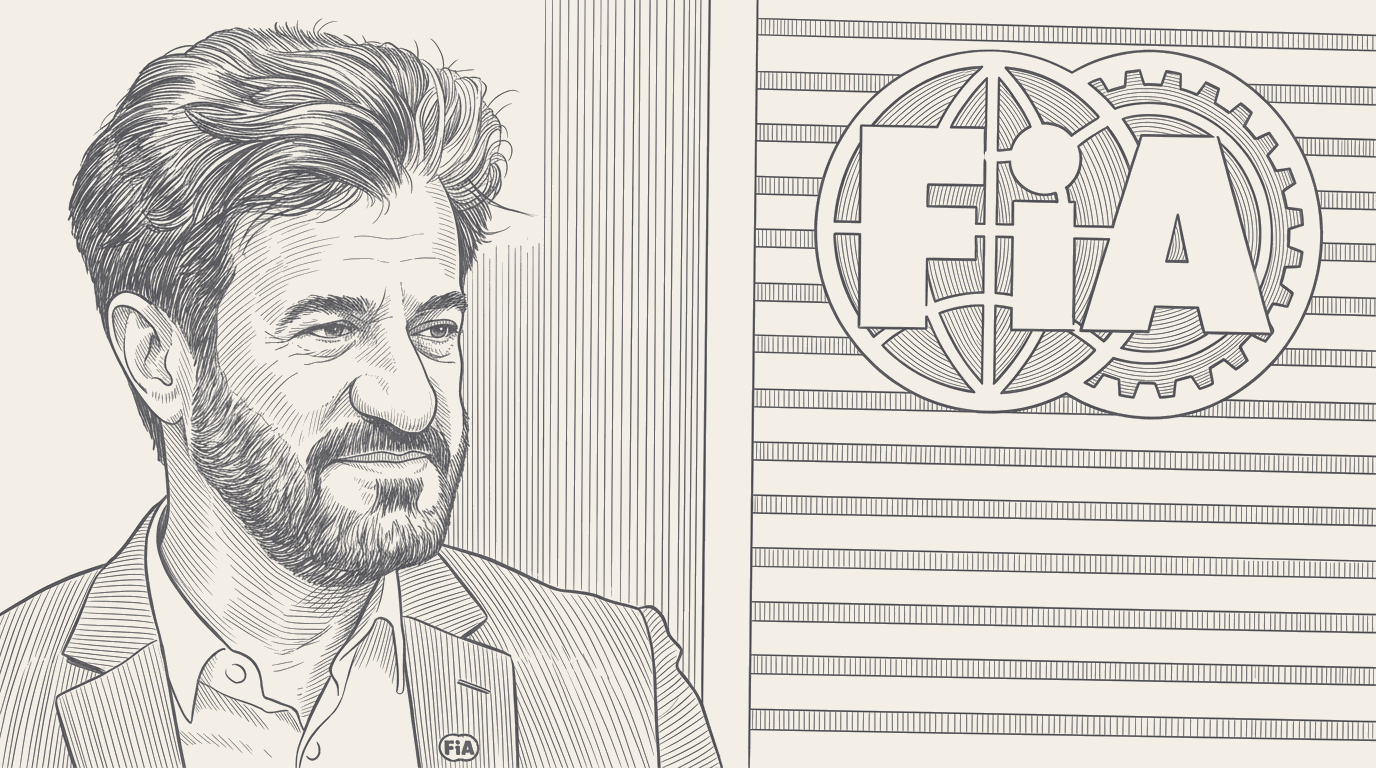
Three live structures, one looking-into: how Ben Sulayem's Miami remark put every Concorde-adjacent ownership question back on the FIA agenda.
Mohammed Ben Sulayem told reporters in the Miami paddock the FIA is "looking into" multi-team ownership in F1, with the on-record qualifier "as long as you are not trying to take it because you don't want others to take it, or also get voting power when it comes to the regulations, then maybe it's OK. But then I do believe that owning two is not the right way, this is my personal point of view." The remark landed three weeks after Cadillac took the eleventh grid slot for 2026, the day after Lawson disputed a Racing Bulls give-back order on the radio, and the same day Reuters carried Ben Sulayem's separate "I feel he will be back" comment about Christian Horner. Three current structures sit at different points along the multi-team line. Each passes a different element of the Ben Sulayem objection. The FIA's review will have to treat them as three different problems, not one.
What Ben Sulayem actually said and what he did not
The remark was conditional. Ben Sulayem did not announce a rule. He did not name a structure. He did not set a timeline. He framed the question with two filters: ownership for blocking purposes is not OK, ownership that produces voting weight on the regulations is not OK. Both filters are about the FIA's own institutional autonomy, not about the competitive question of B-team race-craft. The competitive question, the kind the Lawson-Verstappen Miami sequence put on display, is downstream of the institutional one in the Ben Sulayem framing. Per Reuters' transcript, the FIA president said multi-team ownership is "a complicated area." That language matters because it is the language of preliminary review, not of preliminary directive.
The FIA's options, given the conditional framing, are to publish a discussion document for the Sporting Working Group inside three months, to fold the question into the Concorde renewal cycle which runs through 2030 and reopens for the 2031 cycle, or to do nothing and let the Lawson-Verstappen sequence and any successor incidents serve as the de facto policy through accumulated practice. Each path has costs. A discussion document opens a public record that any of the three live structures can litigate. A Concorde-cycle deferral effectively grandfathers all three structures through 2030. Doing nothing leaves the FIA in the position of the body whose president said the question was complicated and then did not act.
Red Bull and Racing Bulls: the voting-weight structure
Red Bull GmbH owns both Oracle Red Bull Racing and Visa Cash App Racing Bulls through the same holding. Permian Capital, the recent investment partner, sits across the structure rather than dividing it. The voting weight produced by the structure, two of ten Constructors' votes inside the Sporting Working Group, three of fifteen Drivers' votes when the third Red Bull driver is counted (which happens at any meeting where driver representation is by entry rather than by Constructor), is the cleanest match to the Ben Sulayem voting-power objection. Red Bull's structure exists predominantly because the FIA approved it in 2005 when Toro Rosso was first registered. The grandfathering is procedurally settled, but the voting-weight question Ben Sulayem named is not.
The Lawson Miami sequence is the public exhibit. Per RaceFans' Tuesday editorial, Racing Bulls should not have asked Lawson to give the position back to Verstappen on lap 2, and Lawson was right to dispute the order on the radio. The order from race engineer Alexandre Iliopoulos came after the wheel-to-wheel exchange at Turn 11 in which both drivers ran off the track. Lawson rejoined ahead. His response to the team channel: "He drove into the side of me." Per PlanetF1's reconstruction of the untelevised radio, Lawson told the team he had not gained an advantage and did not believe he was at risk of a penalty. The race ended with Lawson out of the points after a gearbox failure; David Coulthard told the Sky Sports F1 Show podcast that Lawson "was fighting for his career" with the call.
The sequence reads as B-team race-craft because the give-back order produced no on-track justification (Lawson was not at risk of a penalty), produced no strategic benefit to Racing Bulls (Lawson was running for points, the give-back put him in dirty air for the next stint), and produced a downstream Verstappen-aligned outcome (the Red Bull moved up one position with Racing Bulls compliance). Whether the order was operationally reasonable inside Racing Bulls' own race-day workflow is a separate question from whether it reads, on the FIA's looking-into review, as the kind of single-decision-unit behaviour that would justify a multi-team-ownership directive. Ben Sulayem named voting weight, not race-day team orders. But the race-day team order is the visible exhibit that makes the institutional question politically actionable.
Audi and Sauber: the supplier-weight structure
Audi's 2026 entry is structurally different. The team is not a Sauber satellite, it is a wholly-owned Audi-AG subsidiary that incorporated the former Sauber operation as a chassis manufacturing capability. Audi is also a power-unit manufacturer, supplying its own works entry exclusively. The structure therefore produces single-team voting weight (one of ten Constructors' votes), single-PUM voting weight (one of four power-unit manufacturers in 2026, alongside Mercedes, Ferrari, and Red Bull Powertrains-Ford), and zero customer-supply structure. There is no second team in the Audi tree.
What there is, structurally, is a question about whether a manufacturer that controls both a chassis programme and a power-unit programme inside its own group represents a different kind of multi-team-equivalent leverage. Audi controls supplier weight on the PUM side that no other single-team entry currently controls in the same combination. Mercedes' PU programme supplies multiple teams; Ferrari's PU programme supplies multiple teams; Red Bull Powertrains-Ford supplies Red Bull and Racing Bulls. Audi supplies Audi only. The vertical integration is the clean opposite of Mercedes' or Ferrari's horizontal supply, and it is the structure Ben Sulayem's "supplier weight" filter, when it gets articulated in the FIA review, will probably engage with first.
The 2026 evidence for the Audi structure to date has been reliability-side, not regulatory-side. The 4.8 barA intake-pressure breach on Bortoleto's car at the Miami Sprint and the parallel Hulkenberg formation-lap PU fire are the symptoms of a chassis-PU integration still being calibrated on track. They are not the symptoms of a multi-team-ownership leverage problem. The Ben Sulayem review will have to decide whether to engage the Audi structure as a multi-team-equivalent question or whether to leave it inside the standard PUM-supplier framework. The PUM-supplier framework is the procedurally cleaner option. The multi-team-equivalent reading is the politically louder one.
Mercedes and Alpine: the minority-stake structure
The third live structure is the most conditional. Mercedes' minority-stake interest in Alpine, which has been reported through the late April-early May window with no on-record confirmation from either party, would represent a cross-supplier holding rather than a single-holding structure like Red Bull's. Mercedes supplies Alpine's power-units in 2026 under the Renault-Alpine PU shutdown (the Otro Capital 24% Alpine sell-down sits as the parallel commercial document). A Mercedes-Alpine minority stake would mean Mercedes holds a financial position in a team it also supplies on the technical side. The voting-weight question is sharper here than in the Red Bull case because the Mercedes structure would gain nothing from voting in lockstep with Alpine; the leverage Mercedes would gain is optionality, the ability to use the Alpine stake as a hedge against future regulation-cycle outcomes.
Ben Sulayem's "looking into" framing was first reported in response to a question about the Mercedes-Alpine structure. The Otro Capital sell-down is the precondition: a 24-percent Alpine sale opens the door for an incoming minority partner, and the most-reported candidate is Mercedes. The structure would not exist yet, which means the FIA can shape it through pre-approval conditions rather than have to litigate a fait accompli. The pre-approval option is procedurally the cleanest path the review has, but it requires the FIA to write the framework before the deal closes. The deal closing on the calendar Otro Capital wants is not aligned with the framework-writing speed the FIA review can support.
What the review actually has to write
The three structures, taken together, define what a multi-team-ownership rule would have to cover. It would have to address single-holding two-team voting weight (the Red Bull case), it would have to address supplier-weight and chassis-supplier vertical integration (the Audi case), and it would have to address cross-supplier minority-stake leverage (the proposed Mercedes-Alpine case). Each of the three is a different procedural document. A single rule that covers all three is, in regulation-drafting practice, almost always a compromise rule that does not cover any of them well.
The historical precedent the review will lean on is the 2014-2015 Sauber-McLaren-Force India period when the FIA briefly considered customer-team rules to constrain B-team behaviour. The 2014 review produced no rule. The Concorde renewal absorbed the question, and the customer-team frame faded as the financial incentive structures shifted. The 2026 review, if it follows the same path, would produce a discussion paper, no rule, and a Concorde-renewal absorption. That outcome would leave Red Bull's grandfathering intact, leave Audi's PUM-supplier framework intact, and either approve or block the Mercedes-Alpine structure on a case-by-case basis through 2030.
What the Lawson contract arc actually does
Lawson is in his second Red Bull contract year. His Imola seat depends on whether the team continues to read him as the development Racing Bulls driver or as a Verstappen-support resource. The Miami sequence put the latter reading on the public record in a way the team cannot retract. If Lawson holds the Imola seat and produces a points-paying weekend, the contract conversation reverts to standard mid-season form. If Lawson loses the seat or the seat performance, the Miami sequence becomes the primary exhibit for the FIA review, because it will be remembered as the moment the B-team structure visibly chose Verstappen over its own driver.
The Coulthard "fighting for his career" line is the human framing the review will not be able to ignore. It is the kind of paddock-vetted language that converts an institutional question into a personnel question, and personnel questions move faster through the FIA's looking-into process than institutional ones because the press cycle around them is shorter. The institutional question (does multi-team ownership produce voting weight that distorts the regulation) is the slow-burn document. The personnel question (does multi-team ownership produce single-decision-unit race-day behaviour that costs a development driver his career) is the fast-burn one. Both feed the same review. Only one produces immediate political pressure on the FIA's pace.
The Horner sidebar that is not actually a sidebar
Ben Sulayem's separate Reuters comment that he expects Horner to return was framed as a sidebar to the multi-team-ownership remark. The structural reading is that it is not. The Otro Capital 24-percent Alpine sale has Horner publicly linked as a possible operational lead, and the proposed Mercedes-Alpine minority stake would land inside an Alpine operational structure that may, by 2027, run with Horner at the helm. Ben Sulayem's "I feel he will be back" sits adjacent to "looking into multi-team ownership" because the same paddock conversation is producing both lines. The review of multi-team ownership and the operational-lead conversation at Alpine sit on top of each other.
The FIA cannot litigate a personnel question. The FIA can litigate an ownership-structure question. If Horner takes an Alpine role inside a Mercedes-Alpine minority stake, the operational and the institutional questions converge, and the multi-team-ownership review becomes the document that decides whether the structure is permissible at all. The looking-into remark, in that frame, is the FIA telegraphing to the Otro Capital deal-team that the deal's structure is in scope before it closes. That telegraph is the fastest mechanism the review has to influence the deal's shape without writing a rule. Whether the deal's principals respond to the telegraph is the May-June question the review's pace depends on.
The credibility question the review carries
Three live multi-team structures, one looking-into review, no published timeline. The credibility question for the FIA is whether the review produces an output before the Cadillac eleventh-team integration completes its first European tranche, before the Otro Capital deal closes, and before the next race-day team-order incident pushes the conversation past the institutional frame into the regulation-failure frame. The pace at which the review has to operate is faster than the pace at which the FIA's discussion-paper-to-rule conversion typically runs. The review is the FIA telegraphing that it knows the question is procedurally on its desk. The next four weeks are how the review either converts the telegraph into a document, defers it to the Concorde cycle, or absorbs it into the standing-practice precedent that the looking-into remark itself becomes part of.