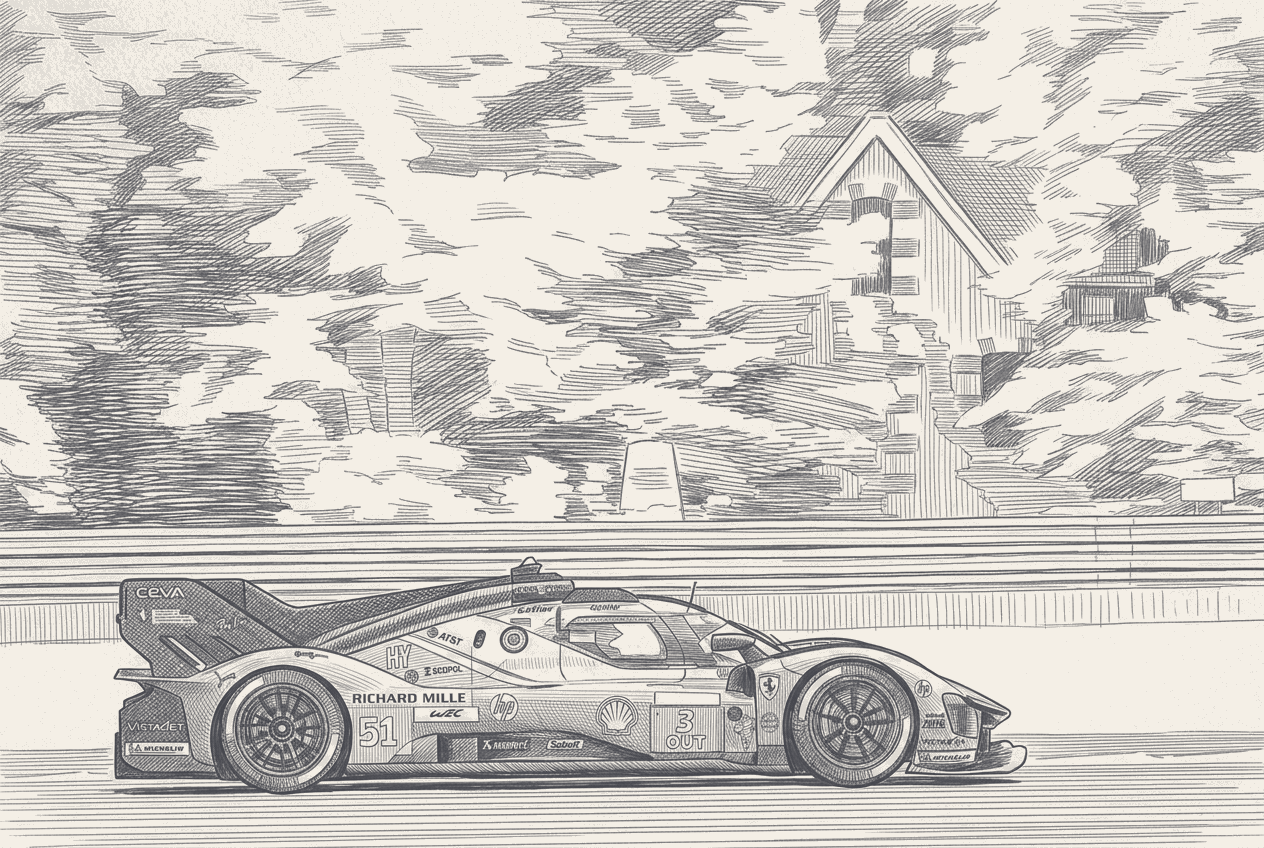
Ferrari will spend three jokers at once on the 499P, making this Le Mans the current car's last.
On the Wednesday of Le Mans week, Ferrari's endurance technical chief Ferdinando Cannizzo put a number on the 499P's future: "I guess around three," he said of the Evo jokers Ferrari plans to spend on a 2027 overhaul, "but it could be four depending on the interpretation," Autosport reported from the marque's first press call of the week.
Each Hypercar is allowed five Evo jokers, the regulated performance upgrades of the LMH and LMDh rulesets, across its initial homologation life, with a further two available over the extension running to the end of 2029. Ferrari has used exactly one since the car's 2023 debut, a brake cooling revision introduced at Interlagos in July 2024. Spending three or four at once on a single 2027 package empties, in one move, an allocation Ferrari has spent three seasons refusing to touch.
Multiple updates covered by one chapter of the technical regulations can, in principle, count as a single joker, which is the "interpretation" in Cannizzo's arithmetic: a suspension revision, a cooling revision and an aero revision filed as one integrated package may cost fewer jokers than the same changes filed separately. Any joker requires sign-off from the FIA and the Automobile Club de l'Ouest, and discussions with the rule makers are already underway, Cannizzo confirmed, saying he was confident of approval for 2027. Ferrari would "tackle different areas of the car in an integrated way, which is the same as when we conceived the car," he added. "Instead of using them individually, we decided to use them together to create a profoundly evolved car," he explained in remarks carried by Sportscar365. Which areas, he declined to name, though in a Hypercar built around coupled aerodynamic, mechanical and powertrain systems, a package conceived together behaves differently from three patches applied in sequence, which is the engineering argument for waiting and bundling rather than drip-feeding.
Cannizzo answered the why-not-sooner question in two halves. Ferrari chose to bring no jokers for 2026, he said, citing "variables" that included Michelin's new slick range built with 50 percent sustainable materials, and has always maintained the decision was its own rather than a block by the rule makers after the 2025 campaign that delivered both the drivers' and manufacturers' titles. The second half is the blunter one: "At some point when you are working on extracting more performance, you reach a limit and you need to make changes." Use-it-or-lose-it pressure does the rest, since jokers left unspent when the ruleset expires are worth nothing, as Autosport's analysis of the plan noted.
What Ferrari is not doing is starting over. The rulebook permits one full second homologation per car across the lifecycle, and Cannizzo stressed the 2027 work will build on the existing one instead. The 499P already absorbed minor aero trims this year through the grid-wide rehomologation, in which every Hypercar passed through the Windshear tunnel in the USA to fit a refined performance window, and the current LMH and LMDh rulesets now run to the end of 2029, which gives a 2027 package three seasons to repay its development cost. The overhaul is a rebuild within the same envelope, not a new car wearing the old name.
Qualifying week supplied the argument for change in real time. BMW took its first Hypercar-era Le Mans pole at 3:22.564 after the quickest Cadillac was demoted for a pit lane start infringement, the ACO confirmed on Thursday night, while Genesis put its GMR-001s sixth and ninth on the marque's debut. Ferrari's week ran the other direction: the defending-winner #83 missed the Hyperpole cut entirely and starts 17th, and the best factory car, the #51, lines up eighth.
Ferrari therefore arrives at this weekend's race chasing a fourth consecutive Le Mans win from deep in the field, in the same week its technical chief stamped a sell-by date on the car in the garage. Whatever happens between 16:00 Saturday and 16:00 Sunday, the 499P that does it will be the last of its specification to race at La Sarthe.
Three straight wins came with one joker spent, which makes this weekend the closing data point on how far a near-frozen car can carry a manufacturer against a field that kept developing. A fourth win, from eighth and 17th on the grid, would be the best argument yet that Ferrari was right to hoard its allocation, and the 2027 sign-off conversation with the FIA and ACO would open with the question of how much evolution a winning car is allowed to need.