Cadillac wins its sponsor's home race in Detroit, and the two drivers who did it report to Le Mans in ten days.
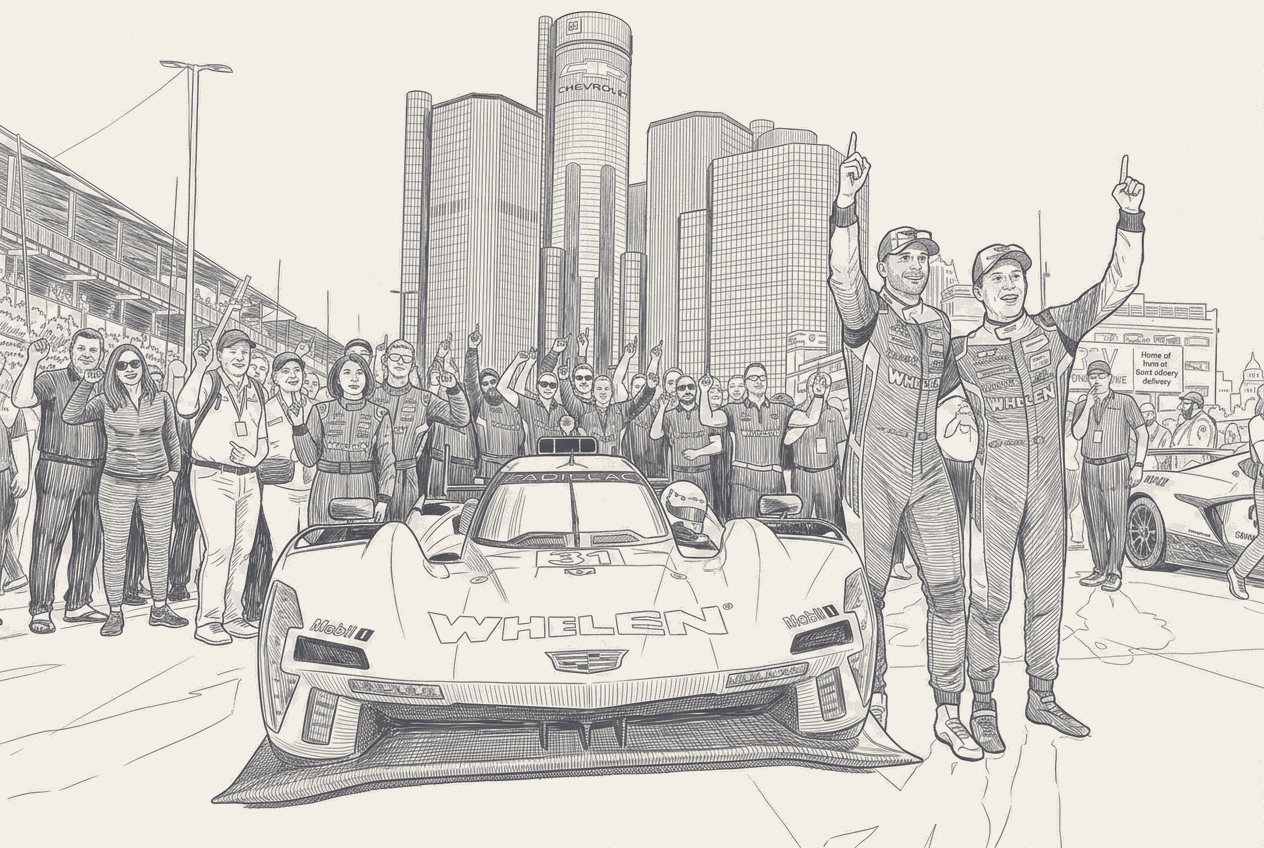
The No. 31 Cadillac Whelen V-Series.R of Jack Aitken and Earl Bamber won the Chevrolet Detroit Sports Car Classic from pole on May 30, on a street circuit that runs in the shadow of the Renaissance Center, the building General Motors uses as its headquarters. Per IMSA's own report, Bamber led the opening stint, handed to Aitken, who built a 14-second margin, absorbed a late full-course caution for debris, and aced two restarts to pull clear of the No. 25 BMW of Philipp Eng and Marco Wittmann by six seconds. It was, in the most literal sense available to a manufacturer, a home win.
A hometown double, then the bigger date
Corvette won GTD Pro on the same afternoon, giving GM a Cadillac-and-Corvette double on Detroit soil, with the No. 10 Wayne Taylor Racing Cadillac of Ricky Taylor and Filipe Albuquerque completing the GTP podium. Aitken took over the GTP drivers' championship lead with the win, per NBC Sports, and the No. 31 logged its seventh consecutive GTP podium. For a program whose entire commercial premise is that Cadillac is a credible top-class endurance brand, a sponsor-named win outside the factory door is close to the ideal photograph.
That photograph is not the point. What decides Cadillac's 2026 is ten days out. The 94th 24 Hours of Le Mans runs June 10-14, the third round of the FIA World Endurance Championship, and the two men who won Detroit are on the entry. Aitken and Bamber are both listed in the No. 38 Cadillac Hertz Team JOTA car for Le Mans, alongside Sebastien Bourdais.
Two programs, one manufacturer, shared drivers
Worth stating plainly, because it travels poorly in a results table: Cadillac runs two separate top-class operations. Cadillac Whelen contests the IMSA WeatherTech SportsCar Championship in North America, the program that won Detroit. Cadillac Hertz Team JOTA contests the WEC, the program that goes to Le Mans. They are different entries with different car numbers, and they share both the V-Series.R chassis under the LMH regulation and, in Aitken and Bamber, two of the drivers.
That shared roster is what makes the Detroit-to-Le Mans line real rather than rhetorical. A driver in form on a street circuit is not automatically a driver in form at the Circuit de la Sarthe; the disciplines barely rhyme. But Aitken's restart management and Bamber's opening-stint pace at Detroit are the same skills the No. 38 needs across a 24-hour race, and both drivers arrive at Le Mans having just executed cleanly under late-race pressure. The JOTA team has been reshuffling its driver pack ahead of the race, with Louis Deletraz standing in for the recovering Alex Lynn on the sister No. 12, so any settled, in-form pairing is a fixed point the team can build around.
More durable than the win is the streak around it. The No. 31's seventh consecutive GTP podium is the marker of a program that finishes, which is the trait a 24-hour race rewards above outright speed. Cadillac's LMH effort spent its first seasons as the quick car that did not always last. A run of podiums that long, on circuits as different as a Detroit street layout and the high-speed sweeps that precede it, is the profile of an operation that has learned to convert pace into results. That is exactly the conversion Le Mans demands, over a distance where a single hour of trouble erases a year of speed.
What the win is worth, and what it is not
A hometown win is a marketing asset with a short shelf life. It validates the chassis, the drivers, and the marketing line in a single afternoon, costs Cadillac nothing it was not already spending, and is forgotten the moment a Hypercar leads Le Mans on Sunday. Cadillac's ambition runs past that. Team principal Dieter Gass has said the program is out to be in a position to win the 24 Hours, a different and harder claim than winning a 100-minute sprint on a 1.645-mile street layout, against a Hypercar grid that now includes Ferrari, Porsche, Toyota, BMW, and the rest of the field the regulation was written to attract.
Cadillac arrives at the Sarthe with the most useful possible momentum: two drivers who just won, a chassis that just won, and a result photographed in front of the building that signs the cheques. None of it is worth a single position once the flag drops on June 13. But a manufacturer that wanted to walk into Le Mans believing it belonged could not have scripted the ten days before it any better than this.