The only adapted braking system Robert Wickens owns burned in a transporter fire; a supplier coalition rebuilt it in four weeks for his home race..
A transporter fire roughly two months ago, on the road to Laguna Seca, burned the only adapted hand-control braking system Robert Wickens owns. The one-of-one hardware lets him brake by hand, the workaround he has raced with since a 2018 IndyCar crash left him paralysed, and it is not a part with a shelf or a catalogue number. When it was gone, so, on paper, was the rest of his season. Motorsport.com reported that a coalition of Bosch, Pratt Miller, DXDT and Corvette Racing built and delivered a replacement in four weeks, and that he lines up for the No. 36 DXDT Corvette this weekend.
Wickens will start that car at Canadian Tire Motorsport Park, the circuit closest to a home race he has, at IMSA's only Canadian round of the year on Sunday July 12. He is 37, and he opened the 2026 GTD season by putting the same DXDT Corvette on pole at Long Beach in April, so this is not a driver returning from a form slump. It is a driver returning from a logistics catastrophe that had nothing to do with his pace and everything to do with a truck.
The part that could not be ordered
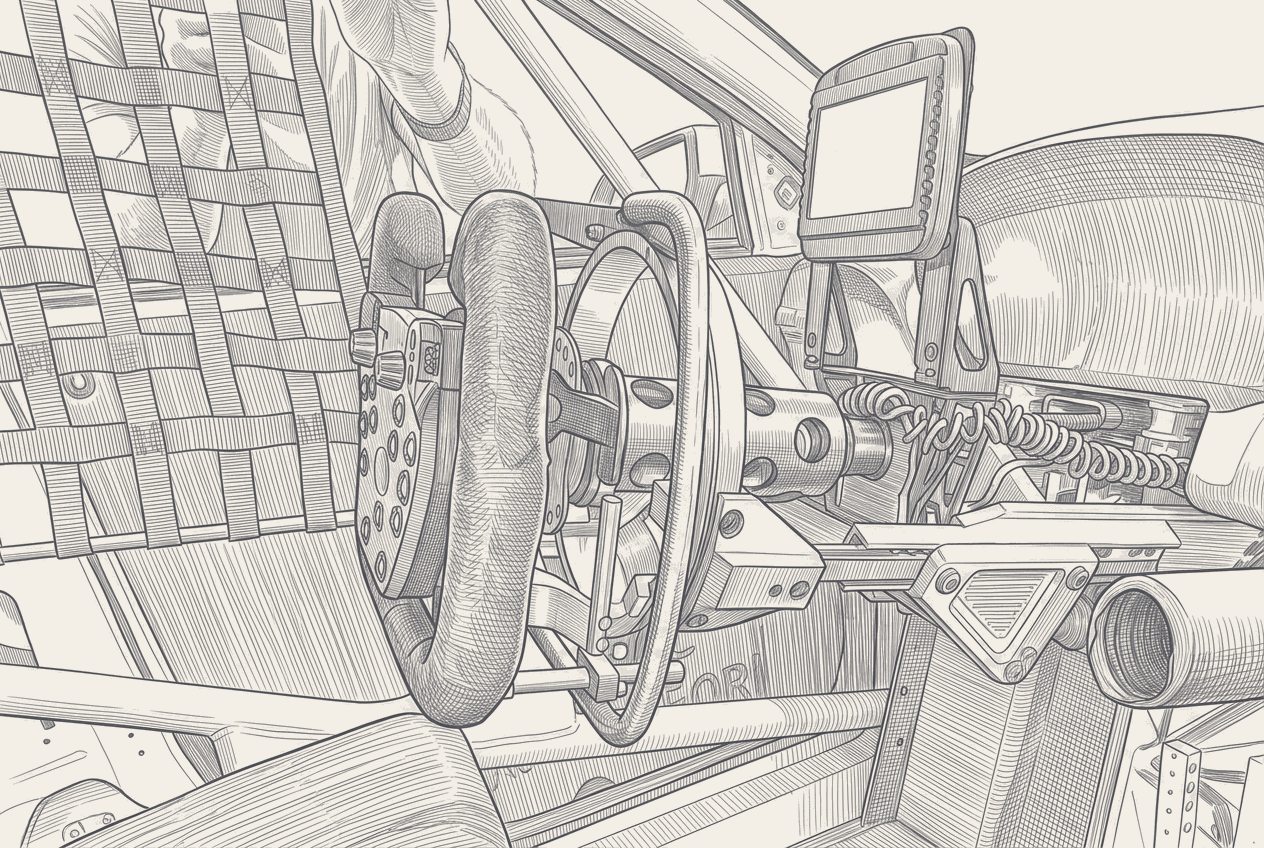
His braking system is bespoke to the point of fragility. A conventional GT3 car is stopped with the right foot; Wickens brakes with a hand-operated lever tied into a Bosch electronic braking system, a setup engineered around his specific reach, grip and force, and there is exactly one of it. That is the vulnerability the fire exposed. A team can carry a spare wing, a spare gearbox, a spare nose, but nobody stocks a spare of a system built once for one driver, so the fire did not damage a component so much as delete a capability.
Rebuilding it fell to the supply chain rather than to a fabricator working alone, and that is the part of the story worth slowing down on. Bosch supplies the electronic braking hardware the system is built on. Pratt Miller engineers and builds Corvette's race cars and much of the hardware around them. Both already sit inside Corvette Racing's own supplier network, the same network that produces the Z06 GT3.R Wickens races, so the coalition that rebuilt his controls was not assembled for charity; it was the production chain that already existed, turned toward a one-off problem.
Why the four-week timeline is the race-to-road point
Four weeks is the number that carries the story. A bespoke, safety-critical control system, destroyed with no spare, was specified, built, tested and delivered inside a month, which is a claim about a supply chain's flexibility as much as about goodwill. The same engineering discipline that lets a manufacturer validate a production braking system to a road-car durability standard is what let this group recreate a driver's single adapted part on a racing calendar's schedule. The adaptive-controls technology reads in one direction, from motorsport toward road-relevant hardware, but the rebuild showed the reverse capability: an OEM supplier chain absorbing a bespoke accessibility problem and solving it at speed.
Wickens framed the outcome not as a technical achievement but as a debt. He said the timeline first looked too high to climb, and settled on a single word for how it turned out: gratitude. That reads as modest until you count the parties who had to move at once, an OEM, its racing arm, a first-tier supplier and a customer team, none of whom gains a championship point from a driver's brake lever existing. What they gain is a demonstration, and demonstrations of this kind are the currency of a manufacturer that wants its accessibility engineering taken seriously.
The competitive stakes have not softened to match the sentiment. Wickens has not set the goal at simply making the grid; he arrives at Mosport chasing a first IMSA win, on a low-grip road course he knows, in a car he already qualified on pole this season. GTP is absent from the Canadian round in 2026, which puts the GTD Pro and GTD classes on the marquee, so a strong DXDT result would not be a feel-good footnote to a bigger race. It would be the headline.
One detail closes a loop this publication opened. The transporter fire ran in late April, en route to the Laguna Seca round that cost one team an axle, a truck and a quarter of its season, and the CTMP return is that story's payoff rather than a new one. What began as a logistics disaster resolves, ten weeks later, at the one race on the calendar where the crowd is his. The system that burned will do its next hard stop on Sunday, at a circuit that reads it as a home part, rebuilt by the chain that could.