Pedro Acosta spent the Brno race chasing 1.80 bar. The front tyre pressure window, not horsepower, set the order behind Marc Marquez..
MotoGP requires the front Michelin to hold above 1.80 bar for sixty percent of a grand prix, and a sensor in the wheel reports anyone who fails. The rule has run in this form since 2024, and the penalty for missing it is sixteen seconds added after the flag, enough to turn fifth place into a finish outside the points. The figure is not a guideline. It is the hardest number to hit on a MotoGP setup sheet, because the pressure a team dials in cold on the grid is not the pressure the tyre runs at racing speed.
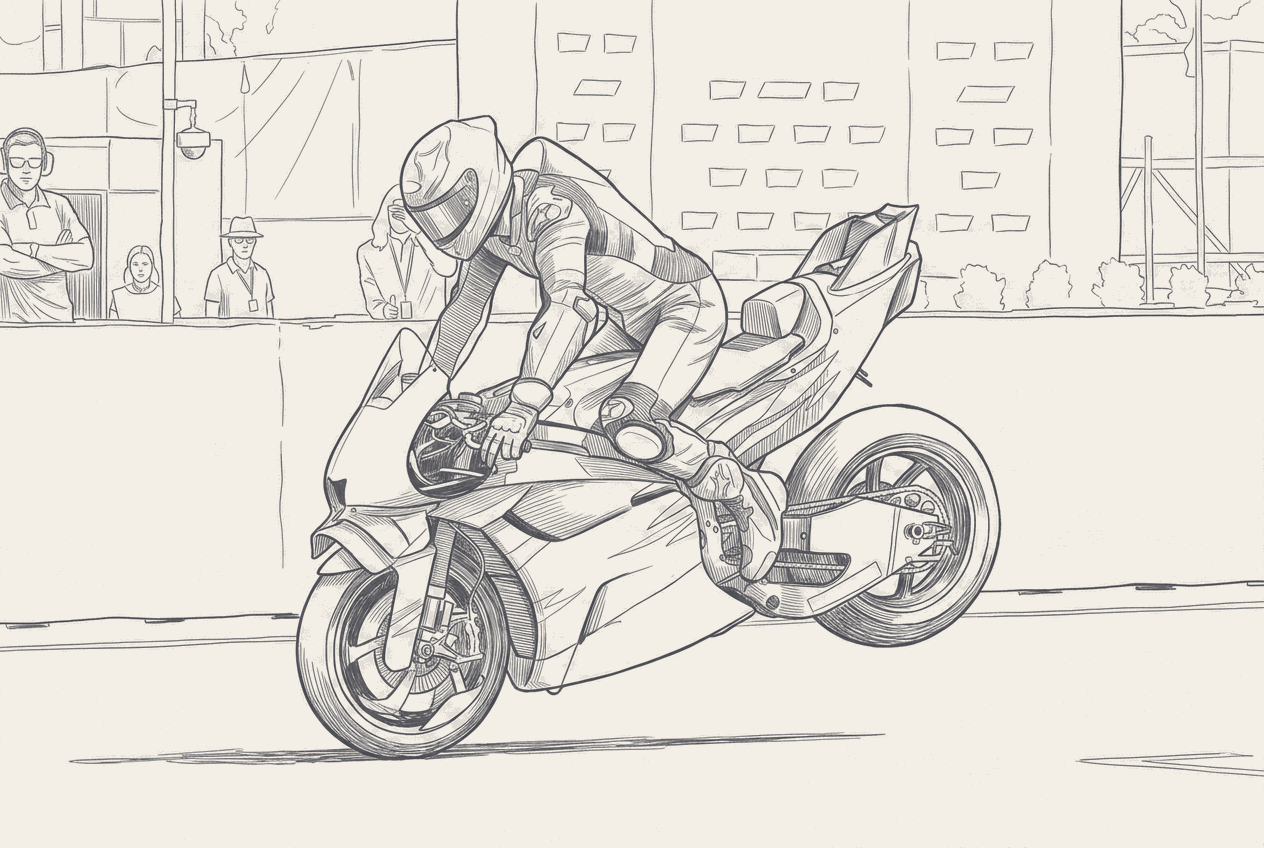
Pedro Acosta ran fourth in the opening laps of Sunday's Czech Grand Prix, then gave the place away on purpose. He let Fabio Di Giannantonio through and tucked into his slipstream to push heat into the front tyre, and when Di Giannantonio escaped into clean air, Acosta dropped several more seconds to sit behind Joan Mir for the same reason. He was not racing the two riders ahead. He was using them as radiators.
Acosta's KTM RC16 cut out at Turn One on the final lap, a recurring fault he had also hit in Friday practice. He was careful to separate it from the tyre question. "Tyre pressure was not the problem today," he said, before describing a race that had been about little else: "I was in the ideal spot, and then just the race was one lap too long." The retirement was mechanical, and KTM owes him an explanation for it. The fifty minutes that preceded it were governed almost entirely by 1.80 bar.
Front tyre pressure in MotoGP rises and falls with the air a rider sits in. Clean air ahead lets the front cool and the pressure drop; a hot, turbulent wake behind another machine heats the carcass and the pressure climbs. Teams answer that by setting a deliberately low cold pressure to win grip and feel early, then trusting the tyre to warm into the legal band as the laps run. The gamble fails when a rider gets clean air he did not plan for, because the front goes cold and slides under the line, and the only legal recovery is to find someone's wake and stay in it.
MotoGP has policed this in real time since the middle of 2023, when a sensor in each wheel began reporting live pressure to race control and to the rider's own dashboard. A rider drifting toward the limit gets the warning and knows he has to do something about it before the percentage runs out. The only escape from a post-race penalty, once the threshold is missed, is to prove a hardware fault such as a leaking rim through the data and a physical check, which leaves the rule with almost no discretion in it. A rider either banked the laps above 1.80 bar or he did not.
Brno was relaid in full before its 2025 return to the calendar, and the dark new asphalt both grips hard and holds heat. That sharpens the cold-pressure gamble more than most circuits do. Ai Ogura's pole lap of 1:51.139 set an outright Brno record on Saturday, quicker again than the mark Francesco Bagnaia set in 2025 when his 1:52.303 had already taken more than two seconds off Marc Marquez's 2016 benchmark. Track temperature touched 57C across the weekend, The Race recorded. A high-grip surface at that temperature drives more energy through the front contact patch than almost any layout MotoGP visits, which widens the gap between a well-judged cold pressure and a wrong one.
Marquez passed Bagnaia with six laps to go, Ogura's late pace then dropped Bagnaia to third, and Marquez held on to win by 0.421 seconds. At the front the rule never bit, because those three spent the afternoon inside one another's wake. Three riders covered by less than a second and a half, all in dirty air, all comfortably above the front minimum without thinking about it. The constraint only appeared where the air went clean, in the gap behind fifth that Acosta kept falling into.
Acosta framed his own afternoon as a tax he had no way to avoid. KTM, he said, is "not in the level to battle with Aprilia and Ducati", so the team runs aggressive cold pressures and plays with everything it has to find lap time the bike does not otherwise own. That is the rule's quiet bias. A front-runner banks wake heat for nothing inside a leading group, while a midfield rider out on his own has to spend track position to stay legal, so the team with the least margin to give is the one asked to give the most. The pressure floor is a flat regulation that lands hardest on the riders furthest from the front.
Bagnaia, Marquez and Diogo Moreira were the only top-ten starters on the soft rear in Saturday's sprint, the compound that asks a rider to manage degradation rather than chase the pressure floor, and Bagnaia's soft-tyre win was his first of 2026. Brno has previous on this exact point. Marquez won the 2025 Czech sprint while under investigation for a tyre pressure breach, a result that was allowed to stand. The rear is almost never the problem. The front is the variable nobody can fully model, and a resurfaced, baking Brno is where the model breaks.
Tyre pressure monitoring reached American showrooms through the TREAD Act after the Firestone and Ford Explorer rollovers of 2000, and the standard made it mandatory on every new US light vehicle from the 2008 model year. The European Union followed, requiring it on all new passenger cars registered from November 2014. The sensor enforcing MotoGP's 1.80 bar is that same road-safety device, run with its logic reversed. A road system warns a driver the pressure has fallen too low to be safe; the MotoGP system reports a rider whose pressure fell too low to be legal. Michelin, which supplies both, treats the race front as a rolling laboratory for how a contact patch behaves when inflation drifts a tenth of a bar.
A passenger tyre two-tenths of a bar low runs hotter, wears faster and lengthens a braking distance, the same physics that cost Acosta a usable front at Brno. Cold inflation pressure is the cheapest performance variable on any vehicle and the one road drivers understand least. The difference is forgiveness. A road car absorbs the error silently for thousands of kilometres, while a MotoGP front converts it into a dashboard alarm and a sixteen-second bill the moment a rider finds clean track and stops feeding the tyre heat.
Assen runs next, from June 26 to 28, and the TT Circuit Assen inverts Brno's problem. Its long, fast, constantly loaded corners make the front work for its heat rather than borrow it from a slipstream, so the tyre tends to climb into the window on its own merit, and cooler Dutch June air lowers the baseline the teams start from. The pressure floor should be easier to clear there. The risk swings back to the opposite failure, a front that overheats and gives up grip through the sweeping left-handers, which is a setup conversation about cooling rather than a racecraft one about wake.
The entire calculation resets in 2027, when MotoGP drops Michelin for Pirelli and a new supplier has to decide what its own minimum pressures and percentages should be. Until then the number is 1.80 bar, and Brno was the round that showed how completely one figure on a setup sheet can sort the finishing order, long after the three fastest riders have ridden out of its reach.