The FIA automated the safety-car restart to prevent another Abu Dhabi. At Silverstone the automation told the grid a restart was coming, then never delivered it..
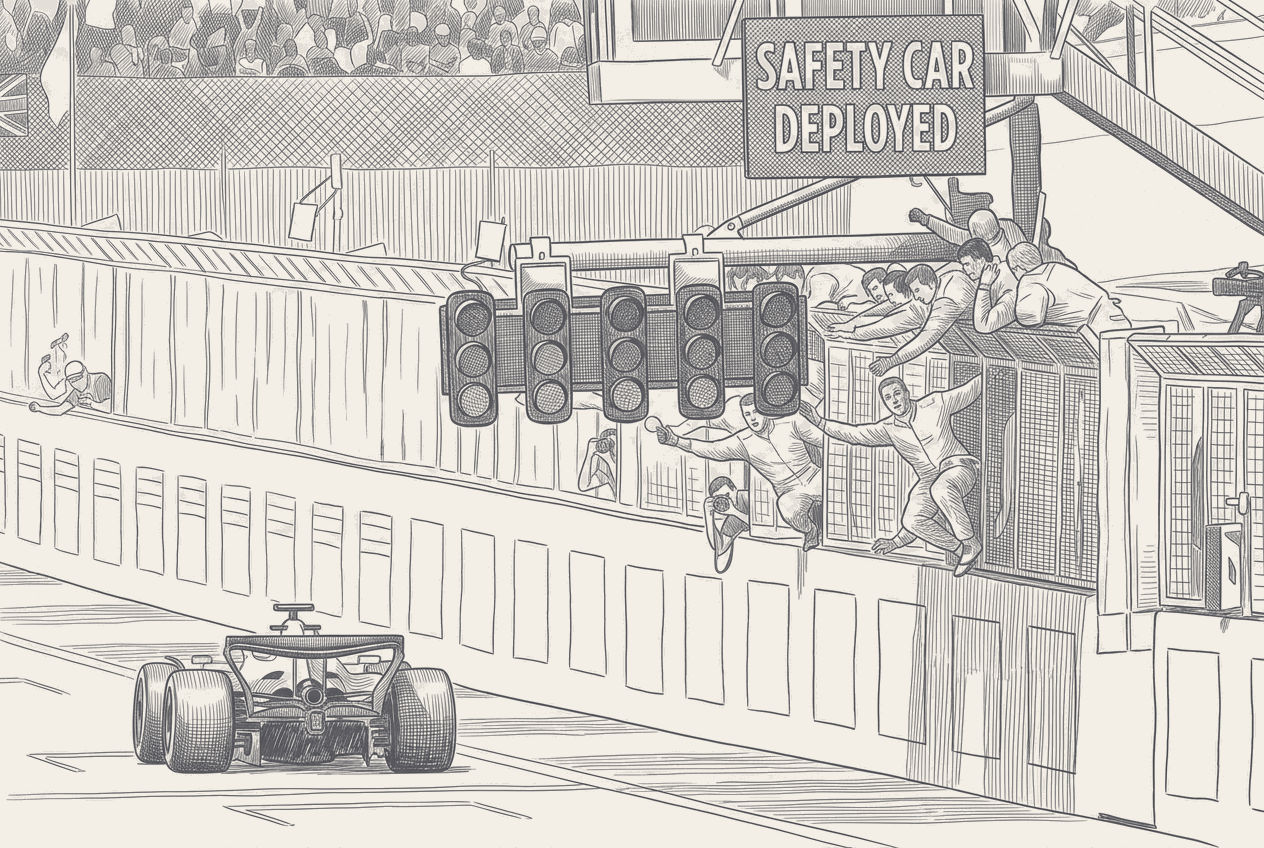
Max Verstappen spun into the gravel at Stowe on lap 48 of 52, and the safety car that followed him out should have been a routine end to the British Grand Prix. Instead the timing screens showed the field a message reading "Safety Car In This Lap," the signal that a green-flag restart is one lap away, and then took it back. The safety car stayed out, Charles Leclerc led the bunched grid across the line, and the Silverstone grandstands booed a finish nobody got to see raced out. The FIA's own account is that the message was wrong the moment it appeared.
The regulation did what it was supposed to. The screen did not.
Article B5.13.5 governed the last four laps, and it is unambiguous: after lapped cars are waved past the safety car, one full racing lap must be completed before the race can go green. The FIA's finding, as The Race set it out, is that the restart regulations were applied correctly. With Verstappen's car being recovered and four laps left, there was not enough distance to run the unlapping procedure and then add the mandatory full lap. A green-flag finish was never physically available. The controllers who kept the safety car out were following the book to the letter.
Software, not the rulebook, is where the error actually sat, one layer up in the automation that talks to the drivers. Speedcafe reported the FIA's confirmation that the "Safety Car In This Lap" message was displayed erroneously because of a software error, generated by the system rather than typed by a human. For roughly a lap, every pit wall and every cockpit was told to prepare for a restart that the regulations had already ruled out. The drivers behind Leclerc backed up, readied their tyres, and then watched the message vanish. The decision was correct; the communication of it was a lie the software told itself.
The system exists because of Abu Dhabi. That is the part that stings.
A machine, not a person, now handles this sequence, and the reason traces directly to December 2021. After the Abu Dhabi finale, where a manual and selective call on which lapped cars could unlap themselves handed Verstappen a one-lap shot at the title, the FIA moved the unlapping-and-restart choreography onto an automated system precisely to remove human discretion and human error from the highest-pressure minutes of a race. RaceFans framed the irony that fans reached for first: the automation built as the Abu Dhabi corrective produced its own procedural failure, at a home race, in front of a home crowd.
That is why the reaction ran hotter than a safety-car finish normally earns. A race ending under yellow is common and rarely controversial. A race ending under yellow because the FIA's own anti-Abu-Dhabi system flashed a false promise is a different object. It reopens the one grievance the sport has spent four and a half years trying to close, and it does so with the fix as the villain. The word "Abu Dhabi" did the rest of the work; it is now shorthand for an FIA procedural failure, and Silverstone handed it a sharper edge than the usual complaint.
What actually broke, and what it costs
Strip the emotion out and the fault is narrow and fixable. The timing-and-scoring software carries logic that decides when to publish the "Safety Car In This Lap" flag, and at Silverstone that logic fired without checking whether the remaining lap count could accommodate the full procedure Article B5.13.5 demands. It is a validation gap, not a rewrite of the rules and not a controller's misjudgement. The FIA will patch the trigger so the message cannot appear when the arithmetic of laps-remaining forbids a restart, and the change is closer to a software release note than a regulatory overhaul.
Measured honestly, the cost sits nowhere near the fix. It sits with a winner robbed of a clean result and a governing body handed avoidable scrutiny at the exact moment it least wanted it. Leclerc took his first victory since the 2024 United States Grand Prix, 0.427 seconds clear of George Russell, and his and Ferrari's first win-and-podium double of the season, and the story of the day became the screen instead of the drive. The FIA's automation was meant to make race control invisible on the biggest days. At Silverstone it made itself the headline, which is the one outcome the Abu Dhabi corrective was built to prevent.
The Belgian Grand Prix at Spa is the next test, in a fortnight, where any late safety car will be watched with the software patch as the subplot. The regulation held at Silverstone. The machine that speaks for it did not, and until the FIA can show the trigger has been closed, the automation built to end the Abu Dhabi argument will keep restarting it.