
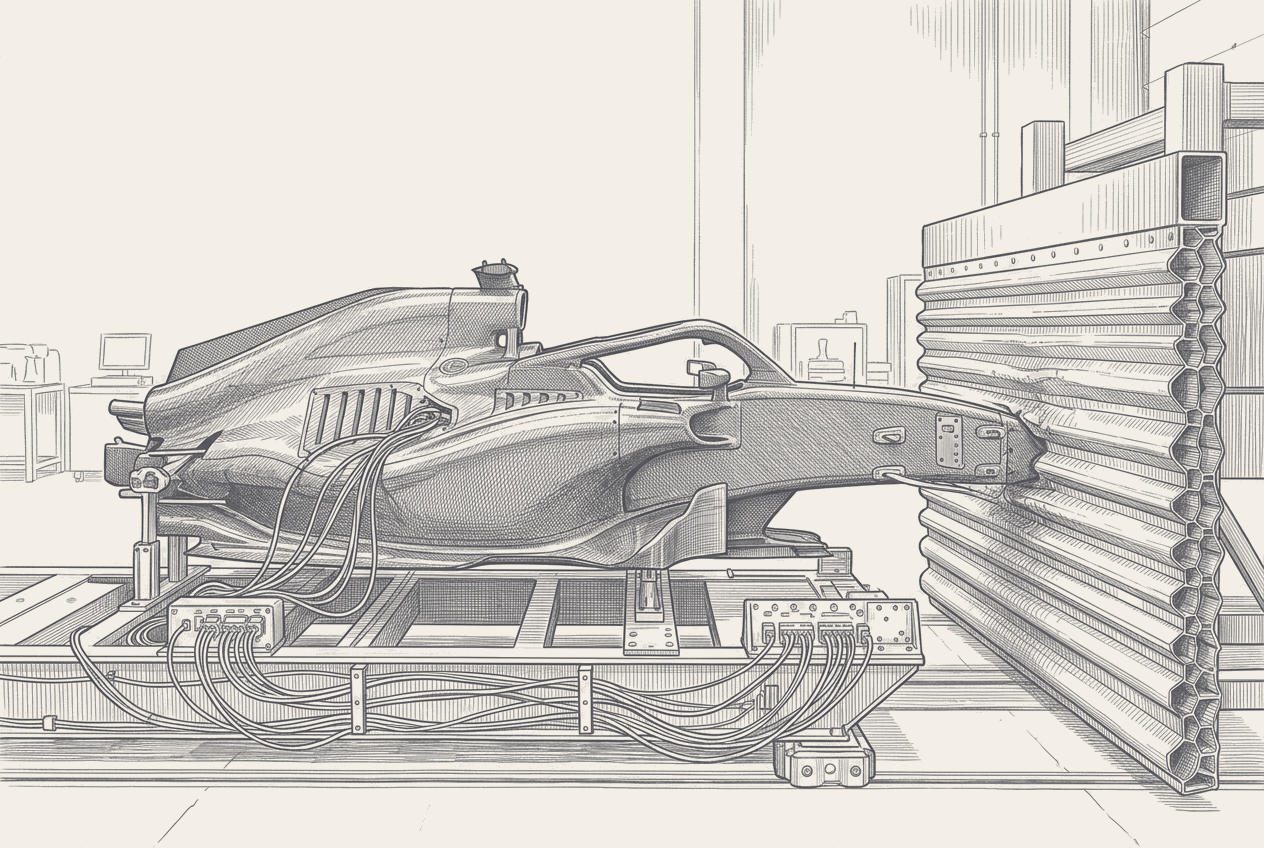
Aston Martin re-crash-tested its own chassis to make the B-spec AMR26, and split the engine step off to Zandvoort.
Adrian Newey has confirmed that Aston Martin took weight out of the AMR26's chassis and gearbox for Hungary, a change that "required re-homologating and crash testing the forward chassis," per the technical breakdown Aston published through formula1.com. The car's basic layout does not fundamentally change. The forward chassis, the survival cell the driver sits inside, had to pass the FIA's crash tests a second time before it could turn a wheel.
That is an expensive way to save weight in July. The front suspension is unchanged, the rear "slightly revised," and the car carries "a new nose and substantially revised aerodynamic surfaces," Newey said, with the stated target being to bring the AMR26 "very close to the weight limit." He is "predicting a large step" and pointedly declined to attach a number to it.
Re-homologation is the detail that separates this from a routine upgrade. Teams bolt on new floors, wings and bodywork every few races without ever touching the tub, because a monocoque is homologated once at the start of the season and then treated as frozen. Changing its geometry or its carbon layup to remove mass means submitting it to the crash-test programme again, the frontal, side and structural load tests that certify the cell will protect the driver. Most teams will not reopen that box mid-year at any price. Aston chose to.
The reason sits in where the car started the season. The same formula1.com breakdown sets the baseline: in Australian qualifying the AMR26 sat behind only the debutant Cadillac, at Spa it was cut adrift by roughly two seconds and more than four seconds off the Q1 benchmark, and the team has scored a single point all year, inherited from post-race penalties at Monaco. A car that far back does not get fixed by a front wing.
The hole had a start date
Newey also dated the deficit for the first time. Serious work on the 2026 car did not begin until mid-March 2025, and there was no wind-tunnel model until mid-April, leaving Aston "several months behind" its rivals on the 2026 regulations. The weight the car is now shedding is mass the original design never had the runway to engineer out. Re-crash-testing the tub in July is what catching up late looks like when the calendar has already run.
Fernando Alonso put the same decision in strategic terms. At the Hungary media day he said the team deliberately passed on the "two or three tenths" incremental updates rivals took through the first half and chose instead to "try to catch up all in once," calling the B-spec "the first step into those fixes" with "more to come." He traced the problem to "the Bahrain test, when we understood that we had a problem." That is a team confirming it spent its development season on one swing rather than a series of jabs.
Why the engine step waits for Zandvoort
The chassis package arrives on its own. Honda's updated power unit follows "just under a month later" at the Dutch Grand Prix, a deliberate split rather than a single combined upgrade. The engineering logic is isolation: land the chassis and the engine together, and a faster car tells you nothing about which half did the work. A chassis-only step at the Hungaroring and an engine step at Zandvoort give two clean readings instead of one ambiguous one.
Circuit choice reinforces the split. The Hungaroring is a slow, high-downforce lap that rewards aerodynamic load and low weight far more than straight-line power, so it flatters exactly the work this package contains. Spa, a fortnight ago, would have flattered an engine step and hidden the aero one. Sequencing each change to the track that exposes it is the difference between a data point and a guess.
What "close to the weight limit" is actually worth
Weight is one of the few gains in Formula 1 available without inventing new downforce. Every kilogram a car carries above the regulation minimum is a fixed lap-time penalty it pays at every corner of every lap, and it costs nothing in aerodynamic development to remove, only mass. Moving the AMR26 from wherever it sat toward "very close to the weight limit" recovers time the car was losing to weight, before a single new aero surface is counted. That is why a team this far back reopened its chassis: the weight was a debt it could pay down directly.
The one figure nobody has is the one that matters. Newey refused to give a lap-time number for the "large step," and the "2.5 seconds" circulating in weekend previews has no primary source behind it. Mike Krack framed the goal only as getting Aston "back racing" the midfield rather than fighting itself, which is a position, not a stopwatch reading.
FP1 at the Hungaroring runs Friday at 13:30 local. That is where the re-homologated tub, the new nose and the aero package Aston held back all season take their first competitive laps, on the kind of slow, downforce-hungry circuit built to reward precisely this sort of work. The engine half of the answer waits for Zandvoort.