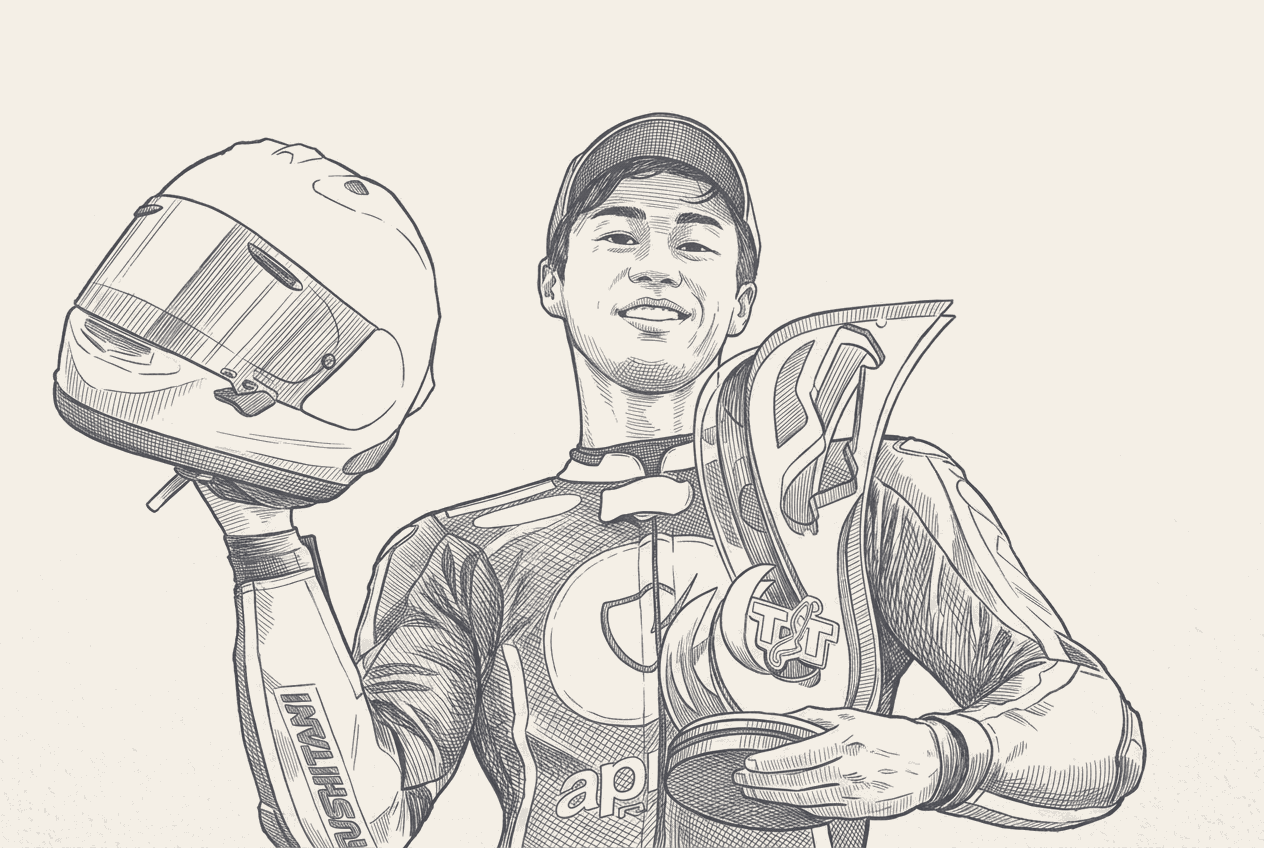
Ai Ogura ended Japan's 22-year wait for a MotoGP win at Assen. He did it on an Italian bike, for an American team, beating the factory that builds it..
Ai Ogura crossed the line at Assen 2.004 seconds clear of his Trackhouse team-mate Raul Fernandez, and the first thing he reached for was not the milestone but the feeling. The win, he said, felt "close to a title, or even better," a line Autohebdo carried from the cool-down that reads as an honest measure of how long the wait had been. The 25-year-old had just become the first Japanese rider to win in MotoGP's premier class since 2004.
Twenty-two years is the real size of the result. Ogura is the 2024 Moto2 world champion and a MotoGP sophomore, and the math of the day put him fourth in the standings, a long way from the title fight. None of that was the point. The point was a drought measured in two decades, ended by a rider carrying a flag that had not stood on the top step of a premier-class podium since he was three years old.
The win Japan waited 22 years for
Makoto Tamada was the last Japanese premier-class winner, at Motegi and Brazil in 2004, on a Honda. The generation of Japanese fans that grew up on Honda and Yamaha dominance has watched the manufacturers win championships without a home rider to put on the bike, and the gap between national pride and national results widened every season. Motorcycles.news framed Ogura's Assen win as the one that "ends Japan's MotoGP wait," and the framing fits the weight of the number.
The detail that sharpens it is the machinery. Japan's first premier-class win in 22 years did not come on a Honda or a Yamaha, the marques whose decline has run parallel to the drought. It came on an Aprilia, an Italian bike, run by Trackhouse, an American team with its roots in NASCAR. The milestone belongs to Japan; almost nothing else about the day did, and that mismatch is its own quiet comment on where the sport's competitive centre has moved.
Trackhouse beat the factory it leases its bikes from
Trackhouse swept both days at Assen, and that is the line the paddock kept circling. Raul Fernandez won Saturday's sprint and Ogura the Grand Prix, a satellite one-two on each day from a team that does not build its own bikes. Trackhouse leases its RS-GP machinery from Aprilia Racing, and across a single weekend it outscored the factory that supplies it, with the works rider Jorge Martin left to complete an all-Aprilia podium in third.
Raul Fernandez and Ogura finishing one-two on the Sunday turned the milestone into a team story as much as a national one. A factory lends a satellite squad last year's development path and this year's parts, and expects to beat it; the arrangement assumes the works garage stays ahead. Assen inverted that. The American team took the sprint and the Grand Prix while the factory managed no better than fourth on Saturday and third on Sunday, the kind of weekend that rewrites how a manufacturer thinks about which side of its garage is actually leading the project.
Justin Marks brought Trackhouse into MotoGP from NASCAR in 2024, taking over Aprilia's satellite slot, and a stock-car owner buying into grand-prix motorcycle racing read as a novelty at the time. Two seasons on, the entry has a sprint win, a Grand Prix win and a weekend that beat the works team twice, a faster return than most new satellite projects manage. The novelty has become the team that out-scored the factory it answers to.
The win nearly died to a stuck device
The race almost slipped away on a hardware fault. Ogura explained that his rear ride-height device stuck mid-race, holding the bike in its lowered, low-drag setting when it should have released, and costing him time to the leaders before it finally let go. He called the moment "scary," the word of a rider watching a maiden win threaten to evaporate over a component the size of a fist.
On lap 20 of 26, with the device behaving again, Ogura passed Raul Fernandez and pulled clear to the 2.004-second margin. The rear ride-height device is the survivor of MotoGP's device era, a spring-loaded mechanism that squats the bike on corner exit for traction and tucks it low on the straights for speed, and a component the rules have steadily narrowed. Ogura's near-miss is a reminder that the systems delivering the lap time are also the ones most able to take a race away, and that the margin between a maiden win and a frustrated fourth can sit inside a stuck actuator.
Five riders, 40 points, and Aprilia over all of it
Jorge Martin left Assen with the championship lead on 193 points, seven clear of Marco Bezzecchi on 186 after Bezzecchi crashed out of fourth on the second lap and went to hospital, cleared of injury the same evening. Ogura's victory made him the season's sixth different winner in ten rounds, the spread of a year no single rider has controlled. The new standings put five riders inside 40 points: Martin on 193, Bezzecchi on 186, Fabio di Giannantonio on 177, Ogura up to 168, and reigning champion Marc Marquez on 153. The title is the tightest it has been all season heading into the mid-year break.
Aprilia sits on top of all of it, the prize the day handed Noale. The marque locked out the Assen podium, leads the championship through Martin, and has its satellite team winning races, a position no one would have written for Aprilia at the start of a season that began with Martin and Bezzecchi crashing into each other. For Ogura, fourth in the standings with a maiden win banked, the day moved his project from promise to proof a season and a half after he arrived from Moto2.
MotoGP breaks now before the Sachsenring on July 10 to 12, the longest pause of the year and the first chance for the five title contenders to reset. Ogura returns to it as a race winner rather than a rookie graduate, the arc the May essay traced from his Le Mans podium now carrying a victory. Japan waited 22 years for the win. The wait for the second one starts in Germany.