Aprilia is fourth of five to roll out an 850cc prototype, and Rivola's 'time to market' line reframes the delay as strategy.
Lorenzo Savadori shook down Aprilia's first 2027-spec 850cc machine at Jerez in late April. Per the Crash.net follow-up piece on the test, Aprilia is the fourth of five MotoGP manufacturers to put an 850cc prototype on track, after KTM and Honda in December 2025 and Ducati's Misano running in early April 2026. Yamaha is the only manufacturer that has yet to reveal its 850cc machine. The 2027 technical regulation drops maximum displacement from 1000cc to 850cc, reduces fuel-tank capacity from 22 litres to 20, freezes aerodynamic homologation to one update per season, bans rear ride-height devices, and switches the spec tyre from Michelin to Pirelli. Aprilia's calendar position is at the back end of the development order. Massimo Rivola's framing of that position is the load-bearing argument the article tracks.
What Aprilia actually rolled out at Jerez
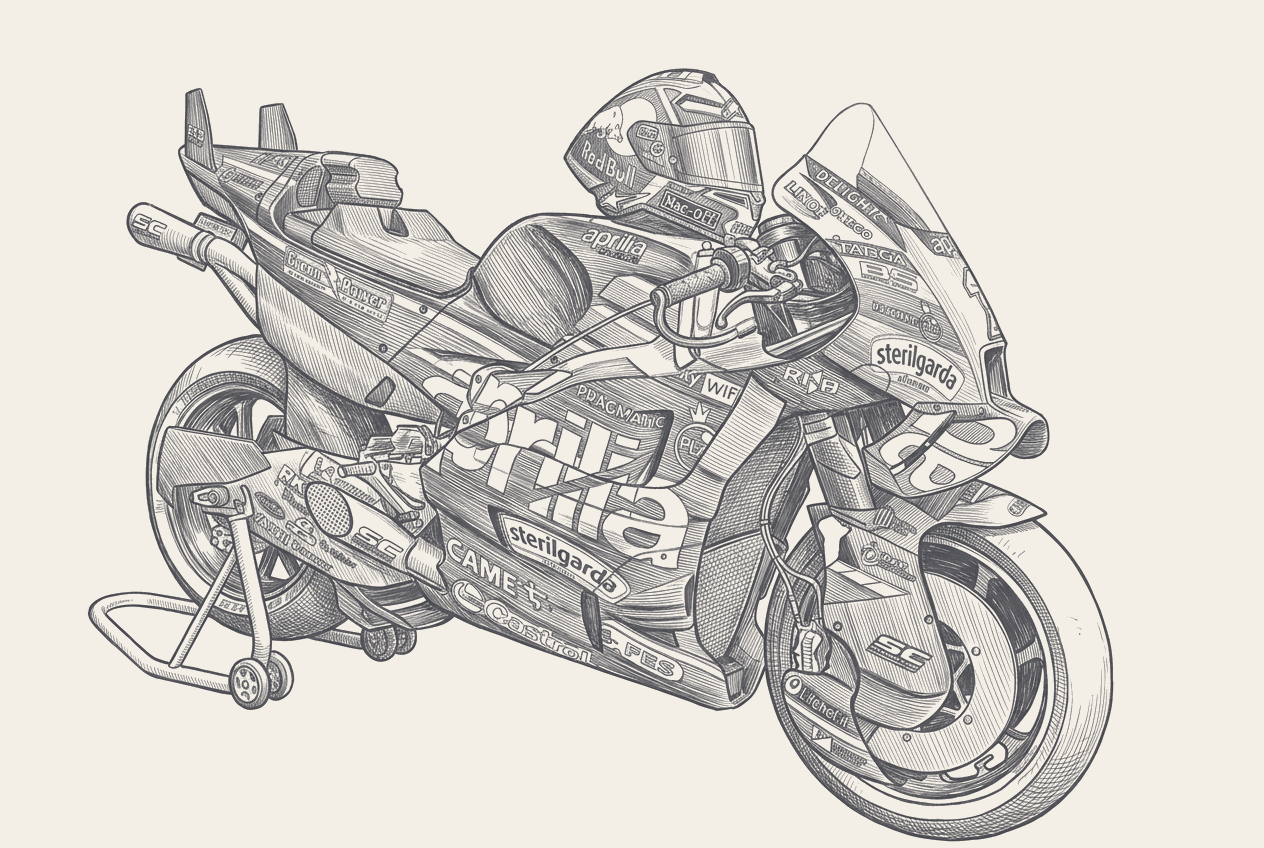
Marco de Luca, Head of Vehicle Department at Aprilia Racing, described the Jerez machine as a "hybrid bike, to shakedown some concepts" in the Crash.net piece on the 850cc Jerez shakedown, confirming the test was a parts-validation pass rather than a development bike on a slip-and-validate timeline. De Luca also confirmed that "very soon we are going to repeat the exercise with a more mature bike" and that the process will run continuously up to the first race of 2027, so Aprilia is on schedule by its own published timeline. The bike carries a revised nose profile and a protruding front wing on what reads as a current-platform chassis, the customary architecture for a manufacturer's first shakedown of a future-regulation concept set.
Massimo Rivola, the Aprilia Racing CEO, had set the framing weeks before the Jerez running. His central line, delivered to Motorsport.com on the timing question, was: "We are not in a hurry, partly because we didn't want to reveal our cards, and also because one of our strengths is time to market." The phrasing matters. The trade-press position for two months had been that Aprilia was behind on 2027 because KTM, Honda and Ducati had already run prototype mileage. The Rivola line repositions the delay as a published strategy choice rather than a development slip, and the Jerez running is the manufacturer's first attempt to put hardware behind the framing.
The five-manufacturer cadence and where Aprilia sits inside it
Per the same Crash.net piece, KTM and Honda published the first promotional videos of running 850cc prototypes in December 2025. Ducati's first 2027-spec machine was spotted at Misano in early April 2026, the only one of the five to surface as paddock footage rather than manufacturer release. Aprilia's Jerez shakedown lands in late April, four months after the KTM and Honda visuals and roughly three weeks after the Ducati Misano spotting. Yamaha is the fifth, and as of Catalan FP1 the only manufacturer that has yet to publish images of its 850cc bike at all.
On the calendar, that is a fourth-of-five cadence. Aprilia is later than KTM, Honda and Ducati and ahead only of Yamaha. The structural question the article tracks is whether being fourth of five carries the development cost the trade press has assumed it does. KTM and Honda spent the December-to-April window running prototypes on what they themselves describe as developmental aero. Aprilia ran a single shakedown on a hybrid concept-validation chassis. Both approaches survive contact with the regulation's first joint-test cycle in late 2026. Neither has yet produced a public lap-time data point.
What the 2026 platform gives the 2027 development cycle
Aprilia's 2026 platform produced the manufacturer's first premier-class 1-2-3 at Le Mans on May 10, its fourth premier-class double finish in three seasons per the Read Motorsport "Le Mans in numbers" piece, and a championship lead taken by Marco Bezzecchi over Jorge Martin going into Catalan FP1. Rivola's "time to market" line carries a second layer against that data. The team has the 2026 performance baseline to build a 2027 bike around a known platform rather than around a fresh one, and the data infrastructure that built the championship-leading 2026 machine is the same infrastructure that ran the Jerez parts shakedown.
De Luca made the platform-continuity argument explicit in his Crash.net interview: "There are concepts we can carry over from this year to next year. Others, for sure, we cannot, because they are too linked to the new power unit, to the new weight distribution. But there are a few fundamentals, a few concepts, from this year that we can continue to develop for next year. So it's not black and white, it's a mix of new and old." That is the operating sentence underneath Rivola's marketing line. Aprilia is not starting from scratch in 2027. The question is whether the carryover layer is large enough to absorb the calendar delay.
Where this leaves the five-manufacturer 2027 cycle
The Aprilia Jerez bike is one shakedown. The Ducati Misano running, the KTM and Honda December videos, and now the Aprilia parts-validation pass are the published 2027 development surface as of Catalan FP1, with Yamaha still to surface a prototype. Ducati has already moved to a second private test (Mugello with Nicolo Bulega, where GPOne reported a 1m47.2s against the 2026 lap record of 1m44.169s on the current 1000cc). Aprilia's de Luca has committed to a "more mature bike" for the manufacturer's next test session. None of the five manufacturers has published baseline-comparable lap-time data, and on the only comparable number the trade press has logged so far (Ducati's Mugello pace, three seconds off the current-platform record), the read is that none of the 2027 bikes are yet a credible performance benchmark against the bikes they will replace.
Three of the four 2027 signals the trade press can verify are on the published record: prototype calendar order (Aprilia fourth of five), the development-team-statement layer (de Luca's "on schedule" and Bonora's "very good start" from Crash.net's 9 May piece), and CEO-side framing (Rivola's "time to market" line). The fourth signal, comparative lap time, is not on the published record from any manufacturer at the same circuit, and will not be until the joint test cycle the regulation requires opens in late 2026.
The 2026 platform-lead reads alongside the 2027 development position
Bezzecchi leads Martin into Catalan FP1 with the Aprilia 2026 platform on a seven-consecutive-premier-class-podium baseline and a fourth premier-class double-finish in three seasons. The intra-team "Black Rules" framework Rivola introduced for the Catalan build was the management-side response to a championship situation the trade press had not expected before Le Mans. The 2027 prototype now lands inside the same week as the championship lead. The manufacturer running fourth of five in the 2027 prototype order is, on the 2026 grid, the manufacturer running first in the points.
The Catalan FP1 cycle opens Friday at 09:45 CEST. The Aprilia 2026 bike runs against four-rider operational data and a one-point championship lead. The Aprilia 2027 bike runs against three pieces of published management framing: Rivola's "time to market" line, de Luca's "on schedule" line, and Bonora's "very good start" line. None of the three is a measured number. All three are statements about pacing that will be checked against the joint-test cycle in late 2026.
What Catalan FP1 produces is a 2026 data point. What the 2027 cycle produces, on the current published read, is a chronology of manufacturer testing dates. The two cycles will converge at the 2027 grid. The reading that matters now is the one Rivola handed the trade press at Jerez: this is positioning, not delay. Whether that reading survives the joint-test cycle is the question the rest of 2026 will answer.