The FIA's first ADUO rulings never mention Red Bull Ford. That silence is what locks it out of the rest of 2026..
Nothing in the 2026 Formula 1 Technical Regulations lets a power unit manufacturer change its engine specification during the season. Appendix C5 permits scheduled upgrades only "For the years 2027, 2028, 2029 and 2030", and even those must be introduced at the first race of the year and run for the whole championship. A manufacturer homologates once and lives with what it built. That is the baseline against which the FIA's first ADUO rulings, published on 26 August, have to be read.
Audi, Ferrari and Honda were each granted two additional homologations in 2026 and two more in 2027, having been "determined to be above 4%" behind the best-performing internal combustion engine across a review period that closed after the Canadian Grand Prix. Mercedes was placed "in the 2-4% window" and granted one in each year. For the second period, which closed after Hungary, the governing body granted nothing to anyone.
What the release does not say
Red Bull Ford Powertrains appears nowhere in the document. Not as a recipient, not as an exclusion, not in a line explaining why it received nothing. Paddock Notes reported in June that the FIA had graded the Red Bull Ford unit the benchmark once the first monitoring window closed at Canada, so the omission is not a surprise. What it now triggers is.
Article 4.1 of Appendix C5 makes that reading checkable rather than inferential: each manufacturer's Performance Index "will be compared to the highest Performance Index measured during the assessment period". The best performer therefore sits at zero deficit by construction and can never qualify. Mercedes is between 2 and 4 percent behind that benchmark, which is proof that Mercedes is not it. Audi, Ferrari and Honda are further behind still. Five manufacturers contest the 2026 championship, a count Nikolas Tombazis established himself when he explained why a four-of-five supermajority froze the formula before it turned a wheel. Four of the five are measured as trailing something. The fifth is the thing they trail.
Eligibility for the final period is then withdrawn by Article 4.4, which states that "PU Manufacturers not granted ADUO following either of the first two ADUO Periods of season N are not eligible for ADUO in the last period of that season." Red Bull Ford was granted nothing after period one and nothing after period two, which on the workable reading of that sentence leaves it shut out of period three, the seven rounds from the Netherlands to Mexico City. The manufacturer with the strongest engine spent its regulatory allowance by never needing it, and will finish the season on the specification it homologated for the year while four rivals are free to move.
The only numbers anyone can pin
Mercedes is the sole manufacturer whose grant can be read off the page, and that is an accident of banding rather than disclosure. Article E4.1.1.t.i of the Financial Regulations for PU manufacturers, issue 06 of 25 June 2026, fixes a sum per band and instructs that "the Power Unit Manufacturer must make a downward adjustment in the calculation of Relevant Costs". Note the direction of travel, because the release describes the same provision as a cost cap increase and the regulation makes it a mandatory reduction in reported spend. The 2-4% window is a single band, so Mercedes gets exactly $3,000,000 per ADUO period, adjusted for indexation, allocable across two reporting periods as it chooses. Above 4% is four bands running from $4,650,000 to $11,000,000, and the FIA declined to say where inside that spread the other three landed. The value of their grants is therefore unknown by a factor of roughly 2.4.
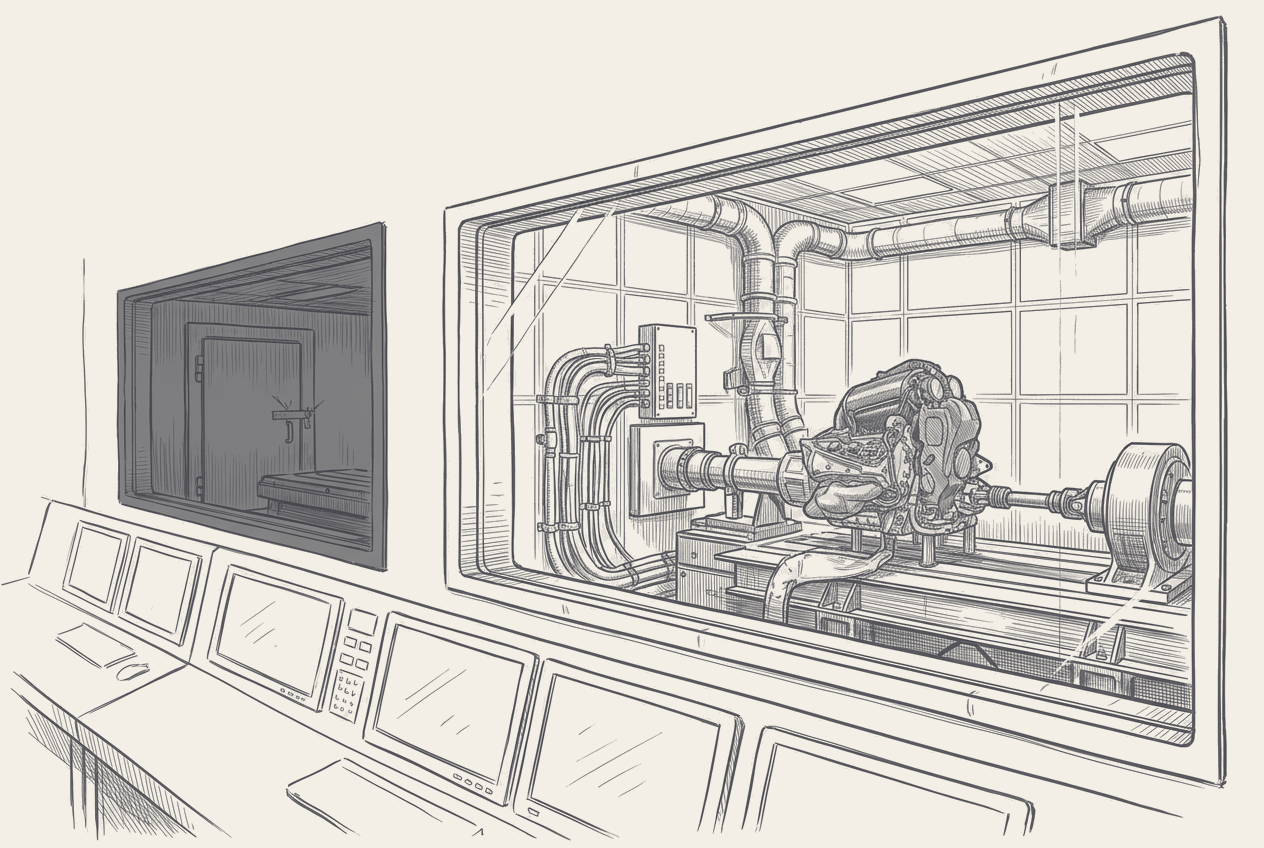
Section F of the same rulebook, issue 10 of 5 August 2026, runs the test-bench allowance the same way. Article F5.2.7 caps ICE operation at 860 hours for 2026, falling year by year to 410 in 2030. The 2-4% band adds 70 hours, which is a little over eight percent more running. Above 4% adds between 110 and 230 depending on the sub-band nobody outside the FIA can see, and those hours accumulate across periods but expire with the calendar year rather than carrying into 2027.
"It's important to make clear that ADUO is not a kind of balance of performance mechanism," Tombazis said in the FIA's own explainer of 13 May. "A team or manufacturer will not suddenly get greater fuel flow rate or more or less ballast. It is, in fact, a Cost Cap relief mechanism." The description is accurate about the money and silent about the rest of the package. Dollars and dyno hours are relief. A homologation is permission, and in 2026 it is permission that nobody outside the ADUO bands holds.
A threshold still in brackets
FIA-F1-DOC-096 is where the whole exercise actually lives, and it is not published. Article 4.1 defers the Performance Index calculation to that document, Article F5.2.7 leans on it again for the hours, and it does not appear on the FIA's regulations index beside the sections that cite it. Tombazis calls the analysis "incredibly robust" on the strength of "the quality of the data", then explains in the same statement why none of it will be shown: the FIA has "to respect the confidentiality and intellectual property of the teams and their Power Unit Manufacturers in disseminating any details from the findings." The May explainer is franker about the limits, conceding that because the index "focuses solely on the ICE, it is not representative of full Power Unit performance, given the ERS system plays a crucial role in the overall power output."
Issue 20 of the Technical Regulations, published on 5 August 2026, still carries the 2 percent trigger inside square brackets, with a note that it "will be validated or adjusted after conclusion of the ongoing activities between PU Manufacturers and F1 Teams related to the on-track ICE performance measurement". Three weeks later the FIA issued binding rulings under it. That is not a scandal, but it is the sort of thing a manufacturer's lawyers read twice.
The release itself points readers to "Article C4", which is the table listing which components an upgrade may contain, when the entitlement sits in Appendix C5. Article 4.4's own drafting is loose enough to matter: read strictly, a manufacturer "not granted ADUO following either of the first two ADUO Periods" would describe all five, since none was granted anything following period two, and period three would vanish for everybody. The reading that leaves the third period with any purpose is that a manufacturer must have missed out on both, and it catches exactly one manufacturer.
Period three closes after Mexico City. Audi, Ferrari and Honda were each granted two 2026 homologations toward that deadline, forfeit whatever they have not introduced by the season's final race, and start 2027 with two more already banked on top of anything the third period adds. Red Bull Ford carries none, can now earn none, and holds the one asset ADUO does not hand out, which is the engine every rival is being paid to catch.