A 4.1-second lead became a 58.3-second loss in two stages. Neuville called it rallying, and meant it as a compliment to the sport that just robbed him..
Sebastien Ogier won the Acropolis Rally Greece by 58.3 seconds, and the man he beat handed the weekend its best line. Thierry Neuville led into the final day and lost it to two punctures, then told reporters he sat "between disappointment and somehow a little bit of joy," before adding the sentence that traveled: "but that's rallying; in Portugal we profited from his puncture and now he does from ours." A driver who had just thrown away a rally win was describing the sport as a ledger that always balances, and not complaining about it.
The result was Ogier's 69th career victory, and his second on the Greek gravel that has tested cars and tempers since the championship's earliest years. The number on the trophy belongs to one of the most successful drivers the sport has produced. The number that decided the rally belongs to Neuville, and it is the gap between what he led by and what he lost by.
The 4.1 seconds that became 58.3
Neuville carried a 4.1-second lead into Sunday, the slimmest of margins on a rally built to punish the smallest mistake. The decisive blow came on the second pass of Aghii Theodori, where two rear punctures cost him 53.5 seconds in a single stage and turned a rally he was winning into one he finished well behind. A four-second lead does not survive a near-minute loss. The arithmetic was brutal and immediate.
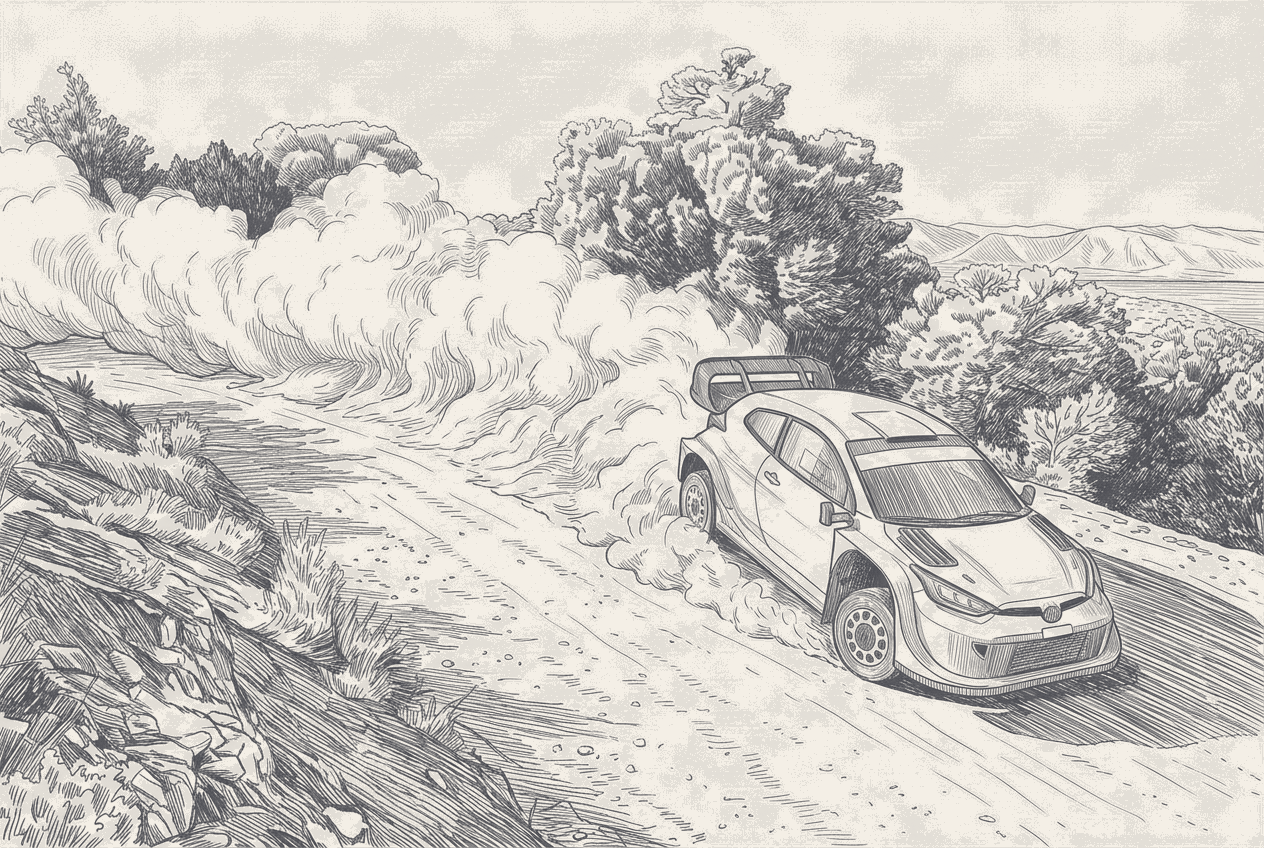
Rocks make the Acropolis, and they make results like this one. The rally is among the roughest on the calendar, its gravel stages loaded with the loose stone that opens a tyre, and the second pass of any stage is the crueller one, the surface broken up and the line strewn with debris the earlier cars dragged across it. Neuville's two punctures on the second run through Aghii Theodori were less freak luck than the rally collecting its toll, the durability test that gives the Acropolis its reputation arriving for the car that could least afford it. A weekend built to break cars broke the one that was leading.
Ogier swept everything that was left to win once the lead fell into his lap. He took the rally, Super Sunday and the Wolf Power Stage, the maximum haul a driver can leave a weekend with, and the kind of clean sweep that only happens when a rival's failure clears the road in front of you. The 58.3-second winning margin reads as dominance. It was built almost entirely in the two stages where Neuville's tyres let go.
Rallying's fatalism, stated by the man it cost
The Portugal reference is what gives Neuville's reaction its weight, because it points at a debt being repaid. Earlier in the season Neuville's campaign had gained from an Ogier puncture; on the Acropolis the direction reversed, and Neuville named the symmetry out loud rather than rage at the luck of it. His words, carried by wrc.com, treat a puncture not as an injustice but as the cost of doing business in a sport where the road, the rocks and the heat decide as much as the driver.
That fatalism is rallying's native temperament, and Neuville stated it more cleanly than most. Circuit racing tends to treat misfortune as a failure to be audited, a part that should not have broken or a call that should not have been made. Rallying, run on open roads strewn with the debris of the cars ahead, builds the randomness into the contract. A driver who accepts that a stray rock can end a winning weekend, and who can find "a little bit of joy" in the day it happens to him, is describing a sport that has taught its competitors to hold success loosely.
The part-season master keeps converting
Ogier ran the Acropolis as part of a partial campaign, and converted it the way he keeps converting the rounds he chooses to enter. The 42-year-old shares the Toyota across the season rather than contesting the full title, yet his selective entries keep producing wins, and the Greek result lifted his points haul to 125 from a programme that skips half the calendar. A driver contesting roughly half the rounds has still banked a total that says as much about his strike rate as his schedule.
Fifteen years separate this Acropolis win from his first, in 2011, a span that covers the careers of most of the drivers he beat on Sunday. The rally that he won as a rising Citroen driver, he has now won again as a nine-time world champion and the sport's elder statesman, on a different manufacturer and under a hybrid regulation set that did not exist the first time. Longevity at that level is its own kind of result, and the Acropolis is where Ogier underlined it.
The title math behind the drama
Elfyn Evans finished seventh and still leads the championship, the season's clearest argument for consistency over spectacle. Evans leaves Greece on 162 points, his lead intact despite a quiet weekend, while Takamoto Katsuta's podium lifted him to 151 and the late penalties to Josh McErlean and Adrien Fourmaux, each docked a minute on Sunday evening, reshuffled the order behind the podium after the cars had stopped.
Toyota now leads Hyundai by 140 points in the manufacturers' standings after eight of fourteen rounds, the kind of cushion that turns the constructors' fight into a formality this far out.
Six rounds remain, and whether Evans's lead holds may depend on how many more starts Toyota hands the driver who keeps winning the ones he enters.